ChatGPT Health Release Date and Who Can Use It
ChatGPT Health started rolling out in the U.S. on July 23, 2026, for logged-in users aged 18 and older on web and iOS. OpenAI's July 23 page sets four conditions and names one exclusion.
Availability as of July 23, 2026 (as OpenAI states it)
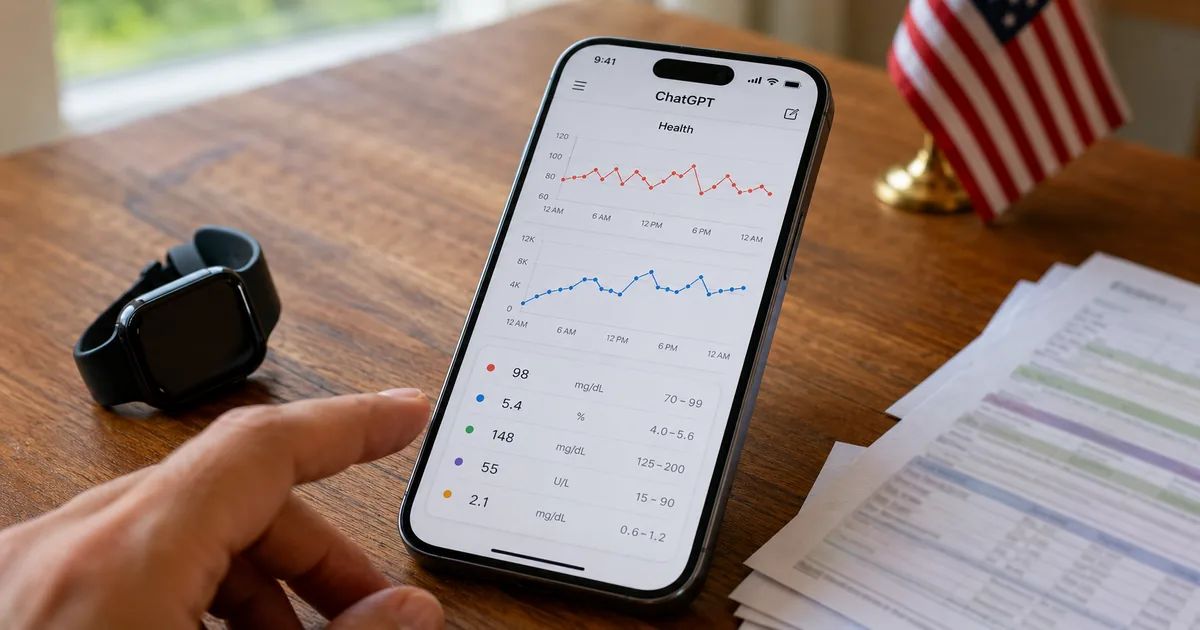
OpenAI ties the launch to how people already use ChatGPT: it puts the number of people bringing health questions each week at more than 300 million, from reading a lab result to preparing for a visit. The context behind those questions is often scattered across patient portals, medical records, apps, and wearables, which makes the complete picture hard to see. To start, open Health from the ChatGPT sidebar.
"We’re beginning to roll out Health to logged-in ChatGPT users 18 and older in the U.S. on web and iOS across Free, Go, Plus, and Pro plans today. Open Health from the sidebar in ChatGPT to get started. Health is not yet available in Codex." — OpenAI Official AnnouncementView official source →
Is ChatGPT Health Free? What Each Plan Gets
Yes: the Free plan is covered, along with Go, Plus, and Pro. The July 23 announcement names one model for the Free plan and another for the paid plans. Free-plan users get GPT‑5.5 Instant, and paid users get GPT‑5.6 Sol, which OpenAI calls its strongest model yet for health.
OpenAI also reports that every GPT‑5.6 model beat GPT‑5.5 on HealthBench Professional, a test built around hard health tasks. The page gives no scores.
It says OpenAI works with hundreds of physicians around the world to develop the health scenarios and rubrics behind its evaluations. For how the GPT‑5.6 models differ, see GPT-5.6 Sol, Terra and Luna: Specs and Pricing.
"These evaluations assess qualities including accuracy, safety, communication, context awareness, completeness, and appropriate escalation." — OpenAI Official Announcement, "Improving health intelligence with physicians"View official source →
What Happened to the ChatGPT Health Waitlist?
The July 23 announcement does not mention the waitlist that the January 7 page used for early access. OpenAI introduced ChatGPT Health in January 2026 with a small early group, and people requested a place through a waitlist. That page said OpenAI planned to open Health to all users on web and iOS in the coming weeks.
The July release also changes the design. In the early version, you had to go to a separate space inside ChatGPT for the full benefit.
OpenAI says early testing showed health questions arise mid-conversation, like a food allergy while planning meals, and that more than 70% of health conversations among people with access happened outside that space. OpenAI's conclusion is that a separate space added an unnecessary step.
Now you can let ChatGPT use connected information in any conversation, without opening Health first. OpenAI names medications, lab results, recent visits, sleep, and activity, and its examples include a dietary restriction shaping a restaurant pick and a recent injury shaping a lower-impact weekend plan with your family. Health stays in the left sidebar as the place to connect and manage information, see trends, browse synced records, and return to past health conversations.
The usage figure moved between the pages too. The January page cited over 230 million people worldwide asking health and wellness questions every week, from a de-identified analysis of conversations.
The July page says more than 300 million. Read each number as of the date of its own page.
"Among people with access, more than 70% of health-related conversations took place outside the dedicated health experience. Moving to a separate space added an unnecessary step." — OpenAI Official Announcement, "Health conversations grounded in your information"View official source →
Health in ChatGPT Outside the US: UK and Europe
The July announcement is addressed to U.S. users and gives no date or plan for other regions. The January page, describing its early-access group, made Free, Go, Plus, and Pro users outside the European Economic Area, Switzerland, and the United Kingdom eligible. Those are two statements from two dates, and neither says when the UK or Europe would be covered.
"users with ChatGPT Free, Go, Plus, and Pro plans outside of the European Economic Area, Switzerland, and the United Kingdom are eligible." — OpenAI, Introducing ChatGPT Health, January 7, 2026View official source →
Connect Apple Health to ChatGPT, Plus Three Other Sources
Health can draw on four sources: Apple Health, supported medical records from U.S. hospital systems, One Medical, and Function Health. Apple Health is where an iPhone gathers health and fitness data. You don't have to connect anything, because health questions work with nothing linked.
Connecting a source
- OpenOpen Health from the sidebar or the More menu and choose "Get started"
- ConnectLink the sources you want: Apple Health, medical records, One Medical, or Function Health
- SyncLet the sync run; it may take a few minutes, and you can add more accounts meanwhile
- ReviewCheck conditions and medications, remove outdated items, and add what is missing, including family health history
- AskAsk in any conversation, or add @Health to a message to bring in health context explicitly
With your permission, ChatGPT can then compare a new result with earlier tests, summarize what changed since your last appointment, or relate sleep, activity, and workouts to your routine. By default ChatGPT asks before using your data, and you can switch to always allow in Settings > Plugins > Health.
"You can ask health questions in ChatGPT without connecting anything. To use Health and get responses grounded in your own information, you can choose to connect Apple Health, supported medical records from U.S. hospital systems, One Medical, or Function Health." — OpenAI Official Announcement, "How to connect and use your health information"View official source →
ChatGPT and Apple Health: Which Data Comes Through
Data from a wearable or nutrition app reaches ChatGPT through Apple Health, so the app must share it there and you must allow it. OpenAI says to make sure that sharing is turned on. What arrives depends on the app and metric, and some proprietary scores may not come across.
Connected information may not always be complete or current; a medication, for example, can stay listed after you stop taking it. OpenAI's advice is to tell ChatGPT about changes and check important details against the original source. The January page adds that connecting Apple Health requires iOS.
"Available information varies by app and metric, and some proprietary scores may not transfer." — OpenAI Official Announcement, "Using a wearable or another health app?"View official source →
Medical Records in ChatGPT Are US-Only
Medical record connections are tied to U.S. hospital systems. The July announcement names supported records from U.S. hospital systems, and the January page says medical record integrations and some apps are offered in the U.S. only. Neither page gives a date for medical record connections elsewhere.
"Medical record integrations and some apps are available in the U.S. only, and connecting Apple Health requires iOS." — OpenAI, Introducing ChatGPT Health, January 7, 2026View official source →
ChatGPT Health Privacy: Is Your Data Used for Training or Ads?
Health data you connect, and any conversation that draws on it, stays out of foundation model training and ad targeting, whatever training setting you chose, OpenAI says. Training here means using conversations to improve the foundation models behind ChatGPT. Conversations that don't use this data follow your normal training setting, which you change in Settings > Data Controls.
OpenAI says every ChatGPT conversation is encrypted at rest and in transit, and information connected through Health gets additional encryption protections. On memory, OpenAI says memories can be created from your Health conversations, but not directly from connected records or Apple Health information. To talk without creating memories, use Temporary Chat or turn memory off in Settings > Memory.
"Connected medical records and Apple Health information, and conversations that use it, are not used to train our foundation models or target ads, regardless of the model-training setting you choose for ChatGPT. Conversations that do not use this data follow your standard ChatGPT model-training setting choices, which you can change at any time in Settings > Data Controls." — OpenAI Official Announcement, "Built with privacy, security, and control"View official source →
OpenAI Health Permissions: Approve Each Time or Always Allow
By default, ChatGPT asks before using your connected health data, and you choose between approving each request and always allowing it. Always allow stops the prompts. The switch is under Settings > Plugins > Health.
There is a second check for sharing outward. Suppose ChatGPT is about to act in another connected plugin in a way that could reveal Health information, such as sending a running partner a training plan built from your Apple Health data.
Additional safeguards then help check that the sharing matches your request. For some sensitive actions, ChatGPT may ask you to confirm first, and OpenAI says it tests these safeguards in dedicated red-team exercises.
"By default, ChatGPT asks for permission before using connected medical records and Apple Health information to personalize a response. You can approve each request or choose to always allow access, which turns off these permission prompts. You can change this setting anytime in Settings > Plugins > Health." — OpenAI Official Announcement, "Built with privacy, security, and control"View official source →
What Happens to Your ChatGPT Health Data When You Disconnect
Disconnect a source in Health > Accounts, and the data synced from it is deleted from OpenAI's systems within 30 days. Information already in your conversation history stays until you delete those conversations.
"Disconnect accounts at any time in Health > Accounts. When you do, data synced from that source is deleted from OpenAI’s systems within 30 days. Information already included in your ChatGPT conversation history remains until you delete those conversations." — OpenAI Official Announcement, "Built with privacy, security, and control"View official source →
Summary
Health in ChatGPT began rolling out on July 23, 2026 to U.S. users who are 18 or older and logged in, on web and iOS, across the Free, Go, Plus, and Pro plans. As of that date, Codex was not covered. Health can draw on Apple Health, supported medical records from U.S. hospital systems, One Medical, and Function Health, and connecting is optional.
Connected records and Apple Health information, and conversations that use them, are kept out of foundation model training and ad targeting. ChatGPT asks for permission by default, and you can switch to always allow. Disconnecting a source deletes its synced data within 30 days, while information in your conversation history stays until you delete those conversations.
The July announcement gives no timing for regions outside the U.S., and the January page's early-access group excluded the European Economic Area, Switzerland, and the United Kingdom. OpenAI says Health is meant to support, not replace, the care you get from medical professionals. For ChatGPT in general, see GPT-5 in ChatGPT: Pricing, Free Tier, Models.
The January page lists PDFs among the places where health information is often scattered. If your records are split across several PDF files, see ChatGPT file upload limit: which one stops you before uploading them, or merge them into one file with the tool below.
"ChatGPT can still make mistakes and does not replace the care and judgment of qualified medical professionals. We encourage people to verify important information and discuss medical decisions with their healthcare provider." — OpenAI Official Announcement, "Improving health intelligence with physicians"View official source →
FAQ
- Can I use ChatGPT Health outside the U.S.?
- The July 23, 2026 rollout is for U.S. users: logged-in ChatGPT users 18 and older, on web and iOS, across the Free, Go, Plus, and Pro plans. That announcement gives no date or plan for other regions. The January 2026 page, which described an early-access group, listed users outside the European Economic Area, Switzerland, and the United Kingdom as eligible.
- Is my connected health data used to train the AI?
- No, not for foundation models. OpenAI says connected medical records and Apple Health information, and the conversations that use them, stay out of foundation model training and ad targeting, whichever model-training setting you picked for ChatGPT. Conversations that don't use this data follow your normal training setting.
- If I disconnect a source, is the synced data deleted?
- Yes. Data synced from a disconnected source is deleted from OpenAI's systems within 30 days. Anything that already made it into your ChatGPT conversation history stays until you delete those conversations.
Related articles
 OpenAI, ServiceNow expand deal with ChatGPT pluginOpenAI and ServiceNow expanded their deal on Oct 28, 2026. A ServiceNow MCP plugin for ChatGPT is live now; Codex, security and voice tools follow in 2027.
 ChatGPT and Codex usage limits merge in DecemberFrom December, Plus, Pro and Business plans will share one token-based allowance across ChatGPT and Codex. Instant chat won't count, and no start date is set.
 ChatGPT now works with iCloud Mail and CalendarOpenAI added iCloud Mail and Calendar plugins to ChatGPT on Oct 27 for all plans. You connect with an Apple app-specific password that outlives a disconnect.
 ChatGPT limits weapons information for teensOpenAI said on Oct 30, 2026 that ChatGPT will limit weapons information for teens, end chats fixated on violence, and report on safety every six months.