What the shared ChatGPT link flaw allowed
Opening a malicious shared link let the creator's code run in the viewer's ChatGPT session, read private chats and send them to an outside server. Parameter published the details on October 28, 2026, after testing the attack between its own accounts.
The setup was ordinary. An attacker would build a conversation, publish it with ChatGPT's normal share button and send the link by email, chat, a support ticket or a social post. A different kind of hijack, aimed at AI coding agents, is covered in AGENTS.md in Downloads hijacks AI coding agents.
Opening the link was the only step needed
The victim did not need to install anything or join a workspace, and in the final version did not even need to click Preview. Preview is the ChatGPT feature that turns a block of HTML in a chat into a small working web page.
Parameter tested two versions. The more reliable one needed a single click on that button after the link opened. A later version marked the HTML so ChatGPT previewed it on its own, and Parameter reproduced that path three times in a separate account, with a test alert appearing after roughly 4.5 seconds.
The code ran as the signed-in user
Because the code called ChatGPT's own account features as the victim, Parameter says it could do almost anything in that account. It was not limited to changing what appeared on the screen.
In Parameter's test, the code pulled the 20 most recently updated conversations, opened one private chat and sent part of it to a server Parameter controlled. Anyone who keeps work notes, drafts or personal questions in ChatGPT would have had that history exposed to the link creator.
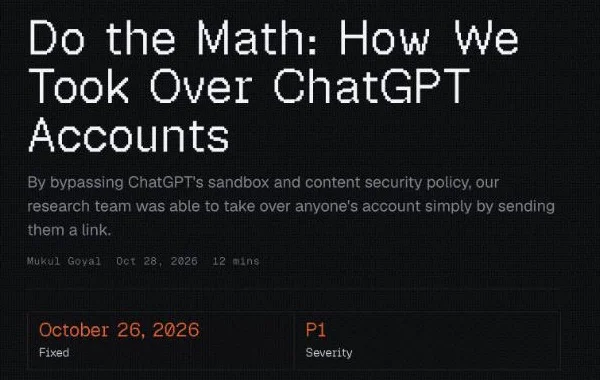
"it could directly call ChatGPT's authenticated APIs as the victim, essentially allowing us to take over the victim's ChatGPT account." / "The victim did not need to install anything, join the attacker's workspace, or authenticate through an attacker-controlled flow." / "We reproduced the automatic path three times in a separate account, including after a hard refresh, with the alert appearing after roughly 4.5 seconds." — from the opening and delivery sectionsView official source →
How a math library opened a path out of Preview
Preview's isolation held, but a math library loaded for a graph in the same chat accepted messages from Preview and let them reach the main ChatGPT page. ChatGPT runs Preview content on a separate web address, so a preview cannot read the signed-in page around it.
When a chat also contains a graph, ChatGPT loads a math library called MathLive into the main page. MathLive listens for messages about its on-screen keyboard. A preview could send it one of those messages, and that was the bridge Parameter used.
The keyboard listener did not check the sender
MathLive accepted a keyboard layout containing HTML from any page and inserted it into the ChatGPT page, where Parameter used it to add a frame with no sandbox. Browsers treated that frame as part of chatgpt.com, with the same access as the real site.
ChatGPT's security settings blocked most outside scripts, but they allowed scripts from YouTube. Parameter used a YouTube response to slip its own code past that rule, and the code then ran with full access to the account.
Each feature looked reasonable on its own
Parameter says the flaw appeared only when Preview, graphs, frame messaging, the YouTube allowance and public sharing were combined in one page. None of them looked wrong by itself, so testing each feature alone would not have revealed the gap.
Parameter also stresses that YouTube was only the last step around ChatGPT's script rules. The root problems were a listener that trusted any sender, a keyboard setting that could carry HTML, and HTML that could create a frame with no sandbox, which the browser treated as chatgpt.com.
"Its listener accepted a message that changed the virtual keyboard layout, and that layout was allowed to contain HTML." / "The YouTube response was the final workaround for CSP, not the root cause." / "The vulnerability appeared only when all of those features were combined in one page." — from the bridge and root cause sectionsView official source →
How OpenAI fixed the flaw and rated it P1
OpenAI reproduced the issue on October 21, raised it from P2 to P1 and paid a $5,000 bounty after both web versions were fixed. The fix was made on OpenAI's side, and Parameter's report does not ask users to update anything.
Timeline from report to fix
Parameter reported the flaw on October 18, and OpenAI had both versions of its web app fixed by October 26. The steps below come from the timeline in Parameter's report, plus its publication date.
From discovery to fix (Parameter's timeline)
| Date | Event |
|---|---|
| October 13 | Parameter confirms the MathLive-to-HTML path in ChatGPT's live code |
| October 14 | Chain reproduced through the normal interface, reaching arbitrary JavaScript |
| October 16 | Attack confirmed between separate accounts through a public share, with one Preview click |
| October 17 | Automatic Preview confirmed when the shared link opens |
| October 18 | Report sent to OpenAI's bug bounty program |
| October 19 | Proof added that private chat content could leave the session |
| October 21 | OpenAI reproduces the issue and raises it from P2 to P1 |
| October 22 | One of two web frontends fixed |
| October 23 | Script-rule changes block part of the chain |
| October 26 | Both frontends fixed, issue resolved, $5,000 bounty paid |
| October 28 | Parameter publishes the details |
ChatGPT's web app runs in two versions, and one was still being updated after the first fix on October 22. Parameter published its report on October 28, after both versions were fixed.
The report does not say whether anyone was attacked
Parameter's write-up covers its own tests and the fix, with no statement on whether real users were targeted before October 26. It describes what the code could reach in Parameter's accounts and how OpenAI responded.
During testing, Parameter sent only a small piece of each response off-site on purpose. It notes that the code had already received the full conversation, so the exposure was not limited to what it sent. Whether anyone else found the same path first cannot be judged from the report.
"OpenAI reproduced the issue; severity was raised from the initial P2 triage to P1." / "OpenAI confirmed both frontends rejected the reported messages, resolved the issue, and awarded a total bounty of $5,000." / "We deliberately sent only a small piece of the response off-site." — from the timeline and proof sectionsView official source →
Steps to protect your ChatGPT chats now
The fix closes this hole, but chats stored in ChatGPT and links from strangers remain the two places where people can limit their exposure. Two government agencies cover those two points: the UK's National Cyber Security Centre (NCSC) on what to keep out of AI chatbots, and the US Cybersecurity and Infrastructure Security Agency (CISA) on what to do with suspicious links.
Companies: set rules for what goes into ChatGPT
The UK's NCSC advises against putting sensitive information into public AI chatbots, because the provider stores what users type. It adds that stored queries could be hacked, leaked or made public by accident.
This flaw showed a second route to the same data: anyone who could run code in your session could read your chat history. A short company rule on what staff may paste into ChatGPT, such as no customer records and no unreleased plans, limits what any future leak could expose.
"Another risk, which increases as more organisations produce LLMs, is that queries stored online may be hacked, leaked, or more likely accidentally made publicly accessible." / "not to include sensitive information in queries to public LLMs" — from the section on sharing sensitive informationView official source →
Employees: check unexpected links before opening them
This link pointed to a real chatgpt.com page, so the address alone could not show it was safe. The safer habit is to ask why someone sent it before you click.
CISA advises against clicking any link in a message you are unsure about. If the message might be genuine, contact the sender another way, for example through a phone number you already have or the company's verified website.
"However, if you think it could be real, don't click on any link or call any number in the message." / "Look up another way to contact the company or person directly:" — from the section on reporting phishingView official source →
FAQ
- Is it safe to open shared ChatGPT links now?
- For this flaw, yes. OpenAI finished the fix on October 26, and Parameter reports that OpenAI confirmed both versions of the ChatGPT web app now reject the messages the attack relied on. Links from people you do not know still deserve a second look before you open them.
- What could the link creator see after I opened the link?
- Your conversation list, the text of private chats you never shared, and anything the code chose to send to an outside server. Parameter says the code acted as you inside ChatGPT, which amounted to taking over the account.
- Did I have to click anything besides the link?
- Not in the final version Parameter tested. An earlier, more reliable version needed one click on ChatGPT's Preview button, but once the HTML was set to preview automatically, opening the link was enough.
Related articles
 OpenAI, ServiceNow expand deal with ChatGPT pluginOpenAI and ServiceNow expanded their deal on Oct 28, 2026. A ServiceNow MCP plugin for ChatGPT is live now; Codex, security and voice tools follow in 2027.
 ChatGPT and Codex usage limits merge in DecemberFrom December, Plus, Pro and Business plans will share one token-based allowance across ChatGPT and Codex. Instant chat won't count, and no start date is set.
 ChatGPT now works with iCloud Mail and CalendarOpenAI added iCloud Mail and Calendar plugins to ChatGPT on Oct 27 for all plans. You connect with an Apple app-specific password that outlives a disconnect.
 ChatGPT limits weapons information for teensOpenAI said on Oct 30, 2026 that ChatGPT will limit weapons information for teens, end chats fixated on violence, and report on safety every six months.