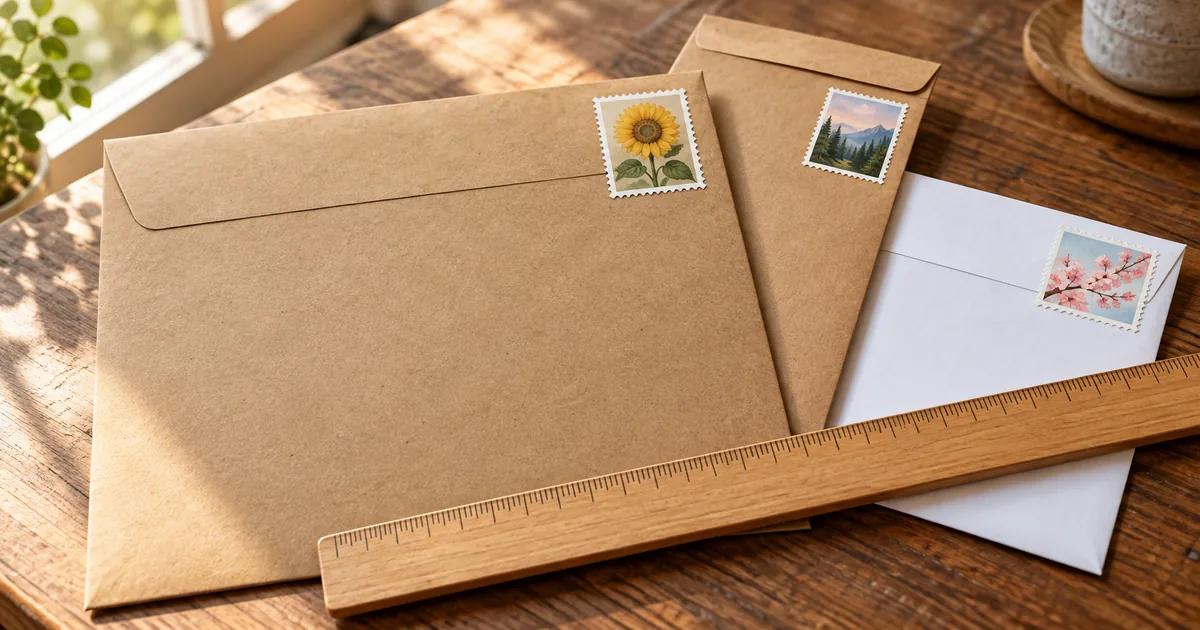
Chou 3 is 120 × 235 mm and posts as standard mail — Japan Post's cheapest letter category — for 110 yen. Kaku 2 is 240 × 332 mm and does not, so the same documents in that envelope cost 140 yen or more. Japanese envelope sizes are named by number within three families, and the number on its own says nothing about which side of that line an envelope falls on.
Japanese envelope sizes in millimeters
Japanese envelopes are sorted into three families by where the opening sits. Chou (長形) and kaku (角形) both open on a short edge; yo (洋形) opens along a long edge, which is why invitations and cards use it.
The shapes are defined in JIS S 5502, the Japanese Industrial Standard for envelopes, first issued in 1964 and now in its 2010 edition, which replaced the 1997 one. Within a family the proportions are fixed: chou runs at roughly 1:2 or longer, kaku at roughly 1:√2. The standard allows a tolerance of ±2 mm.
Dimensions below are width × height in millimeters, the order Japanese suppliers use. The Standard column shows whether the size is current JIS, a former JIS size, or trade practice with no JIS entry.
| Name | Japanese | Size (mm) | Standard |
|---|---|---|---|
| Chou 3 | 長形3号 | 120 × 235 | JIS |
| Chou 4 | 長形4号 | 90 × 205 | JIS |
| Chou 40 | 長形40号 | 90 × 225 | JIS |
| Chou 30 | 長形30号 | 92 × 235 | trade practice |
| Chou 6 | 長形6号 | 110 × 220 | JIS |
| Chou 2 | 長形2号 | 119 × 277 | JIS |
| Chou 1 | 長形1号 | 142 × 332 | former JIS |
| Kaku 2 | 角形2号 | 240 × 332 | JIS |
| Kaku 0 | 角形0号 | 287 × 382 | JIS |
| Kaku 20 | 角形20号 | 229 × 324 | JIS |
| Kaku A4 | 角形A4号 | 228 × 312 | trade practice |
| Kaku 3 | 角形3号 | 216 × 277 | JIS |
| Kaku 4 | 角形4号 | 197 × 267 | JIS |
| Kaku 5 | 角形5号 | 190 × 240 | JIS |
| Kaku 6 | 角形6号 | 162 × 229 | JIS |
| Kaku 7 | 角形7号 | 142 × 205 | JIS |
| Kaku 8 | 角形8号 | 119 × 197 | JIS |
| Yo 4 | 洋形4号 | 235 × 105 | JIS |
| Yo naga 3 | 洋形長3号 | 235 × 120 | trade practice |
| Yo 6 | 洋形6号 | 190 × 98 | JIS |
| Yo 1 | 洋形1号 | 176 × 120 | JIS |
| Yo 2 | 洋形2号 | 162 × 114 | JIS |
| Yo 3 | 洋形3号 | 148 × 98 | former JIS |
Chou 3 takes an A4 sheet folded in three. Kaku 2 takes A4 flat, without a crease.
Standard mail in Japan: four conditions and a flat 110 yen
The price of a letter is not set by the envelope's name. It is set by whether the finished item fits inside a category Japan Post calls standard mail (定形郵便物), and that category has four conditions:
- long side between 14 cm and 23.5 cm
- short side between 9 cm and 12 cm
- thickness no more than 1 cm
- weight no more than 50 g
All four have to hold at once. Break any single one — a sheet too many, an envelope 3 mm too wide — and the item leaves the category and is priced as non-standard mail instead.
Anything that stays inside costs 110 yen, whatever it weighs up to the 50 g limit. That flat rate has been in force since 1 October 2024.
Before that, standard mail was split into two weight bands, 84 yen up to 25 g and 94 yen up to 50 g, merged into a single 110 yen band. Postcards moved from 63 yen to 85 yen on the same date, so stamps bought before the change no longer cover a letter on their own.
Which sizes stay inside standard mail: most chou and yo, plus kaku 8
Measuring each size against those four conditions gives a clean split. These stay inside, so they post for 110 yen:
| Name | Size (mm) | Long side | Short side |
|---|---|---|---|
| Chou 3 | 120 × 235 | 235 mm | 120 mm |
| Chou 4 | 90 × 205 | 205 mm | 90 mm |
| Chou 40 | 90 × 225 | 225 mm | 90 mm |
| Chou 30 | 92 × 235 | 235 mm | 92 mm |
| Chou 6 | 110 × 220 | 220 mm | 110 mm |
| Kaku 8 | 119 × 197 | 197 mm | 119 mm |
| Yo 4 | 235 × 105 | 235 mm | 105 mm |
| Yo naga 3 | 235 × 120 | 235 mm | 120 mm |
| Yo 1 | 176 × 120 | 176 mm | 120 mm |
| Yo 2 | 162 × 114 | 162 mm | 114 mm |
| Yo 6 | 190 × 98 | 190 mm | 98 mm |
| Yo 3 | 148 × 98 | 148 mm | 98 mm |
Seven of these sit exactly on a limit. Chou 3 and yo naga 3 hit the maximum in both directions at 235 × 120 mm; chou 30 and yo 4 are 235 mm long; yo 1 is 120 mm wide; chou 4 and chou 40 are 90 mm wide, which is the minimum rather than the maximum. JIS allows ±2 mm on the envelope itself, and that tolerance runs both ways, so an envelope cut at the far end of it falls outside the limits rather than on them.
Everything else is out. Chou 2 (119 × 277 mm) and chou 1 (142 × 332 mm) are too long.
Kaku 8 is the only size in its family that fits, because at 119 × 197 mm both of its sides are inside the limits. Kaku 7 (142 × 205 mm) already has a short side of 142 mm against a 120 mm limit, and every size above it is wider still.
Rates for the sizes that fall outside
Falling out of standard mail does not mean one flat penalty. Non-standard mail (定形外郵便物) is itself split in two, and which half applies depends on size again. Both tables below are Japan Post's domestic rates, in force since 1 October 2024.
Regular size covers items with a long side up to 34 cm, a short side up to 25 cm, a thickness up to 3 cm and a weight up to 1 kg. Each of those four is a maximum rather than a range, so the item just has to stay under all four:
| Weight | Rate |
|---|---|
| up to 50 g | 140 yen |
| up to 100 g | 180 yen |
| up to 150 g | 270 yen |
| up to 250 g | 320 yen |
| up to 500 g | 510 yen |
| up to 1 kg | 750 yen |
Oversize covers anything beyond that, up to a long side of 60 cm, a combined length-plus-width-plus-thickness of 90 cm and a weight of 4 kg. The 4 kg figure is the maximum for the category as a whole:
| Weight | Rate |
|---|---|
| up to 50 g | 260 yen |
| up to 100 g | 290 yen |
| up to 150 g | 390 yen |
| up to 250 g | 450 yen |
| up to 500 g | 660 yen |
| up to 1 kg | 920 yen |
| up to 2 kg | 1,350 yen |
| up to 4 kg | 1,750 yen |
Kaku 2, the A4-flat envelope, measures 240 × 332 mm — 33.2 cm on the long side and 24 cm on the short side — so it lands in regular size and starts at 140 yen. Kaku 0 at 287 × 382 mm runs past the 34 cm long-side limit and is charged as oversize, starting at 260 yen. That is the practical gap between sending A4 flat in the usual business envelope and sending it in a larger kaku: the same documents fall into a different bracket.
The 2024 revision raised these as well. Regular size up to 50 g went from 120 yen to 140 yen, up to 100 g from 140 yen to 180 yen, and up to 1 kg from 580 yen to 750 yen. Oversize up to 50 g went from 200 yen to 260 yen, and the 4 kg ceiling from 1,350 yen to 1,750 yen.
Check the weight before you post
Postage is charged on the finished item, which means the envelope counts as much as what goes inside it. Put the empty envelope on the scale first; the 50 g limit has to cover both.
The contents are easier to predict, because paper weight is arithmetic rather than guesswork. Paper is sold by basis weight in grams per square meter, and an A4 sheet is 210 × 297 mm, an area of 0.06237 m². Multiply that area by the basis weight and you have the weight of one sheet:
- ordinary copy paper at 64 g/m²: 0.06237 × 64 ≈ 4.0 g per A4 sheet
- heavier premium paper at 90 g/m²: 0.06237 × 90 ≈ 5.6 g per A4 sheet
A dozen sheets of copy paper therefore come to roughly 48 g on their own, which leaves nothing for the envelope. Ten sheets at about 40 g leave room to stay inside standard mail.
Folding is the only thing that gets A4 into a chou 3. Dividing the 297 mm length by three gives 99 mm, so a tri-folded A4 sheet measures 210 × 99 mm, inside the envelope's 235 mm length and 120 mm width. If the documents must not be creased, kaku 2 takes them flat and the 140 yen bracket applies instead.
Paper size is the other half of this calculation, because the sheet decides both the fold and the weight. If you need the same numbers for screens and printing, A4 size in pixels: 2480 × 3508 at 300 DPI covers those conversions.
Summary
- Japanese envelope sizes are named by number within three families — chou, kaku and yo — and the name does not tell you the price.
- What sets the price is the standard-mail category: long side 14–23.5 cm, short side 9–12 cm, thickness within 1 cm, weight within 50 g. All four conditions must hold.
- Chou 3 (120 × 235 mm) takes A4 folded in three, stays inside the category, and posts for 110 yen.
- Kaku 2 (240 × 332 mm) takes A4 flat but falls outside, so it starts at 140 yen.
- Weight is the condition that trips people up. A4 copy paper runs about 4.0 g a sheet, and the envelope itself counts toward the same 50 g.
FAQ
- How much postage does a letter need in Japan? 110 yen
- A letter meeting all four standard-mail conditions — long side 14–23.5 cm, short side 9–12 cm, thickness within 1 cm, weight within 50 g — costs 110 yen regardless of how much of that 50 g it uses. Miss any one condition and the item is priced from the non-standard tables, which start at 140 yen.
- Does a kaku 2 envelope count as standard mail? No
- Kaku 2 (角形2号) is 240 × 332 mm, which exceeds both the 23.5 cm long side and the 12 cm short side that standard mail allows. It is charged as non-standard mail, regular size: 140 yen for items up to 50 g and 180 yen up to 100 g.
- Does the envelope's own weight count toward postage? Yes
- Yes. The 50 g limit applies to the item as posted, envelope included, not to the contents alone. Weighing the empty envelope before filling it is the reliable way to know how many sheets you can add.
Related articles
 How many grams in a tablespoon? Sugar 12.6 gGrams in a tablespoon: 12.6 g of sugar, 14.2 g of butter, 18 g of salt. The spoon is 15 mL, the cup is 240 mL, and the cup is where charts go wrong.
 Claude Fable 5.2: 20% price cut, up to 30% fasterAnthropic released Claude Fable 5.2 on November 9, 2026. API prices fall 20% to $8/$40 per million tokens, and output is up to 30% faster than Fable 5.1.
 PayPay security and passkeys in 10 Japan pay appsPayPay security compared with 9 other Japanese payment apps: passkeys, extra checks to send or pay, and fraud compensation deadlines.
 AI fact check: only 40% of cited stats hold upAI fact check: Trakkr traced 1,285 stats cited by ChatGPT, Perplexity, Gemini, Claude and AI Overviews. Only 40% led to a matching study. How to check one.