M3's MR-kun service leaked data on doctors and pharma staff
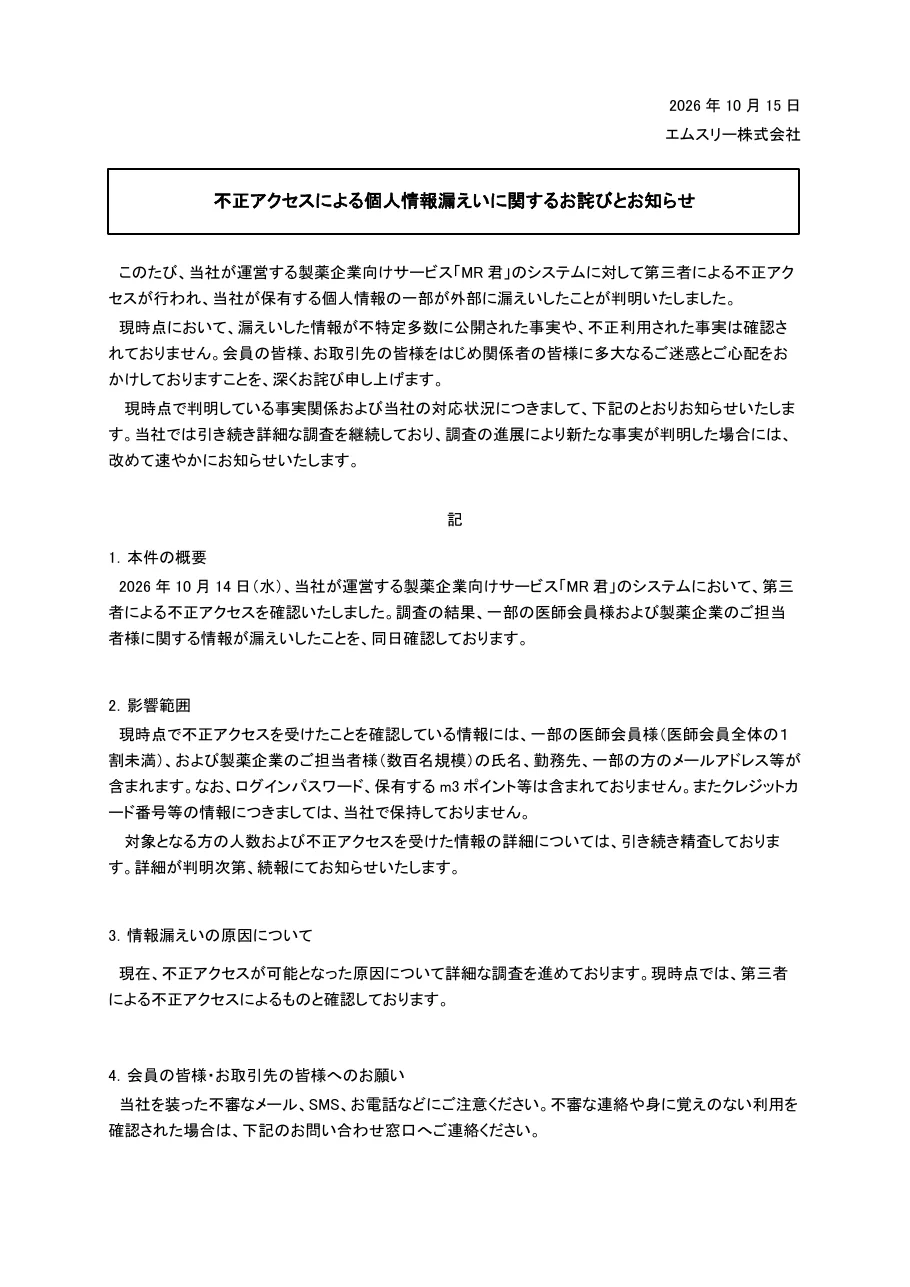
Someone broke into the system behind MR-kun, a service M3 runs, and personal data on physician members and pharmaceutical company staff got out. M3 posted an apology and an outline of the incident on its corporate site on October 15. The notice is in Japanese only.
M3 says it has found no sign that the leaked data was made public or misused so far. It is still looking into the details and plans to publish updates if it learns more.
The incident at a glance (from M3's notice)
| Item | Detail |
|---|---|
| Break-in found | October 14, 2026 (Wednesday) |
| Announced | October 15, 2026 |
| Service | MR-kun, M3's service for pharmaceutical companies |
| People affected | Some physician members (fewer than 10% of all) and pharmaceutical company staff (several hundred) |
Japan has seen a run of breach disclosures this autumn. Earlier cases are listed in Japan data breach list: cases by date and cause.
M3 found the break-in on October 14
M3 noticed the unauthorized access to the MR-kun system on Wednesday, October 14. By the end of that day it had also found that information on some physician members and pharmaceutical company staff had leaked. It went public the next day.
"第三者による不正アクセスを確認いたしました。" / "一部の医師会員様および製薬企業のご担当者様に関する情報が漏えいしたことを、同日確認しております。" — 「1.本件の概要」よりView official source →
MR-kun is M3's drug promotion service
MR-kun is a drug promotion service that M3 runs for pharmaceutical companies. The "MR" stands for medical representative, the drug company employee whose job is to give doctors information about medicines.
M3 also runs m3.com, a members-only site for healthcare professionals. Its service page says m3.com has more than 250,000 physician members, and the notice sends members with questions to m3.com customer support.
"医薬品プロモーションでその実績を誇るMR君サービス" / "m3.comの医師会員25万人以上" — 「QOL君」「治験君」の紹介文よりView official source →
Names and workplaces leaked, but not passwords or m3 points
The leaked data includes names, workplaces and, for some people, email addresses. Login passwords and m3 points were not part of it. Here is how the items break down.
What leaked and what didn't (from M3's notice)
| Type | Items |
|---|---|
| Leaked | Names, workplaces, some email addresses, among other items |
| Not leaked | Login passwords, m3 points held by members, among other items |
| Never held by M3 | Credit card numbers and similar data |
M3 says it never held credit card numbers in the first place. Email addresses were exposed only for some of the people affected, not for everyone.
Fewer than 10% of physician members are affected
M3 puts the affected group at fewer than 10% of its physician members, plus several hundred pharmaceutical company staff. Both figures are rough numbers from the announcement, not a final count.
Update: In its second report on October 23, 2026, M3 said it had confirmed that personal information of 25,775 m3.com members and others and 2,260 pharmaceutical company staff was leaked. Email addresses were included for 6 of the members and 264 of the pharmaceutical company staff (per M3's second report).
M3 is still working out exactly how many people are affected and what data was accessed, and says it will share more once it knows. Until then, there is no way to tell from news reports whether a particular person is on the list.
"製薬企業のご担当者様(数百名規模)の氏名、勤務先、一部の方のメールアドレス等が" / "なお、ログインパスワード、保有する m3 ポイント等は含まれておりません。" / "対象となる方の人数および不正アクセスを受けた情報の詳細については、引き続き精査しております。" — 「2.影響範囲」よりView official source →
M3 blocked the access routes it found
After spotting the break-in, M3 shut the access routes it had identified and has kept watching its systems since. It tightened its defenses while it worked out how far the breach reached, and plans to strengthen protection across its other services too.
The cause is still unknown. All M3 has confirmed is that a third party got in without permission. It has not said how the attack worked or where the attackers entered.
"現在、不正アクセスが可能となった原因について詳細な調査を進めております。" / "現時点で判明している不正アクセスの経路は遮断しており、監視を続けております。" — 「3.情報漏えいの原因について」「5.当社の対応および今後について」よりView official source →
Affected people will be contacted in turn
M3 will contact the people affected in turn. For pharmaceutical company clients, M3's own account staff will make the contact.
The company is also reporting the incident to the supervising authorities. Anyone wondering whether they are affected will need to wait for that message from M3.
"監督官庁への報告など必要な対応を進めている他、本件の対象となる方に対しては、順次ご案内をいたします。" / "当社の担当者から順次ご連絡させていただきます" — 「5.当社の対応および今後について」「6.本件に関するお問い合わせ先」よりView official source →
Watch for messages pretending to be from M3
M3 is warning members and clients about suspicious emails, text messages and phone calls that claim to come from M3. A message that gets your name and workplace right can still be fake. M3 asks people to get in touch in either of these cases.
- You receive a suspicious email, text or call that says it is from M3
- You notice activity on your account that you don't recognize
Members should contact m3.com customer support
Members with questions should go to m3.com customer support. The form is on the m3.com contact page. Other groups have their own contacts, listed below.
Contacts for this incident (from M3's notice)
| Who | Contact |
|---|---|
| Members | m3.com customer support |
| Pharmaceutical clients | M3 account staff will reach out |
| Shareholders and investors | IR (info-ir@m3.com) |
| Press | PR (pr@m3.com) |
"当社を装った不審なメール、SMS、お電話などにご注意ください。" / "エムスリー株式会社 m3.com カスタマーサポート https://www.m3.com/contact" — 「4.会員の皆様・お取引先の皆様へのお願い」「6.本件に関するお問い合わせ先」よりView official source →
What workplaces can learn from the M3 breach
Companies that hold customer or client data should review their defenses, and staff should get ready for fake messages. On October 9, Japan's Ministry of Economy, Trade and Industry (METI) warned businesses that data leaks caused by unauthorized access keep happening at Japanese companies and organizations.
Companies should check vulnerability handling and leadership
If your company holds data on customers or partners, check whether it is doing the three things METI asked for. The ministry asked businesses for:
- Leadership from the top of the organization
- Early awareness of vulnerability information, and a quick response to it
- A move to "zero trust" security
M3 has not yet said how attackers got in. That makes the basics a better place to start than any one attack method.
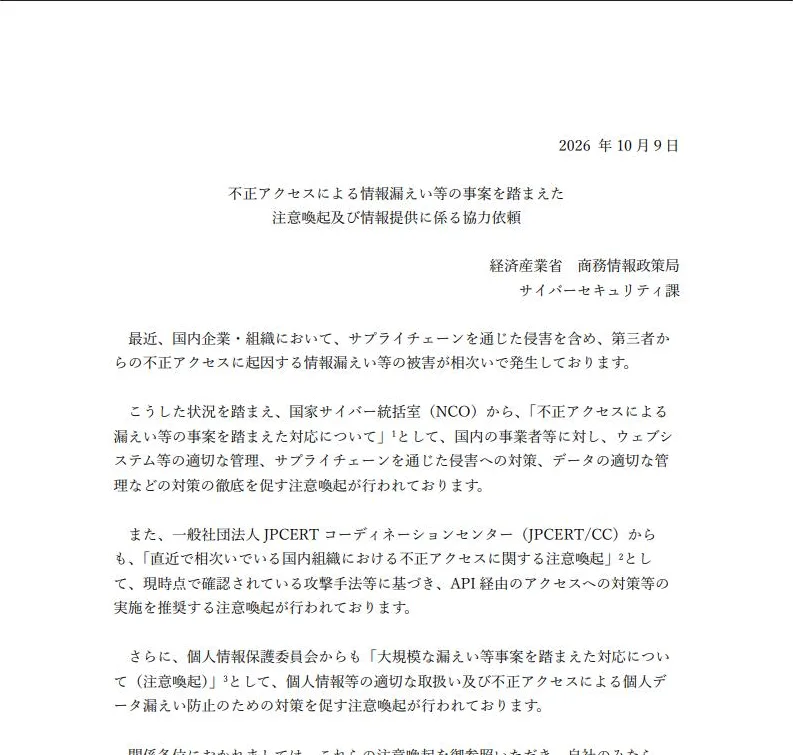
"①組織のトップによる主導、②脆弱性情報の早期把握と対応、③「ゼロトラスト」への移行など" — 本文よりView official source →
Staff should not click links in leak-themed messages
Employees should not click links in emails or texts that use a data leak as a hook. Phishing means messages that pretend to come from a real company to lure you to a fake site and get you to type in your details. Japan's National Police Agency (NPA) says many phishing messages use urgent phrases such as "personal information leak" or "unauthorized access detected."
Some phishing emails even spoof a real company's address, so the sender line alone won't tell you whether a message is genuine. The NPA advises reaching the real site through a bookmark you saved earlier or through the company's official app.
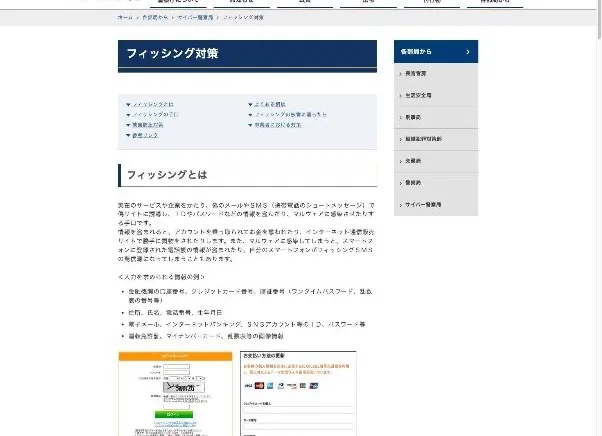
"電子メール等の文面は、「個人情報の漏えい」、「不正アクセス検知」、「取引の停止」等、切迫感を煽り、ログインさせようとするものが多数確認されています。" / "あらかじめ公式サイトを「お気に入り」や「ブックマーク」に登録しておいたり、公式アプリを活用するなどして正しいサイトに接続するようにしてください。" — 「フィッシングの手口」「フィッシング対策」よりView official source →
FAQ
- Were passwords leaked in the M3 MR-kun breach?
- No. M3 says login passwords and the m3 points members hold were not part of the leaked data.
- Were credit card numbers exposed in the M3 breach?
- No. M3 says it does not hold credit card numbers at all, so they could not be part of the leak.
- How do I know if I was affected by the M3 breach?
- Wait for a message from M3. The company says it will contact affected people in turn, and its own account staff will reach out to affected pharmaceutical company clients.
Related articles
 Japan foreign ministry leak may hit 3,600 recordsJapan's foreign ministry says names and email addresses in about 3,600 records may have leaked, including 900 outsiders. No classified or passport data.
 Japan's data leaks hit 260 million since AprilJapan's privacy regulator says unauthorized access affected data on a cumulative 260 million people from April to mid-October, with 830 reports in October.
 GMO's Onamae.com Desktop Cloud hacked, data leakedAttackers broke into Onamae.com Desktop Cloud, GMO Internet's VPS for FX trading, stole trading logins and leaked data after GMO refused a ransom.
 Japan data breach list: cases by date and causeThis Japan data breach list sorts disclosed cases newest first. Skyticket (14.64M records) and KDDI (12.23M users) lead. See what leaked, why, and what to do.