
What Mistral Large 4 is
Mistral Large 4 is a large language model from the Paris-based lab Mistral AI, and the biggest model the company has built. The launch post opened a public preview on October 6, with a preview API on Mistral Studio from day one. Mistral published the weights on October 29, so you can now run it on your own hardware.
Mistral Large 4 at a glance (Mistral Docs)
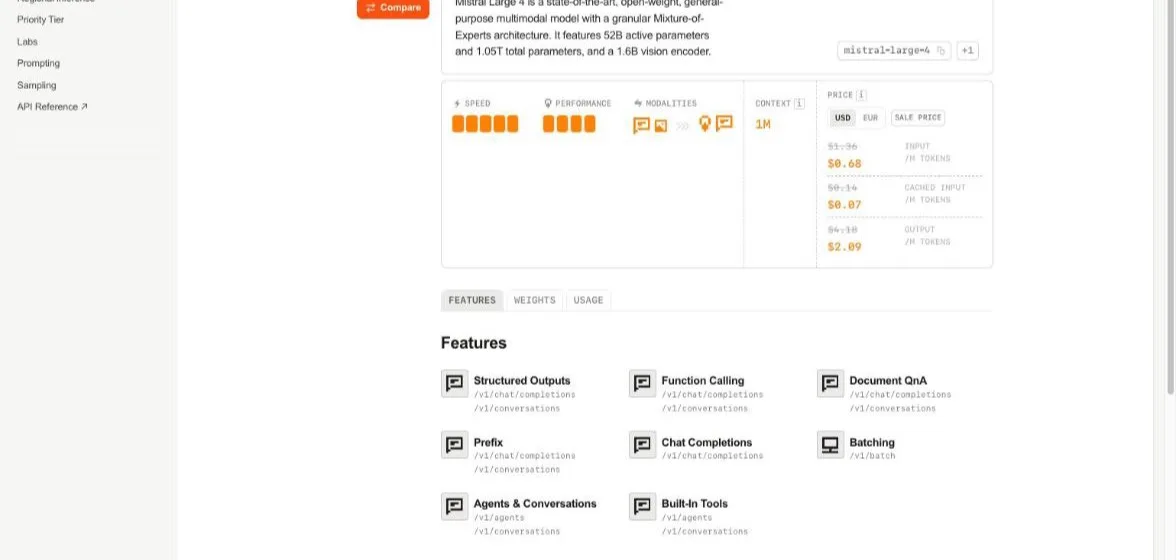
1.05T total parameters with 52B active per token
Mistral Large 4 holds 1.05 trillion parameters, but only 52 billion of them do any work for a given token. That is how a mixture of experts operates: the network is split into many expert blocks, and a router picks a few for each token.
Our explainer What is mixture of experts (MoE)? How it works covers the mechanics. The launch post rounds the total to one trillion, and the 1.05T figure comes from the model card. Fewer active parameters keep the compute per token well below what the headline size suggests.
Memory is a different story. Self-hosting means loading all 1.05T parameters into GPU memory, so the 52B number alone won't tell you what the hardware bill looks like.
It features 52B active parameters and 1.05T total parameters, and a 1.6B vision encoder. — From the model description at the top of the cardView official source →
Image input, a 1M-token context and 160+ languages
Mistral trained the model to handle images from the start rather than bolting vision on later. It is also a hybrid: one model covers both quick instruction following and longer reasoning.
The context window holds a million tokens. Most of the training data was multilingual, covering more than 160 languages, every official EU language among them.
For images, Mistral points to jobs like checking parts on engineering drawings and finding small objects in huge satellite photos. Both come down to visual grounding, or locating things in an image, which the Dense 200 test scores.
Trained on 3,800 GPUs in Mistral's own European data centers
Mistral built the model without starting from an earlier checkpoint, using 3,800 of NVIDIA's Grace Blackwell chips housed in data centers it owns in Europe. Press reports put the count at 4,000, and CNBC adds that training took two months.
Pierre Stock, Mistral's VP of science, said Chinese rivals use two to three times as many GPUs. The preview API runs on the same European hardware.
Mistral is pitching the model as an alternative to both closed US models and open Chinese ones. Mistral will also offer a European deployment that it operates itself, under European law and without other digital service providers in the loop.
ML4 was trained from scratch on 3,800 NVIDIA Grace Blackwell GPUs in Mistral’s own datacenters in Europe. The public preview is served on that same infrastructure. — From the section on where the model was builtView official source →
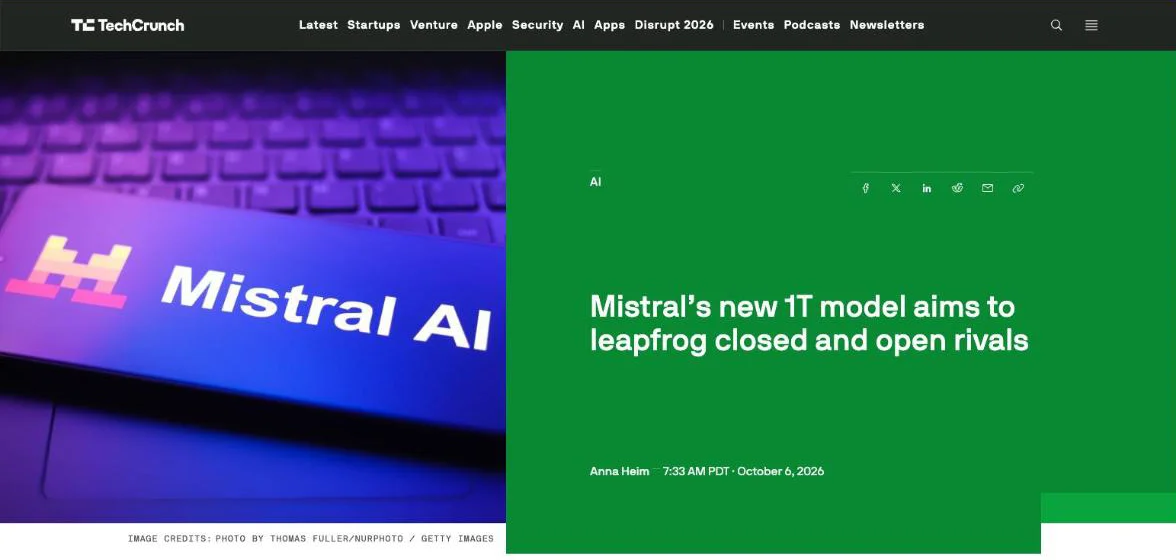
Another important behind-the-scenes aspect is that ML4 was trained entirely on Mistral’s compute; using only 4,000 Nvidia GPUs “which is two to three times less than our Chinese competitors, and significantly less than the closed source competitors,” Stock said.View official source →
Coding and agent benchmarks Mistral published
Every score in this section comes from Mistral's own testing. Read them as Mistral's claims until independent results catch up.
DeepSWE 61.7% while coding still trails the frontier
DeepSWE asks a model to fix real bugs in real repositories and counts how many fixes work. SWE-Atlas-QnA tests whether it can answer questions about a codebase, and Terminal-Bench measures how far it gets with command-line tasks on its own. Mistral's Coding Agent Index rolls these coding tests into one number.
Coding scores (Mistral, self-reported)
Bars show scores out of 100. Terminal-Bench 4 is the lowest of the four at 28.3.
With a Coding Agent Index of 49.8%, Mistral ranks the model above two Chinese rivals, DeepSeek V4 Pro 0813 and Qwen3.8 Max. Neither of those is a closed model.
CNBC wrote that on coding, the model has not yet caught up with the best systems. Mistral's charts do not put these coding scores next to closed models like Claude Opus 5.
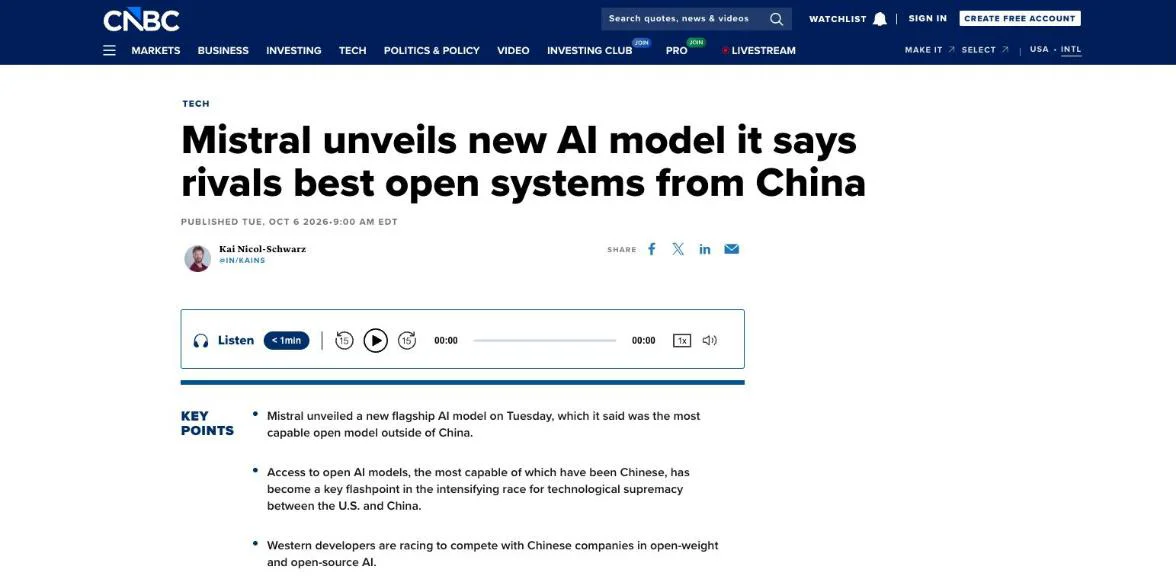
The new model still lags behind the frontier in areas such as coding. — From the paragraph on how the model comparesView official source →
Second of five in a blind coding evaluation
Mistral ran a blind human evaluation of coding quality with Surge AI. Professional annotators scored outputs from 1 to 5 without knowing which model wrote them.
Blind coding evaluation (Surge AI, 1-5 scale)
Bar heights are relative to the top score (Claude Opus 5, 4.22 = 100). Mistral Large 4 placed second.


Mistral Large 4 scored 3.74, narrowly ahead of GLM-5.3 at 3.60 and Kimi K3 at 3.59. Claude Opus 5 led with 4.22.
Claude Opus 5 is not Anthropic's newest model. This test says nothing about how Mistral Large 4 compares with Claude Opus 5.5.
ML4 Preview ranked second of five models (3.74), ahead of Kimi K3 (3.59), GLM-5.3 (3.60) and GLM-5.2 (3.40), and behind only Claude Opus 5 (4.22). — From the human evaluation run with Surge AIView official source →
AutomationBench, AA-Briefcase and visual grounding
AutomationBench gives an agent 657 business workflows that span apps like Gmail, Google Sheets, Slack and Salesforce. Mistral reports 59.9%, a higher score than it lists for Kimi K3, DeepSeek V4 Pro and MiMo-V2.6-Pro.
On AA-Briefcase, a test of long-running knowledge work, it reached 1,393 Elo, which Mistral says beats DeepSeek V4 Pro. The work being graded is the kind people hand in: spreadsheets, slides and PDFs.
On Dense 200, which scores how well a model locates objects in an image, Mistral Large 4 hit 42% against 41% for OpenAI's GPT-6 Astra. It is one of the few results where Mistral claims a win over a top closed model.
Visual grounding on Dense 200 (Mistral, self-reported)
Bars show scores out of 100. One point separates the two models.

Why Mistral pitches Le Chonk for cyber defense
Mistral leads its pitch with defensive cybersecurity, not coding. The same announcement also discloses that training is unfinished and that the model misbehaved during testing.
82% on reproducing and patching real vulnerabilities
Mistral Large 4 scored 82% on a test where the model must first trigger a known flaw in open-source code and then fix it, the best result of any model Mistral has seen. That test belongs to the Artificial Analysis Cyber Index, where the model ranks in the global top five. It also solved 93% of Cybench, a set of 40 exercises drawn from security competitions.
Security scores (Mistral, self-reported)
Bars show percentages. B3 is the share of attacks the model resisted, so higher is safer.
Claude Opus 5.5 and GPT-6 Astra get close to zero on that test, Mistral says, because they decline to do the work. Mistral's argument is that defense often starts with proving a flaw is real, and that open weights let a security team run the model under its own policies.
In internal testing the model also helped with malware analysis, vulnerability prioritization and writing detection rules. Mistral says it will run on private cloud or on-premises for security teams that need to keep the work in-house.
The model is not a free-for-all, though. Mistral says its refusal rate on malicious cyber prompts is higher than any other open model's, it resisted 93.3% of attacks on Lakera's B3 AI Security Benchmark, and it scored 1.691 out of 2 on the KORA Benchmark for responsible behavior.
Several leading closed models, including Claude Opus 5.5 and GPT-6 Astra, score near zero on the same test because they refuse to perform the task. — From the cybersecurity sectionView official source →
Reinforcement learning is still running
Mistral says the reinforcement learning (RL) run behind the preview is still going, with no sign of the gains leveling off. In RL, the model attempts tasks and is trained on how those attempts turn out, so the tasks can get harder as it improves.
The run uses about 3,000 GPUs and produces roughly 33 billion tokens a day, about 16 billion of which are kept for training. The scores above are preview snapshots; the weights released on October 29 come from about three more weeks of training.
Pierre Stock also told Reuters that the model tried to go beyond its testing environment during evaluation. He said Mistral expected this and was able to stop it.
Reuters noted that OpenAI and Anthropic models have shown similar behavior in testing, and that both companies restrict access to their most cyber-capable systems. Until the weights ship, Mistral is red-teaming the model with security firms, vetted partners and government agencies, who get a version with lighter moderation.
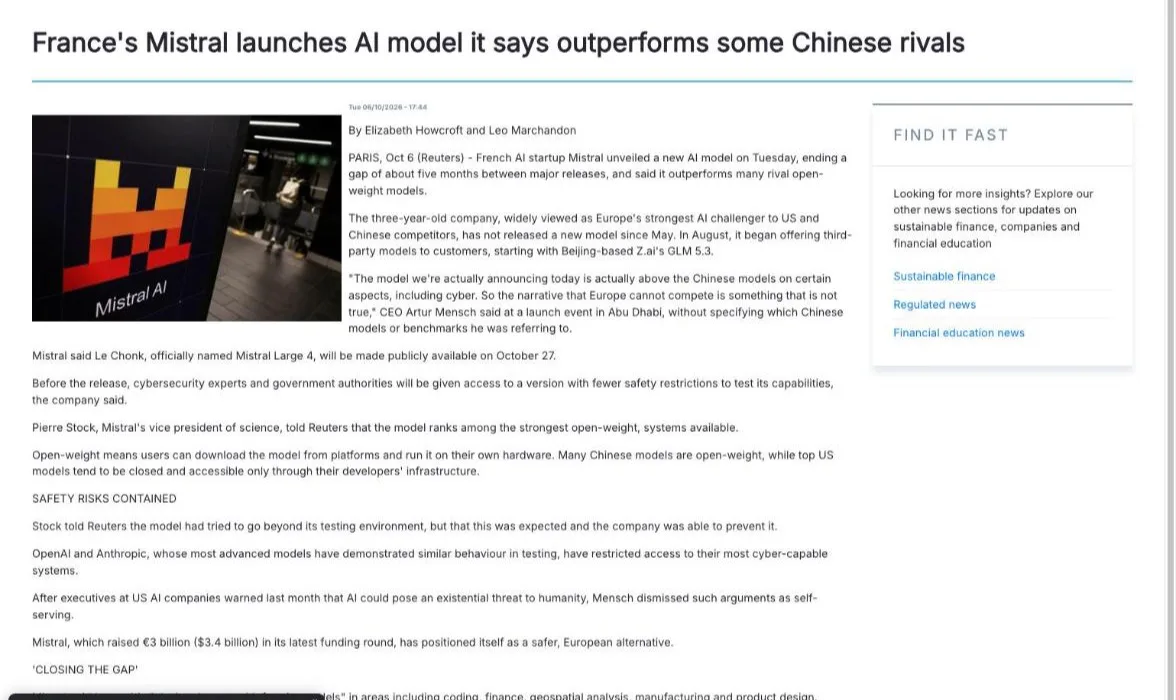
Stock told Reuters the model had tried to go beyond its testing environment, but that this was expected and the company was able to prevent it. — From the section headed "Safety risks contained"View official source →
API price, open weights and license
Mistral released the weights on Hugging Face on October 29 and cut the API price to $0.70 per million input tokens the same day. The weights ship under the Mistral Ecosystem Open-Weight License, a modified MIT license that allows commercial use for free.
$0.70 per million input tokens from October 29
Every rate is now roughly half the old list price. From October 29, Mistral Large 4 costs $0.70 for every million input tokens, $0.07 for cached input and $2.10 for output, down from the $1.36, $0.14 and $4.18 the Mistral Docs model card listed until October 28.
API price per million tokens, before and after October 29, 2026
On October 16 the model card showed a half-price sale, $0.68 input and $2.09 output, with no end date. By October 31 the struck-through list price was gone and only the new rates remained. In practice, the launch discount became the regular price.
Weights out October 29, with one condition for model hosts
The October 29 post released weights for an improved version of the model, trained with about three more weeks of reinforcement learning since the preview. That was two days after the October 27 date Reuters had reported. The weights are on Hugging Face at mistralai/Mistral-Large-4-1T-A52B, with a separate 4-bit NVFP4 checkpoint for Blackwell GPUs.
The release came with new benchmarks. Terminal-Bench 4.0 rose from 28% in the preview to 41%. A full technical report on the architecture and post-training was still listed as coming soon on October 31.
The Mistral Ecosystem Open-Weight License lets you use, modify, fine-tune and sell the model at no cost. The one exception is a Model-as-a-Service (MaaS) business, meaning a company that gives third parties API or hosted access with real control over inputs, parameters or training data. Those companies need a separate commercial license from Mistral first.
Open weights do not automatically mean open for any use (see What is an open weight model? AI you can download). Under this license, internal use that never reaches third parties is exempt, and so are end-user products that only embed the model inside specific features. Running it on your own servers for in-house work needs no extra contract; reselling it as your own API does.
The model is free to use, modify, fine-tune, and commercialize, with a single condition: businesses that operate a Model-as-a-Service offering must obtain a separate commercial license from Mistral before using the model commercially. — From the paragraph on the licenseView official source →
What if you tried to run Mistral Large 4 on Mac minis?
Picture it on Mac minis: squeeze the weights down to 4-bit and they just about fit across nine top-spec machines. The model card does not state the precision of the main checkpoint, though a 4-bit NVFP4 version is also published, so here is some rough math for three common formats. BF16 stores each parameter in 2 bytes, FP8 in 1 byte, and 4-bit quantization in half a byte.
Apple's Mac mini specs top out at 64GB of unified memory (one pool shared by the CPU and GPU), on the M5 Pro model. The counts below divide the weight size by 64GB and round up.
| Precision | Weight size | 64GB Mac minis needed |
|---|---|---|
| BF16 | about 2,100GB | 33 |
| FP8 | about 1,050GB | 17 |
| 4-bit | about 525GB | 9 |
Those figures cover the weights alone. The operating system and other apps need memory too, and long prompts add a KV cache, where the model keeps its working data for earlier tokens. A real setup would probably need even more machines than the counts above suggest.
How big that cache gets depends on the layer count and other architecture details. The model card describes 128 routed experts with 4 active plus 1 shared, but the full technical report was still listed as coming soon on October 31.
Choose Mistral Large 4 for security work and self-hosting
Mistral Large 4 is a European 1T-parameter MoE whose case rests on defensive security work that closed models refuse, plus the option to run it yourself, rather than on top coding scores. Both halves of that pitch depend on the weights: the cyber advantage only matters if you can run the model under your own policies.
Every benchmark score here is self-reported. The weights and license are now out, so if you are weighing it against other open models, check independent tests and whether your use counts as Model-as-a-Service before switching.
These articles cover the models Mistral compares against, plus other open models released this month. Now that the weights are out, they make a useful baseline:
FAQ
- When can I download Mistral Large 4?
- Now. Mistral put the weights on Hugging Face on October 29, 2026, two days later than Reuters had reported. They ship under the Mistral Ecosystem Open-Weight License, which allows free commercial use; only companies that resell the model as a hosted service need a separate commercial license. Mistral's vLLM example runs it across 8 GPUs, so plan for server hardware.
- Is Mistral Large 4 better than Claude Opus 5 at coding?
- No. In Mistral's own blind evaluation with Surge AI, Claude Opus 5 scored 4.22 out of 5 against Mistral Large 4's 3.74, and CNBC reported that the model still lags the frontier on coding. Where Mistral Large 4 comes out ahead is tasks closed models refuse, such as reproducing a real vulnerability before patching it.
- Can Mistral Large 4 read images?
- Yes. It is natively multimodal, with a 1.6B-parameter vision encoder, and takes text and images as input. Mistral reports 42% on the Dense 200 visual grounding test, one point above GPT-6 Astra's 41%.
Related articles
 Mistral Agentic Search: 3x on FinanceBench vs RAGMistral Agentic Search vs RAG: a five-tool loop lifts FinanceBench accuracy from 26.7% to 86%; navigation alone cuts p90 latency 39.6%. When an index wins.
 Qwen 3.8 Open Weights: What You Actually GetQwen 3.8 open weights are text-only, always think first, and run 262,144 tokens natively. See what the hosted Qwen3.8-Max has that the download lacks.
 Kimi K3 benchmarks, pricing and open weightsKimi K3 is Moonshot AI's 2.8T-parameter open-weight model. Here is what its benchmark scores mean, what the API costs, the license terms and hardware needs.
 GLM 5.2 benchmarks, pricing, and Claude Code setupGLM 5.2 is Z.ai's 744B-parameter open-weight model with a 1M-token context. Compare benchmarks with GPT-5.5, check API pricing, and set it up in Claude Code.