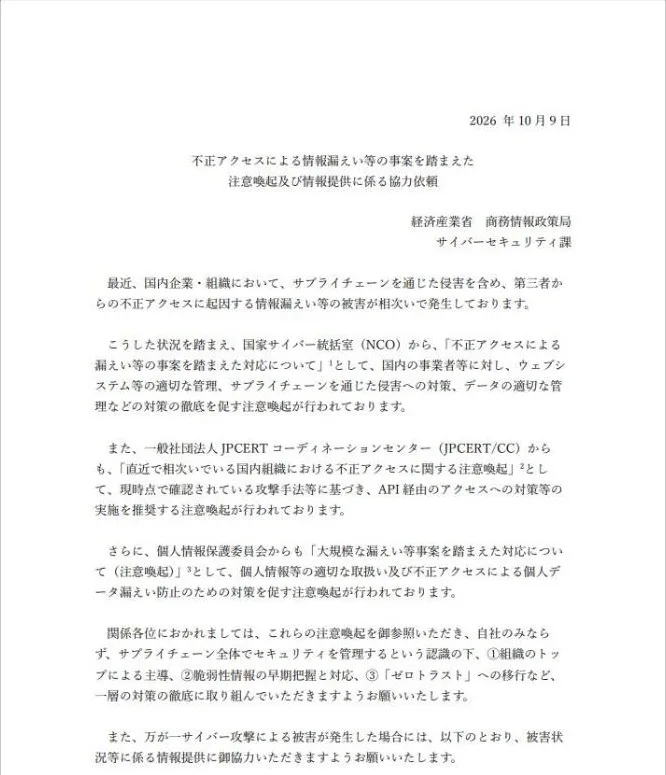
What did METI ask companies to do?
METI asked companies to manage security across their whole supply chain, not just inside the company, and named three measures: leadership from the top of the organization, early action on vulnerability information and a move to "zero trust". The document, dated October 9, 2026, came from the Cybersecurity Division of METI's Commerce and Information Policy Bureau.
Here, the supply chain means the contractors, vendors and business partners a company relies on. Zero trust is a security model in which no device or network is trusted by default, even inside the company, and access is checked every time. At a press conference the same day, Minister of Economy, Trade and Industry Ryosei Akazawa described it as constantly checking every action inside internal systems.
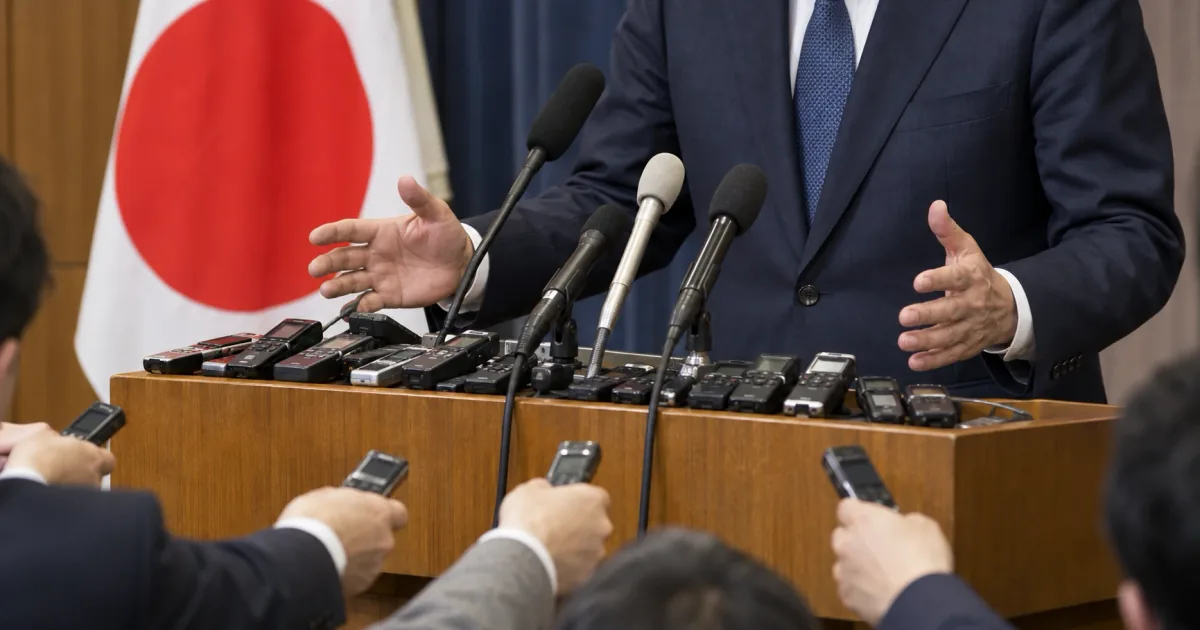
The alert goes out through about 1,000 industry groups
Akazawa told reporters on October 9 that the ministry would send the alert that day through about 1,000 industry groups it oversees. He asked the heads of companies to take responsibility for securing the people and budget needed and to lead the response themselves.
Akazawa also recalled that he had personally asked the heads of critical infrastructure operators to act in May, and said METI would keep checking on their progress. He named two kinds of information to protect: people's personal data and information that matters for Japan's economic security.
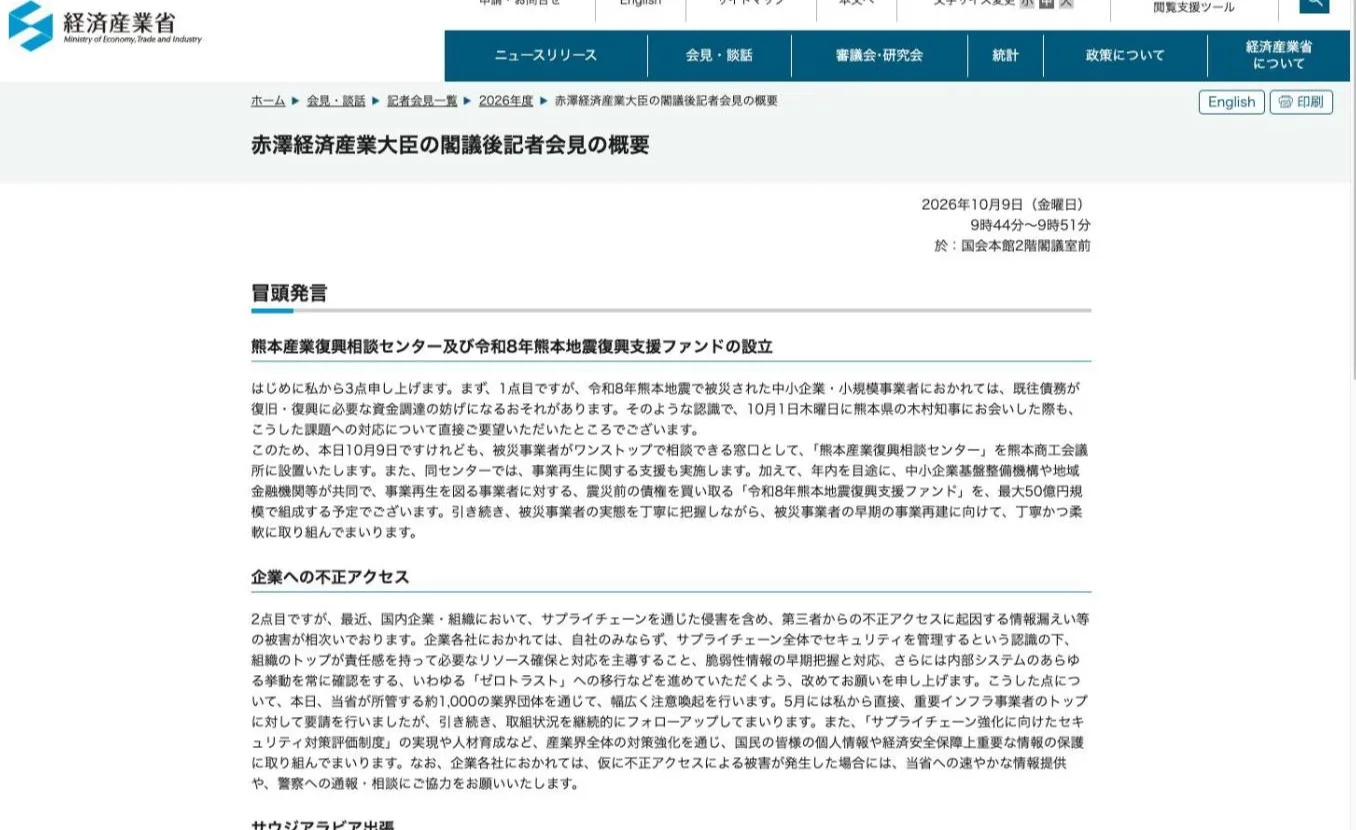
"組織のトップが責任感を持って必要なリソース確保と対応を主導すること" / "本日、当省が所管する約1,000の業界団体を通じて、幅広く注意喚起を行います。"(opening remarks, "Unauthorized access to companies")View official source →
How companies should report a cyber incident to METI
Companies in industries METI oversees should contact the METI division in charge of their industry promptly when a cyberattack, or a suspected one, causes damage. METI asks for three pieces of information, as far as the company can provide them:
- A timeline from discovery to the present, including when the incident happened and when it was found
- The damage, such as a data leak or a system outage
- The type of attack, such as ransomware, unauthorized access or DDoS
In return, METI says it can introduce specialist organizations and advise on next steps. It will not publish what a company reports without consent, though it may share the information with the National Cybersecurity Office if the company agrees. Companies that become crime victims are also encouraged to report to or consult the police.
"自社のみならず、サプライチェーン全体でセキュリティを管理するという認識の下、①組織のトップによる主導、②脆弱性情報の早期把握と対応、③「ゼロトラスト」への移行など" / "経済産業省の担当課室(業所管課室)まで、速やかに御一報ください。" / "事業者様の同意なく公表することはありません。"(main text and the section on reporting incidents)View official source →
The three alerts METI tells companies to read
METI's document asks companies to read three alerts from that week: one from the National Cybersecurity Office (NCO), one from JPCERT/CC and one from the Personal Information Protection Commission (PPC). All three came out between October 7 and 9 and respond to the same run of break-ins.
Government cyber office calls security a management issue
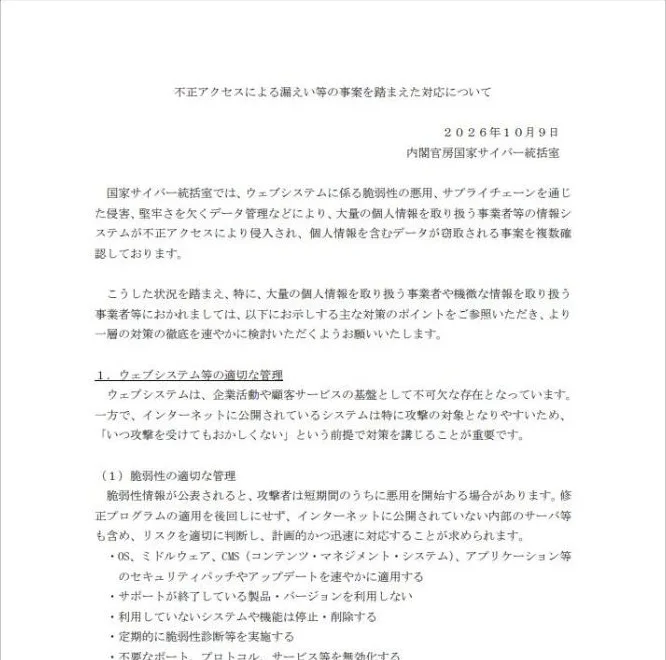
The National Cybersecurity Office, part of the Cabinet Secretariat, said on October 9 that it had confirmed several cases in which attackers broke into the systems of companies holding large amounts of personal data and stole it. It traced the cases to exploited web system vulnerabilities, intrusions through the supply chain and weak data management.
The office grouped its advice into three areas. Each one lists concrete steps, such as applying patches quickly and checking how contractors handle data:
- Proper management of web systems
- Defenses against intrusions through the supply chain
- Proper management of data
It also wrote that cyber damage is no longer a matter for the IT department alone. Executives should treat cybersecurity as a management issue and fund the investment and staffing it needs.
"サイバー攻撃による被害は、もはや情報システム部門だけの問題ではありません。" / "サイバーセキュリティ対策を経営課題と位置づけ、必要な投資や人的体制整備を含む対策の強化をお願いいたします。"(closing message to executives)View official source →
JPCERT/CC lists four attack patterns, including API abuse
JPCERT/CC, Japan's national computer emergency response team, published its alert on October 8 and said leaks of personal data from unauthorized access had piled up at Japanese organizations since around September 2026. An update on October 9 brought the number of attack patterns it describes to four:
- Probing for known software vulnerabilities
- Unauthorized operations through APIs
- Exploiting a SQL injection flaw in the BI tool Metabase (CVE-2026-72898)
- Planting web shells on application servers that can be reached from public web servers
An API is the interface that apps and systems use to exchange data. In the API cases, attackers analyzed public smartphone apps to find API endpoints and keys, then sent requests to internal APIs that the app's own screens never call.
JPCERT/CC recommends capping the number of API requests per unit of time. It also covers access control on every API endpoint, including ones that are not public, and tokens that carry only the permissions they need and expire.
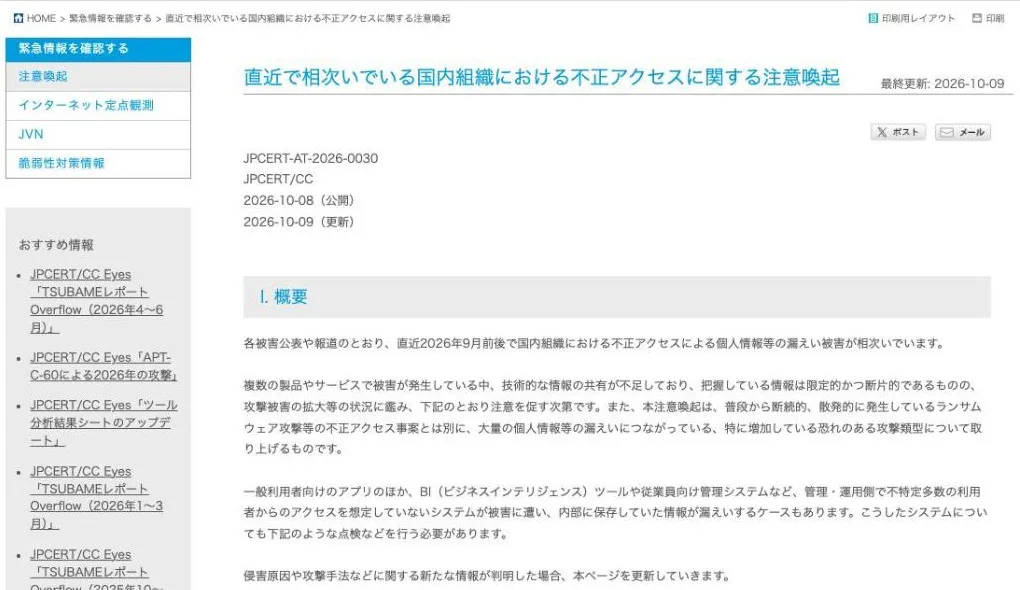
"直近2026年9月前後で国内組織における不正アクセスによる個人情報等の漏えい被害が相次いでいます。" / "APIへのアクセスには単位時間あたりのリクエスト件数を制限し、短時間に繰り返されるアクセスや大量実行を防止する"(sections I, overview, and III, countermeasures)View official source →
Privacy watchdog urges firms to delete unneeded data
The Personal Information Protection Commission, Japan's privacy regulator, issued its alert on October 7 to businesses that hold large amounts of personal data. It said it had seen cases in which outside attackers leaked, or put at risk, large volumes of such data.
The alert previews technical security measures from a planned revision of the "examples of methods" in the annex to its General Rules guidelines, which is due to be finalized in April 2027. The commission also reminded businesses to delete personal data they no longer need. In some cases, it said, old data that should have been deleted made a leak larger.
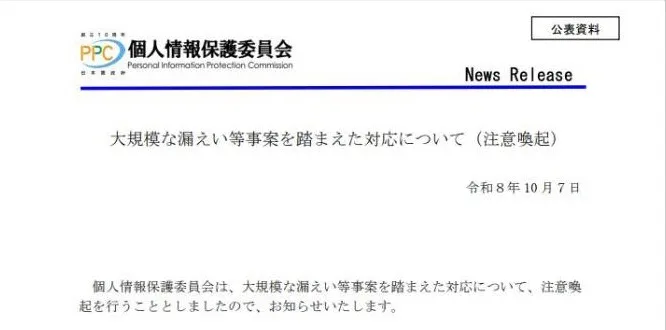
"保管している個人データの必要性についてその法令等の根拠とともに確認を適切に行うことを含めて、改めて注意喚起します。"(section 3, deleting personal data no longer needed)View official source →
Four breaches disclosed from October 6 to 9
In the four days up to and including the day of METI's alert, at least four large breaches were disclosed in Japan. These are the ones SOKUFU has covered so far:
Breaches disclosed October 6–9, 2026 (based on each company's disclosure)
| Date | Company | What happened | Records |
|---|---|---|---|
| Oct 6 | Scala Communications | Daiwa Securities data breach: 5 firms, one vendor | Up to 713,126 in total |
| Oct 8 | Lawson | Lawson data breach exposes 2.16M Lawson ID users | About 2.16 million |
| Oct 8 | Daiichikosho | Big Echo data breach: 8.72M records may be exposed | About 8.72 million |
| Oct 9 | Adventure Inc. (Skyticket) | Skyticket data breach: 3 incidents, up to 14.64M | About 14.64 million in the largest |
Two of the four, Scala Communications and Daiichikosho, came through a vendor or contractor. Both METI's document and the NCO's document mention intrusions through the supply chain in their opening paragraphs.
Supply chain security ratings due to start in March 2027
METI says it is preparing a supply chain security rating system, called the SCS rating system, to start in March 2027. It will rate the security of companies in a supply chain against a common standard. The aim is to raise the level across the whole chain while easing the burden on both the companies that outsource work and their contractors.
The document closes with six support programs that companies can use. Three of them mention small and midsize businesses:
Support programs listed by METI (from METI's document)
| Program | What it is |
|---|---|
| SECURITY ACTION self-declaration | A first step into security |
| Cybersecurity Otasuketai service | A service to protect your company |
| Using the SCS rating system | A supply chain measure for small businesses |
| SME information security guidelines | Security guidance for small businesses |
| Registered Information Security Specialists | Experts to consult when in trouble |
| Incident response guide for SMEs | A guide for after an attack |
"委託元企業・委託先企業双方の負担を軽減しつつ、サプライチェーン全体のセキュリティ水準の底上げを図る" / "2027 年 3 月の制度開始に向け、準備を進めています。"(page 2)View official source →
FAQ
- Who does METI's October 2026 security alert apply to?
- It is aimed at companies in industries that METI oversees. Minister Ryosei Akazawa said the ministry would send it out on October 9 through about 1,000 industry groups under its jurisdiction. The request to report incidents applies to the same companies.
- What should a company tell METI after a cyberattack?
- METI asks for three things, as far as the company can provide them: a timeline from discovery to the present; the damage, such as a data leak or system outage; and the type of attack. The ministry says it will not publish the information without the company's consent.
- When does Japan's SCS supply chain security rating system start?
- METI says it is preparing the system to start in March 2027. It will rate the security of companies in a supply chain against a common standard, with the aim of easing the burden on both the companies that outsource work and their contractors.
Related articles
 Japan foreign ministry leak may hit 3,600 recordsJapan's foreign ministry says names and email addresses in about 3,600 records may have leaked, including 900 outsiders. No classified or passport data.
 Japan's data leaks hit 260 million since AprilJapan's privacy regulator says unauthorized access affected data on a cumulative 260 million people from April to mid-October, with 830 reports in October.
 GMO's Onamae.com Desktop Cloud hacked, data leakedAttackers broke into Onamae.com Desktop Cloud, GMO Internet's VPS for FX trading, stole trading logins and leaked data after GMO refused a ransom.
 Japan data breach list: cases by date and causeThis Japan data breach list sorts disclosed cases newest first. Skyticket (14.64M records) and KDDI (12.23M users) lead. See what leaked, why, and what to do.