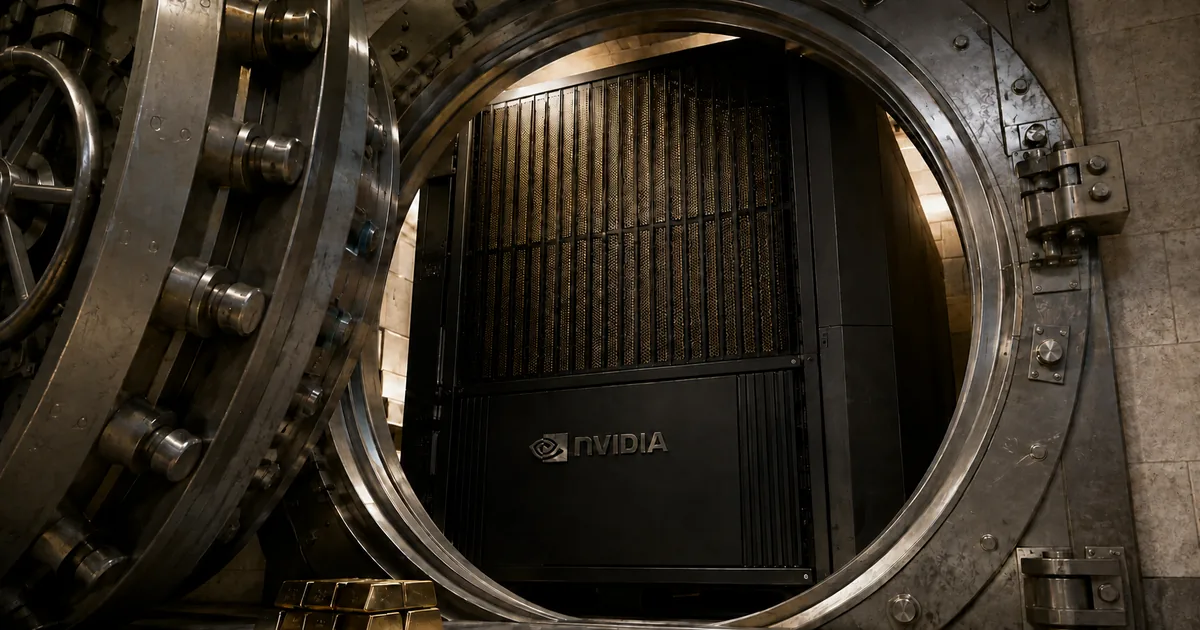
NVIDIA's $500 billion financing platforms with six partners
On August 10, 2026, NVIDIA announced strategic partnerships with six financial institutions to set up independent compute financing platforms. The platforms aim to mobilize over $500 billion of third-party capital for building AI infrastructure over time. Third-party capital means money from investors other than NVIDIA, and compute here means the processing power that AI models run on.
The release says the platforms are meant to support the AI infrastructure buildout across NVIDIA's ecosystem, including leading frontier AI labs, enterprises and AI clouds. NVIDIA says it will work with the six to create dedicated pools of capital at significant scale, offered to NVIDIA customers at attractive rates. The release does not say what those rates are.
Apollo, BlackRock and Goldman Sachs among six institutions
The release names six institutions: Apollo, BlackRock, Blackstone, Brookfield, Goldman Sachs and KKR. It gives no amount per firm. Goldman Sachs' chairman and CEO, David Solomon, refers to the firm's investment and distribution roles and to a chance to build a market for credit backed by NVIDIA compute.
Three of the other firms describe their ties to NVIDIA. BlackRock's Larry Fink says the partnership deepens BlackRock's relationship with NVIDIA, including through the AI Infrastructure Partnership. KKR's co-CEOs describe NVIDIA as a founding investor in Helix Digital Infrastructure, and Blackstone says it continues to be an enormous investor across the NVIDIA ecosystem.
Our investment and distribution roles reflect our confidence in NVIDIA’s leadership, and we’re excited for the new opportunity to create a market for credit backed by NVIDIA compute — from the comment by David Solomon, Chairman and CEO of Goldman SachsView official source →
The $500 billion is subject to final agreements
The $500 billion is a target for mobilizing capital over time, and the release does not say the money has been raised. A memorandum of understanding is a signed document that records what the parties intend to do together. It is not the final contract.
The release says memorandums of understanding have been signed with the six institutions, and the last sentence of its announcement text says the partnerships remain subject to execution of the final agreements. The forward-looking statements, a legal notice at the end of the release, list the final agreements and the terms and timing of the partnerships among the expectations that could turn out differently. So the memorandums are signed, the final agreements are not, and the release gives no terms or timing.
These partnerships remain subject to execution of the final agreements. — from the last sentence of the announcement textView official source →
Why NVIDIA calls its compute an investable asset class
NVIDIA says the new platforms make its compute and the AI infrastructure around it an investable asset class for global capital. An investable asset class is a category of assets that investors can put money into, as they do with bonds or real estate. The release's subtitle adds that the platforms widen access to AI factories (NVIDIA's term for data centers built to run AI) and create usage-linked revenue over long periods, and that they are meant to help NVIDIA's ecosystem grow through hardware sales and software adoption.
The four properties NVIDIA offers as the investment case
The release names four properties of NVIDIA compute as the investment case: the lowest token cost, the highest revenue, the longest life and a rich ecosystem of offtakers built on CUDA. A token is the unit of text an AI model reads and writes, so token cost is the price of running a model. Offtakers are the buyers who take the capacity that gets built, and CUDA is NVIDIA's software platform.
Jensen Huang, NVIDIA's founder and CEO, adds detail. He says NVIDIA compute is broadly adopted, flexible across models and workloads, and fungible and transferable across customers and operators, which means capacity built for one customer can be used by another. He says continuous improvement through CUDA software extends its useful life and improves its economics over time.
These are NVIDIA's own claims. The release gives no figures for token cost, revenue or life.
NVIDIA compute is an investable asset — one which provides the lowest token cost, highest revenue and longest life along with a rich ecosystem of offtakers built upon NVIDIA’s CUDA platform. — from the second paragraph of the announcement textView official source →
What Jensen Huang and the six firms said about compute
Huang says compute is revenue, while Apollo, Brookfield and KKR call it an asset or an essential layer of infrastructure. Goldman Sachs talks about credit. The table paraphrases each statement in the release.
| Speaker | Firm | What they said |
|---|---|---|
| Jensen Huang, founder and CEO | NVIDIA | Compute is revenue, and NVIDIA compute is suited to that role. He wants long-term capital providers to underwrite AI infrastructure independently. |
| Jim Zelter, President | Apollo | Modern compute is a scarce, mission-critical asset class. NVIDIA's ecosystem and Apollo's long-term capital are a foundation for the next stage of the AI buildout. |
| Larry Fink, Chairman and CEO | BlackRock | The partnership deepens BlackRock's relationship with NVIDIA, including through the AI Infrastructure Partnership, and connects long-term capital to essential infrastructure. |
| Jon Gray, President and COO | Blackstone | Blackstone continues to be an enormous investor across the NVIDIA ecosystem, and the announcement shows its confidence in the platform. |
| Bruce Flatt, CEO | Brookfield | NVIDIA, as a strategic partner, is enabling Brookfield to scale AI factories. Compute is becoming the essential layer of infrastructure. |
| David Solomon, Chairman and CEO | Goldman Sachs | Its investment and distribution roles reflect confidence in NVIDIA. It sees a chance to build a market for credit backed by NVIDIA compute. |
| Joe Bae and Scott Nuttall, Co-CEOs | KKR | Compute is a critical infrastructure asset, and delivery, not ambition, is the hard part. NVIDIA is a founding investor in Helix Digital Infrastructure. |
The firms speak of confidence, infrastructure and credit. None of the statements gives an amount.
In AI, compute is revenue. NVIDIA compute is uniquely suited for this role. — from the statement by Jensen Huang, founder and CEO of NVIDIAView official source →
Is NVIDIA compute financing the same as GPU financing?
The release never uses the word GPU. It speaks of compute and of dedicated pools of capital at attractive rates for NVIDIA customers, and Goldman Sachs says it sees a chance to build a market for credit backed by NVIDIA compute. The release gives no loan terms and no collateral wording, so it does not describe lending against GPUs.
What the release does state is who is meant to provide the capital. Huang says NVIDIA is bringing long-term capital providers together to underwrite AI infrastructure independently, and underwriting means taking on the financial risk of a deal. The subtitle adds that the platforms support NVIDIA's ecosystem growth across hardware sales and software adoption.
That is why we are bringing the world’s leading long-term capital providers together to independently underwrite AI infrastructure. — from the statement by Jensen Huang, founder and CEO of NVIDIAView official source →
Is circular financing or residual value in the release?
The release does not use the terms circular financing or residual value, and it gives no rate, no amount per firm and no timeline. Its only mention of guarantees is the standard legal notice that forward-looking statements are not guarantees of future performance. The term circular financing describes a supplier helping to fund its own customers' purchases, and residual value is what equipment is still worth after years of use.
For NVIDIA compute financing, the signed documents as of the August 10, 2026, release are the memorandums of understanding with the six institutions. The final agreements have not been signed, and the release gives no terms or timing for them. The $500 billion remains a target for third-party capital mobilized over time.
These forward-looking statements are not guarantees of future performance — from the NVIDIA Forward-Looking Statements sectionView official source →
FAQ
- Has $500 billion actually been committed?
- The release does not say so. It describes over $500 billion as the amount the partnerships aim to mobilize over time. Memorandums of understanding have been signed with the six institutions, and the partnerships remain subject to execution of the final agreements.
- Whose money is this?
- The release calls it third-party capital, meaning money from outside NVIDIA. NVIDIA and the six firms aim to mobilize it through platforms the release calls independent. The release gives no amount per firm and does not say where the capital will sit on anyone's books.
- Why does NVIDIA call compute an asset class?
- NVIDIA's release says its compute provides the lowest token cost, highest revenue and longest life, along with a rich ecosystem of offtakers built on CUDA. Those are NVIDIA's own claims, and the release gives no figures for them.
Related articles
 NVIDIA's $250M compute gift for UK AI agent safetyNVIDIA will give UK researchers $250M of compute over five years for AI agent safety work, not cash. Jensen Huang also previewed $2B in new European deals.
 Nvidia Hugging Face Deal Draws DOJ QuestionsThe DOJ is asking whether Nvidia's $12.93 billion Hugging Face deal would hurt AI competition, Reuters reported. Closing is due in the first half of 2027.
 NVIDIA Vera CPU Specs and Why SpaceXAI Picked ItNVIDIA Vera CPU has 88 Olympus cores and up to 1.2TB/s of bandwidth, and NVIDIA claims up to 1.8x faster task completion than x86. SpaceXAI will deploy it.
 Nvidia Price Increase: AI Servers Up More Than 15%Bloomberg reports the Nvidia price increase: AI servers up more than 15% in many cases from early 2027 on memory costs. Q3 gross margin guide: 74.0%.