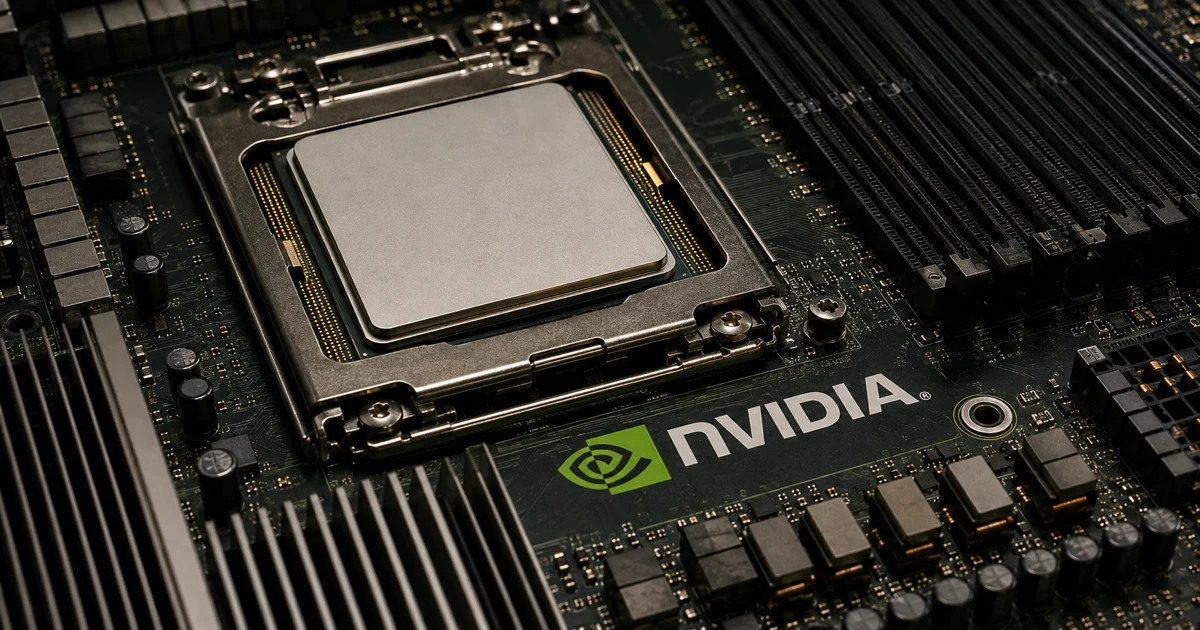
NVIDIA Vera CPU specs: 88 Olympus cores and 1.2TB/s
NVIDIA Vera CPU has 88 NVIDIA-designed Olympus cores and up to 1.2TB/s of memory bandwidth. NVIDIA designed the cores in-house, and the bandwidth comes from LPDDR5X memory. The company calls Vera the first CPU built for AI agents and says it is meant to speed up the CPU-intensive work around model inference: tool use, code execution, data processing, orchestration and simulation.
The table separates two kinds of values. The left column is what NVIDIA's release publishes. The right column is what outlets reported, taken from their headlines and headings, so each value there belongs to the outlet named beside it.
Vera CPU values: NVIDIA's release and outlet reports
| Item | NVIDIA release | Reported by outlets |
|---|---|---|
| Cores | 88 NVIDIA-designed Olympus cores | 88 cores (VideoCardz, Igor's Lab) |
| Threads | Not stated | 176 threads (VideoCardz, Igor's Lab); that is two threads per core |
| Threading | NVIDIA Spatial Multithreading | Igor's Lab contrasts it with conventional SMT; Radiant calls it physical partitioning, not time-slicing |
| Memory | High-bandwidth LPDDR5X, up to 1.2TB/s | 1.2TB/s of LPDDR5X (VideoCardz) |
| I/O | Not stated | 176 PCIe Gen 6 lanes on a dual-socket platform (VideoCardz) |
| Power | Not stated | Up to 450 W (Igor's Lab) |
| Rack | Not stated | 256 processors in the CPU rack (Radiant) |
Spatial Multithreading is NVIDIA's name for its multithreading technology. The passage quoted below names it without explaining how it works, so the contrasts in the right column are the outlets' wording.
"NVIDIA Vera is the first CPU built for AI agents, designed to accelerate the CPU-intensive work that surrounds model inference — from tool use and code execution to data processing, orchestration and simulation."/"Vera features 88 NVIDIA-designed Olympus cores, NVIDIA Spatial Multithreading technology and high-bandwidth LPDDR5X memory, delivering up to 1.2TB/s of bandwidth."(NVIDIA Vera — The CPU for Agents section)View official source →
NVIDIA Vera CPU benchmarks: 1.8x is NVIDIA’s own claim
NVIDIA says Vera enables up to 1.8x faster task completion than x86 CPUs. The claim covers workloads including agentic AI, reinforcement learning and data processing. It comes from NVIDIA's press release about its own product.
The release does not name the x86 CPU used for the comparison, and it gives no test configuration. The release also ends with a forward-looking statements disclaimer.
Other comparisons of Vera exist: the Radiant overview links to a Redpanda throughput comparison against AMD EPYC Turin, a TechPowerUp article, and an NVIDIA blog post about a Phoronix comparison. Tom's Hardware covers SPEC CPU 2026 results for Vera. We don't repeat their figures here, so the 1.8x is the only performance number on this page, and it is NVIDIA's.
"Vera enables up to 1.8x faster task completion compared with x86 CPUs across workloads including agentic AI, reinforcement learning and data processing."(NVIDIA Vera — The CPU for Agents section)View official source →
Why SpaceXAI is deploying Vera CPUs for agentic AI
SpaceXAI will use Vera for the CPU work that agents do between calls to a model. NVIDIA lists that work as orchestrating tools, executing code, processing data and running simulations.
Picture an agent that asks a model for a plan, runs the code it gets back, then loads a data file before asking again. Running that code and loading that file are the kind of work the release assigns to CPUs.
NVIDIA states the goal as helping AI agents act faster while keeping GPUs fed and busy. A SpaceXAI executive said in the release that Vera gives the company the CPU performance and memory bandwidth to run enormous amounts of orchestration, code and data processing while keeping GPUs doing what they do best.
"Agentic AI applications increasingly rely on CPUs to orchestrate tools, execute code, process data and run simulations between model calls. SpaceXAI will use Vera to accelerate these application workloads, helping AI agents act faster while keeping GPUs fed and fully utilized."/"Vera gives us the CPU performance and memory bandwidth to run enormous amounts of orchestration, code and data processing while keeping GPUs doing what they do best,"(SpaceXAI Scales AI Infrastructure section)View official source →
Scaling Grok toward gigawatts on Vera Rubin
SpaceXAI is expanding the AI infrastructure behind Grok on the NVIDIA Vera Rubin platform. NVIDIA says that as SpaceXAI expands toward gigawatts of computing capacity, Vera Rubin provides a common architecture for efficiently scaling SpaceXAI's next generation of AI factories. AI factory is NVIDIA's term for a data center built to run AI.
NVIDIA says Vera Rubin is codesigned across compute, networking and software to optimize the AI factory as a whole. The stated aims of that integrated architecture are high performance, energy efficiency at scale, and a lower cost per token (a token is the unit of text a model reads and writes).
For related coverage, see Nvidia Price Increase: AI Servers Up More Than 15% and NVIDIA Compute Financing: $500B Aim, Terms Pending. Neither article is about this announcement.
"NVIDIA Vera Rubin is codesigned across compute, networking and software to optimize the AI factory as a whole."/"As SpaceXAI expands toward gigawatts of computing capacity, Vera Rubin provides a common architecture to efficiently scale its next generation of AI factories"/"in an integrated architecture designed to deliver high performance and energy efficiency at scale while driving down cost per token."(SpaceXAI Scales AI Infrastructure section)View official source →
Starmind: a planned AI satellite on a Vera Rubin NVL72 rack
Starmind is the first-generation AI satellite that SpaceXAI plans to build on an optimized Vera Rubin NVL72 rack-scale system. NVL72 is the name of that Vera Rubin system, which fills a full server rack. NVIDIA says this extends the architecture used in AI factories on Earth into space.
SpaceXAI is developing AI computing infrastructure for orbit. NVIDIA names five constraints there that differ dramatically from those in conventional data centers: power, thermal management, bandwidth, reliability and physical integration. NVIDIA and SpaceXAI say they are working to adapt the Vera Rubin design to the requirements of orbital computing while preserving a common NVIDIA architecture and software ecosystem.
The release calls the satellite planned. Nothing in it says Starmind hardware has launched.
"SpaceXAI is developing AI computing infrastructure for orbit, where power, thermal management, bandwidth, reliability and physical integration impose dramatically different constraints from conventional data centers."/"SpaceXAI's planned first-generation Starmind AI satellite will be based on the optimized NVIDIA Vera Rubin NVL72 rack-scale system, extending the same accelerated computing architecture powering next-generation AI factories on Earth into space."/"NVIDIA and SpaceXAI are working to adapt that foundation to the requirements of orbital computing while preserving a common NVIDIA architecture and software ecosystem."(From Earth to Orbit section)View official source →
NVIDIA Vera CPU price and release date: not announced
NVIDIA has not announced a price or a release date for Vera. The August 24 release states neither. If you see a Vera price or ship date quoted elsewhere, it did not come from this announcement.
What the release does give is a named customer, SpaceXAI, along with the specifications and the 1.8x claim covered above. NVIDIA's own page for the release is the place to look for later updates.
FAQ
- What are the NVIDIA Vera CPU specs?
- Vera has 88 NVIDIA-designed Olympus cores, NVIDIA Spatial Multithreading, and high-bandwidth LPDDR5X memory rated at up to 1.2TB/s. NVIDIA also claims up to 1.8x faster task completion than x86 CPUs.
- Why does an AI agent need a special CPU?
- According to NVIDIA, agentic AI applications rely on CPUs between model calls to orchestrate tools, execute code, process data and run simulations. SpaceXAI will use Vera for that work, with the stated aim of keeping GPUs fed and fully utilized.
- What is the Starmind AI satellite?
- Starmind is SpaceXAI's planned first-generation AI satellite, built around an optimized NVIDIA Vera Rubin NVL72 rack-scale system. It is a stated plan, not hardware in orbit.
Related articles
 NVIDIA Compute Financing: $500B Aim, Terms PendingNVIDIA compute financing: six firms aim to mobilize over $500 billion of third-party capital. What the release says, and what it leaves out.
 NVIDIA's $250M compute gift for UK AI agent safetyNVIDIA will give UK researchers $250M of compute over five years for AI agent safety work, not cash. Jensen Huang also previewed $2B in new European deals.
 Nvidia Hugging Face Deal Draws DOJ QuestionsThe DOJ is asking whether Nvidia's $12.93 billion Hugging Face deal would hurt AI competition, Reuters reported. Closing is due in the first half of 2027.
 Anthropic Nscale: $45B Compute Deal ReportedAnthropic Nscale reportedly signed a $45B compute rental on Nvidia Vera Rubin chips from late 2027. See the terms, the source and what is unconfirmed.