Five GPT-4o and GPT-4.1 snapshots shut down January 14
Any production code that calls one of five dated GPT-4o or GPT-4.1 snapshots through OpenAI's API has until January 14, 2027 to move. OpenAI notified affected developers by email on October 14, 2026 and added a matching entry, dated 2026-10-14, to the Deprecations page in its API documentation.
The five model IDs and their replacement
A snapshot is a model name with a date appended, such as gpt-4o-2024-08-06, which pins your requests to one fixed version. The notice lists four models and five snapshots, and OpenAI recommends gpt-6-luna for every one of them.
Shutdown dates for the five snapshots on OpenAI's API and on Azure (OpenAI Deprecations page, Microsoft Learn)
| Snapshot ID | Family | OpenAI API | Azure OpenAI |
|---|---|---|---|
| gpt-4o-2024-08-06 | GPT-4o | Jan. 14, 2027 | Apr. 14, 2027 |
| gpt-4o-2024-11-20 | GPT-4o | Jan. 14, 2027 | Apr. 14, 2027 |
| gpt-4o-mini-2024-07-18 | GPT-4o mini | Jan. 14, 2027 | Apr. 14, 2027 |
| gpt-4.1-2025-04-14 | GPT-4.1 | Jan. 14, 2027 | Apr. 14, 2027 |
| gpt-4.1-mini-2025-04-14 | GPT-4.1 mini | Jan. 14, 2027 | Apr. 14, 2027 |
The entry does not say which snapshot the undated aliases gpt-4o and gpt-4.1 resolve to. If your code uses an alias, the dated ID is what decides the deadline.
Fine-tuned models stop on the same day
Every model you fine-tuned on top of these five snapshots shuts down with its base model on January 14. OpenAI's separate fine-tuning notice explains the rule behind it: inference on a fine-tuned model keeps working only until the underlying base model is retired.
How to check whether your app is affected
OpenAI's List models endpoint (GET /v1/models) returns a shutdown_date field for each model you can access. The field holds a YYYY-MM-DD date once a shutdown has been announced and null otherwise, and the Retrieve a model endpoint returns the same field for a single model.
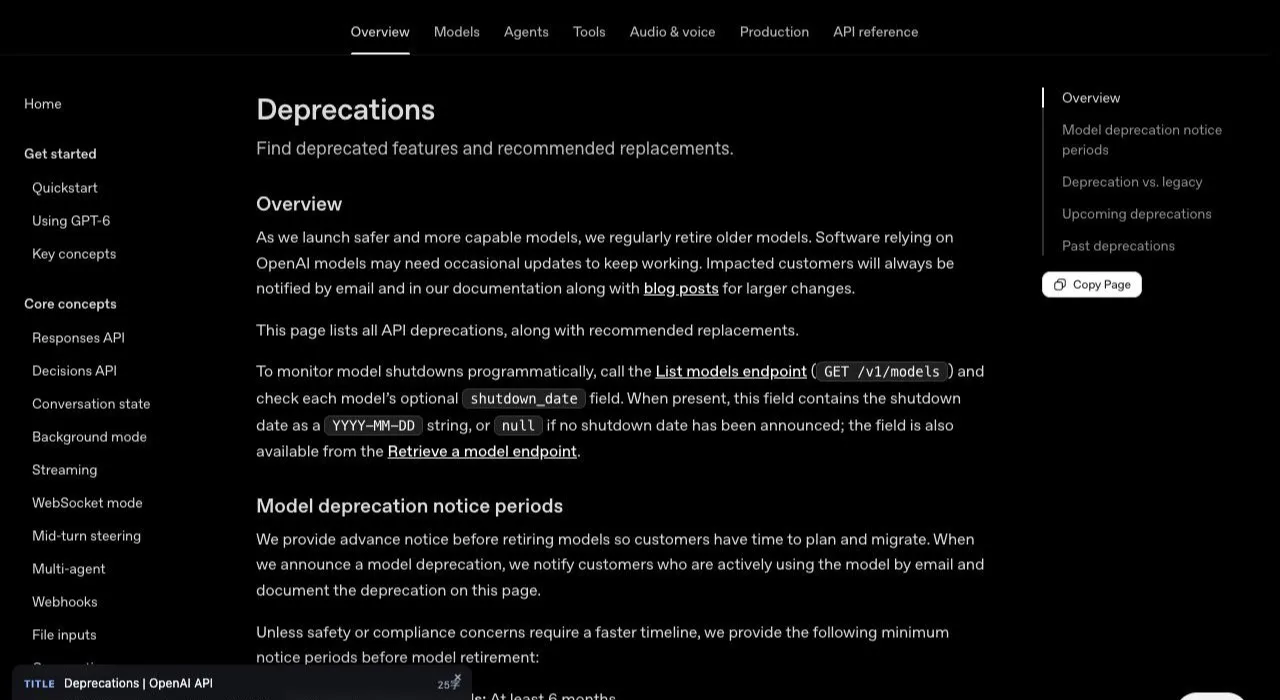
"Fine-tuned versions of these models follow the same shutdown schedule as their underlying base models." — from "2026-10-14: GPT-4 series model deprecations"View official source →
OpenAI gave three months' notice instead of six
The October 14 notice came 92 days, roughly three months, before the January 14 shutdown. The same Deprecations page sets out longer minimums for models like these.
What the deprecation policy promises
OpenAI lists three notice tiers, each of which applies unless safety or compliance concerns force a faster timeline. Which tier applies depends on what kind of model is being retired.
- Generally available models: at least six months
- Specialized variants such as chat, Codex and deep research models: at least three months
- Preview models: possibly much shorter, such as two weeks
When safety or compliance does require an earlier retirement, OpenAI says it will give as much notice as it reasonably can. None of the five snapshots in the October 14 notice is a preview model or a chat, Codex or deep research variant.
The October 14 entry gives no reason
The GPT-4 series entry does not explain why these snapshots get three months, and it does not cite the safety or compliance exception. By comparison, the October 1 entry for the text-to-speech models states its own notice period of at least three months. Developers planning a migration have only the dates to work with.
GPT-6 Luna costs far less per token than GPT-4o
OpenAI describes gpt-6-luna as its most efficient model for focused, high-volume tasks, and its per-token price undercuts every model it replaces. Luna accepts text and image input, returns text, and offers a 1,050,000-token context window with up to 128,000 output tokens. How Luna fits alongside the other GPT-6 models is covered in GPT-6 in ChatGPT: release dates and Intelligent UI.
Per-token prices side by side
On Standard pricing, Luna's $0.10 input rate is 25 times lower than GPT-4o's and 20 times lower than GPT-4.1's. The table uses OpenAI's pricing page and model pages.
Standard price per million tokens (OpenAI pricing page and model pages)
| Model | Input | Output |
|---|---|---|
| GPT-4o | $2.50 | $10.00 |
| GPT-4o mini | $0.15 | $0.60 |
| GPT-4.1 | $2.00 | $8.00 |
| GPT-4.1 mini | $0.40 | $1.60 |
| GPT-6 Luna (replacement) | $0.10 | $0.50 |
On output, Luna is 20 times cheaper than GPT-4o and 16 times cheaper than GPT-4.1. GPT-4o mini users see the smallest change, from $0.15 to $0.10 on input and from $0.60 to $0.50 on output.
Why the per-token price is not the whole bill
Luna supports reasoning tokens, so the number of tokens a request uses depends on the reasoning effort you set, not just on the prompt. A workload that cost a known amount on GPT-4o can use a different number of tokens on Luna.
The model page adds two pricing rules worth knowing. Prompts above 272K input tokens are billed at twice the input rate and 1.5 times the output rate for the whole request, while Batch and Flex processing cost half the Standard rate.
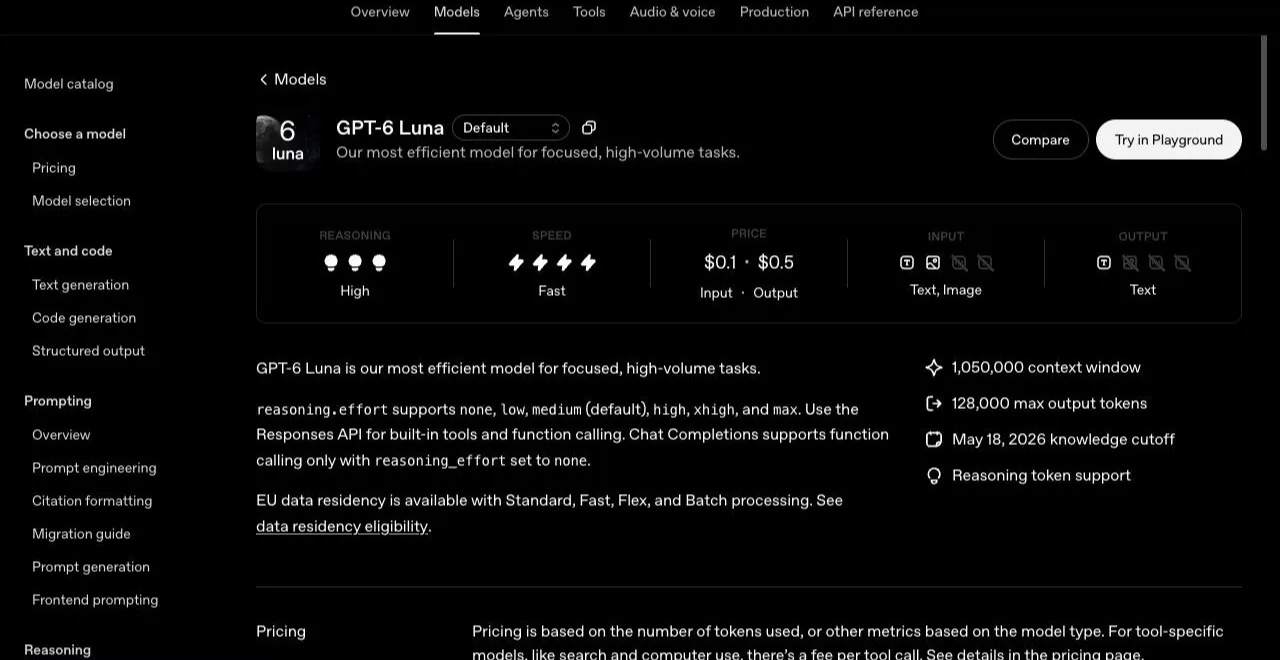
"GPT-6 Luna is our most efficient model for focused, high-volume tasks." — from the model overviewView official source →
Switching to gpt-6-luna takes more than a model ID swap
Luna is a reasoning model, and several of its defaults differ from those of the models it replaces. OpenAI's Using GPT-6 guide lists what to check after you change the model name, and four of those checks matter for this migration.
Set reasoning effort on purpose
If you only change the model name, Luna runs at medium reasoning effort, its default. It accepts six values from none to max, set with reasoning.effort in the Responses API or reasoning_effort in Chat Completions. The guide asks you to keep your current effective effort where the new model supports it, and Luna does support none.
Remove sampling parameters unless effort is none
Requests that run Luna at any effort above none have to drop temperature, top_p and top_logprobs. In Chat Completions you also remove logprobs, and in the Responses API you remove message.output_text.logprobs from the include list. Requests that pass these parameters with effort above none are the ones to find first.
Tool calls with reasoning need the Responses API
Chat Completions lets Luna call functions only when reasoning_effort is none. To reason and call tools in the same request, or to use built-in tools such as web search and file search, you need the Responses API. A Chat Completions integration that relies on function calling therefore has two options: run at none, or migrate to Responses.
Luna has no fine-tuning endpoint
The Luna model page lists the fine-tuning endpoint as not supported, along with embeddings, realtime and audio endpoints. Luna works only through Chat Completions, Responses and Batch, so a fine-tuned GPT-4o or GPT-4.1 cannot be recreated on it.
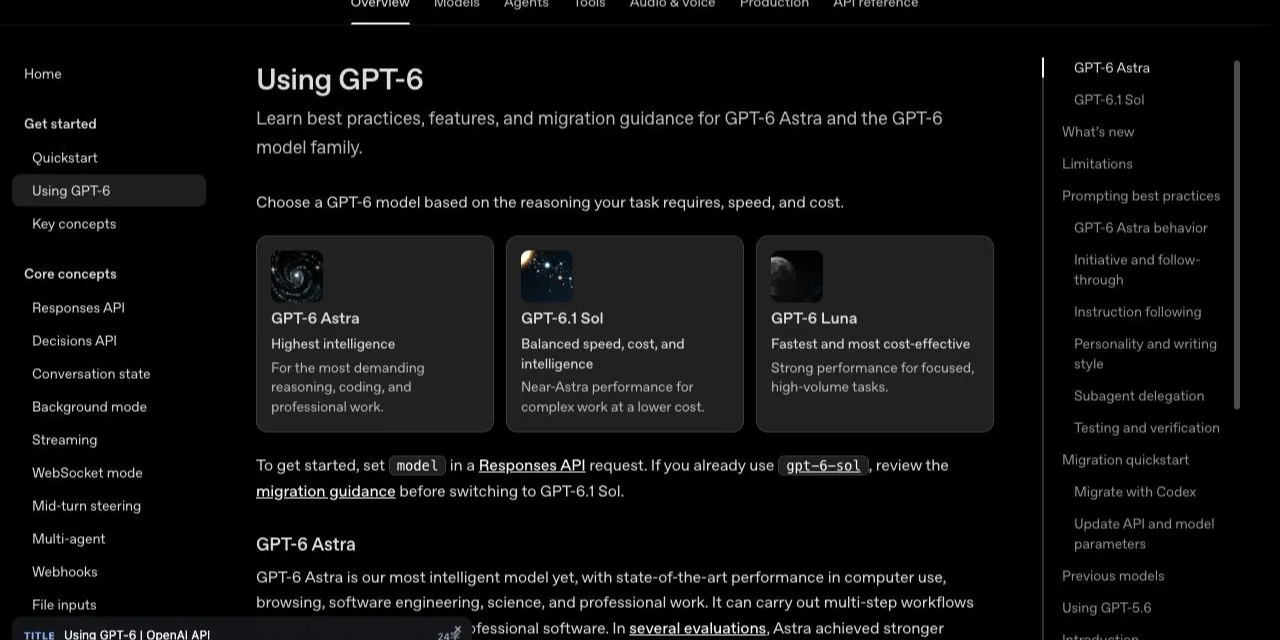
"When reasoning effort is notView official source →none, removetemperature,top_p, andtop_logprobs." — from "Update API and model parameters"
Other GPT-4o deadlines between October and April
January 14 is not the only GPT-4o date on OpenAI's calendar, and two of the others come sooner. Each comes from a separate Deprecations entry with its own replacement.
October 23: GPT-4.1 nano and the May 2024 GPT-4o
gpt-4.1-nano and gpt-4o-2024-05-13 shut down on October 23, 2026, under an April 22 notice. Their replacements differ from the January list: gpt-4.1-nano moves to gpt-5.6-luna and gpt-4o-2024-05-13 moves to gpt-5.6-sol. Fine-tuned GPT-4.1 nano models stop on the same day.
January and February: audio, realtime and transcription
The GPT-4o voice and transcription models follow three other dates. None of them is part of the October 14 entry.
- January 6, 2027: gpt-4o-mini-tts snapshots are removed, with gpt-realtime-2.1-mini as the replacement. New fine-tuning jobs also end that day
- January 20, 2027: gpt-4o-audio and gpt-4o-mini-audio move to gpt-audio-1.5, gpt-4o-realtime to gpt-realtime-2.1 and gpt-4o-mini-realtime to gpt-realtime-2.1-mini
- February 26, 2027: gpt-4o-transcribe, gpt-4o-mini-transcribe and gpt-4o-transcribe-diarize are removed, with gpt-live-transcribe or gpt-transcribe as replacements
Azure OpenAI keeps the five snapshots until April 14
Microsoft's model retirement schedule, last updated September 23, 2026, lists April 14, 2027 for the same five snapshots on Azure. On Azure, a fine-tuned gpt-4o or gpt-4o-mini deployment keeps serving until October 1, 2027, and a fine-tuned gpt-4.1 or gpt-4.1-mini deployment until October 14, 2027.
"October 23, 2026 gpt-4.1-nano | gpt-4.1-nano-2025-04-14 gpt-5.6-luna" — from the "2026-04-22: Legacy GPT model snapshots" tableView official source →
Fine-tuned and mixed GPT-4 workloads have the least room
Putting the dates and Luna's limits together shows where the 92 days are tightest. Each point combines facts from at least two of the sections above.
- Fine-tuned GPT-4o and GPT-4.1 models stop on January 14, Luna cannot be fine-tuned, and new fine-tuning jobs end on January 6. Inside OpenAI's API there is no listed path that keeps a fine-tuned GPT-4o model running past January 14; outside it, Microsoft's schedule keeps existing fine-tuned deployments on Azure serving until October 2027
- An app that also calls gpt-4.1-nano or gpt-4o-2024-05-13 meets its first deadline on October 23, not on January 14
- The 25-fold input saving applies cleanly only at reasoning effort none. At the medium default, reasoning tokens change how many tokens each request uses, so the bill has to be measured rather than calculated from the price table
FAQ
- Will my GPT-4o API calls stop working on January 14, 2027?
- They will if your code names gpt-4o-2024-08-06 or gpt-4o-2024-11-20. Both snapshots leave the API on January 14, 2027. The older gpt-4o-2024-05-13 is on a separate list and stops earlier, on October 23, 2026, with gpt-5.6-sol as its replacement.
- Does the GPT-4o API shutdown affect ChatGPT?
- The October 14 notice is an API deprecation. OpenAI's Deprecations page describes itself as a list of API deprecations, and the entry says nothing about ChatGPT, so it does not tell you anything about which models ChatGPT offers.
- Can I fine-tune GPT-6 Luna?
- No. The Luna model page marks the fine-tuning endpoint as not supported. Separately, OpenAI's self-serve fine-tuning notice says existing customers can no longer create new fine-tuning jobs from January 6, 2027, although inference on fine-tuned models runs until the base model is retired.
- When does Azure OpenAI retire GPT-4o?
- Microsoft's retirement schedule lists April 14, 2027 for the same five snapshots, three months after OpenAI's own date. Fine-tuned deployments last longer on Azure: October 1, 2027 for gpt-4o and gpt-4o-mini, and October 14, 2027 for gpt-4.1 and gpt-4.1-mini.
Related articles
 OpenAI, ServiceNow expand deal with ChatGPT pluginOpenAI and ServiceNow expanded their deal on Oct 28, 2026. A ServiceNow MCP plugin for ChatGPT is live now; Codex, security and voice tools follow in 2027.
 ChatGPT and Codex usage limits merge in DecemberFrom December, Plus, Pro and Business plans will share one token-based allowance across ChatGPT and Codex. Instant chat won't count, and no start date is set.
 ChatGPT now works with iCloud Mail and CalendarOpenAI added iCloud Mail and Calendar plugins to ChatGPT on Oct 27 for all plans. You connect with an Apple app-specific password that outlives a disconnect.
 ChatGPT limits weapons information for teensOpenAI said on Oct 30, 2026 that ChatGPT will limit weapons information for teens, end chats fixated on violence, and report on safety every six months.