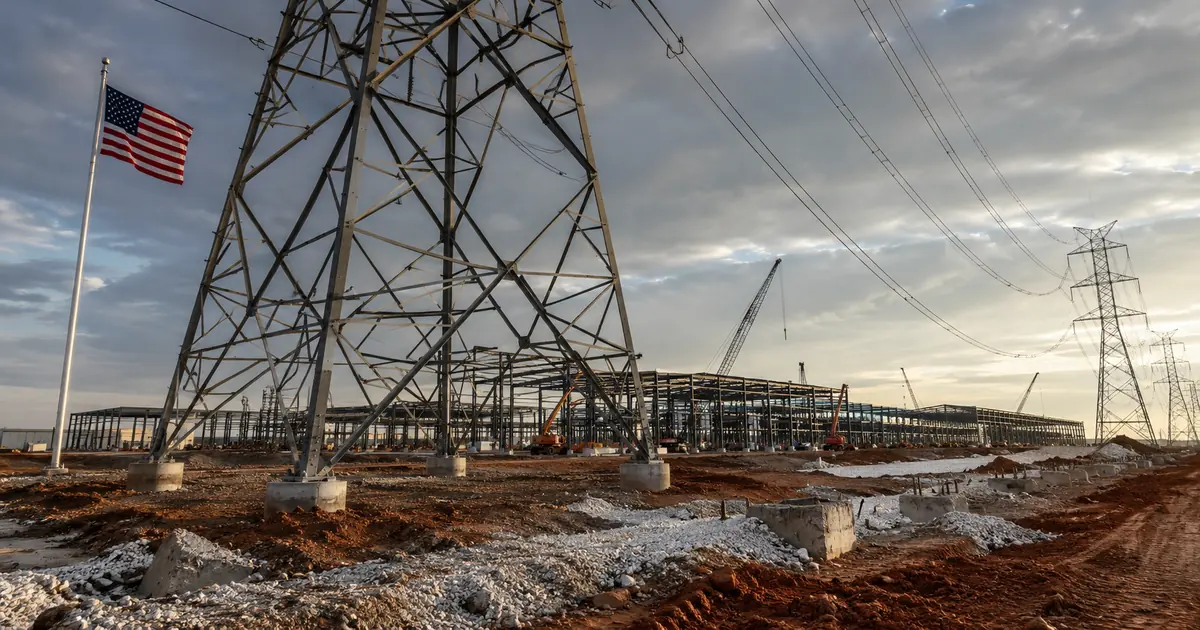
Who builds, funds and leases the Pike County data center
NVIDIA secures the land, power, and shell; SB Energy builds, owns, and operates the data center; and OpenAI is the customer. NVIDIA and OpenAI each announced the Pike County, Ohio, data center on August 17, 2026. The lease to OpenAI runs 20 years, and NVIDIA is the exclusive AI compute provider, so the campus hosts only NVIDIA AI compute.
Land, power, and shell (LPS) covers the site, its electricity supply, and the building around the computers. NVIDIA's release says it secured that capacity through a partnership with SB Energy.
The PORTS-Pike Technology Campus sits on private and federal land around the decommissioned Portsmouth Gaseous Diffusion Plant, so the Portsmouth data center site and the Pike County campus are the same place. AEP Ohio, the U.S. Department of Energy, and the U.S. Department of Commerce are development partners. SB Energy is the developer. Each claim below names NVIDIA or OpenAI as its source.
"NVIDIA announced that it has secured land, power and shell (LPS) capacity through a partnership with SB Energy at the PORTS-Pike Technology Campus in Pike County, Ohio, to host NVIDIA compute. OpenAI will be the customer. SB Energy will build, own and operate the data center under a 20-year lease to OpenAI."(roles and lease)/"Spanning private and federal land, the campus is being developed in collaboration with AEP Ohio, the U.S. Department of Energy and the U.S. Department of Commerce."(development partners)— from NVIDIA's press releaseView official source →
Initial 4.25 IT-GW, with an option on 3.75 more
The first deployment is designed for 4.25 IT-GW, and NVIDIA holds an option on the remaining 3.75 IT-GW, for 8 IT-GW in total. NVIDIA's release counts the capacity of the AI factory, its term for the data center, in IT-GW, while OpenAI says it secured about 8 gigawatts-IT. Both units measure the power that goes to the computing equipment itself.
NVIDIA's release also says it can expand beyond the initial capacity at PORTS-Pike. SB Energy and SoftBank will build at least 10 gigawatts of new energy generation, which NVIDIA says results in 8 IT-GW of AI factory capacity.
The AI factory will use NVIDIA's full-stack DSX AI factory platform, which the release describes as GPUs, CPUs, and networking together. The initial deployment is designed to support 4.25 IT-GW on that platform.
"The AI factory will use NVIDIA’s full-stack DSX AI factory platform, including GPUs, CPUs and networking. The initial deployment is designed to support 4.25 IT-GW of AI factory capacity. NVIDIA has the option to extend the opportunity at PORTS-Pike beyond the initial capacity."(platform and initial capacity)/"OpenAI will be the customer for 8-IT GW."(news summary)/"SB Energy and SoftBank will build at least 10 gigawatts of new energy generation, which results in 8 IT-GW of AI factory capacity"(generation behind the capacity)— from NVIDIA's press releaseView official source →
"OpenAI has entered into an agreement to secure approximately 8 gigawatts-IT at the PORTS-Pike Technology Campus in Pike County, Ohio, working with SB Energy, NVIDIA, and the U.S. Department of Energy."— from OpenAI's announcementView official source →
What NVIDIA's credit covers and what is only reported
NVIDIA's release says it provides credit support on the land, power, and shell buildout for the first 4.25 IT-GW, and it names no dollar figure. The figure of up to $105 billion seen in coverage comes from UPI, which reported financing of that amount, with the credit funding the first 4.25 gigawatts. Neither the NVIDIA release nor the OpenAI post contains that number, so it remains a reported figure.
NVIDIA will also invest $1.5 billion in SB Energy, joining existing investors SoftBank Group and OpenAI. That is a stake in the developer, and the credit support is a separate commitment on the buildout. OpenAI describes its own side this way: it will begin paying only as completed capacity becomes available for lease, and it will fund those commitments from revenue, cash flow, and capital raised from investors.
"NVIDIA to provide credit support on land, power and shell buildout to secure initial 4.25 IT-GW, with an option to take the remaining 3.75 IT-GW."(news summary)/"NVIDIA will invest $1.5 billion in SB Energy, joining existing investors SoftBank Group and OpenAI."— from NVIDIA's press releaseView official source →
"OpenAI will begin paying only as completed capacity becomes available for lease and will fund those commitments through revenue and cash flow from the significant growth of our business and capital raised from investors. Separately, NVIDIA will invest $1.5 billion in SB Energy and will provide credit support for the land, power, and shell buildout associated with the initial 4.25 IT-GW."— from OpenAI's announcementView official source →
"Nvidia announced on Monday that it will finance an OpenAI data center in Ohio for up to $105 billion."(the reported figure)/"The credit from Nvidia will fund the data center's first 4.25 gigawatts in computing capacity with an option to bring 3.75 gigawatts more online."(what the credit covers)— from UPIView official source →
First 800 MW due in 2028, pending permits and financing
The first 800 megawatts are expected to become available in 2028, largely on existing AEP infrastructure. Everything after that needs new power plants connected to the grid, including natural gas generation, and new transmission lines. OpenAI states that development depends on the necessary infrastructure, permits, environmental reviews, and financing being in place.
NVIDIA says the planned capacity will come online in phases beginning in 2028. OpenAI adds that the full data center will not be built all at once. SB Energy is developing it across private land and cleaned-up land that the Department of Energy controls at the former Portsmouth plant.
The 2028 date therefore covers only the first phase. Later phases need the new power plants and transmission lines described above.
"The first 800 megawatts are expected to become available in 2028 largely using existing AEP infrastructure. Further development will require new power plants connected to the grid, including natural gas generation, as well as new transmission lines and associated infrastructure."/"There is significant work ahead, and the full data center will not be built all at once."/"Development will depend on the necessary infrastructure, permits, environmental reviews, and financing being in place."— from OpenAI's announcementView official source →
"The planned capacity is expected to come online in phases beginning in 2028."— from NVIDIA's press releaseView official source →
Who pays for the grid upgrades and new transmission lines
OpenAI says SB Energy pays the full cost of the grid upgrades and new transmission lines needed to serve the data center. It adds that those costs will not be shifted to Ohio or other ratepayers in the region. Ratepayers are the customers whose electric bills fund the utility.
NVIDIA describes a second commitment. SB Energy and SoftBank will invest at least $4.2 billion in new regional grid infrastructure through a partnership with AEP Ohio. NVIDIA says the partnership is designed to protect ratepayers, and its release lists the investment together with the 10 gigawatts of new generation described earlier.
Both statements are the companies' own promises. Neither the NVIDIA release nor the OpenAI post says who checks them.
"SB Energy will pay the full cost of the grid upgrades and new transmission lines needed to serve the data center. Those costs will not be shifted to Ohio or other ratepayers in the region."— from OpenAI's announcementView official source →
"In support of the surrounding Ohio community, SB Energy and SoftBank will build at least 10 gigawatts of new energy generation, which results in 8 IT-GW of AI factory capacity, and invest at least $4.2 billion in new regional grid infrastructure through an innovative partnership with AEP Ohio designed to protect ratepayers."— from NVIDIA's press releaseView official source →
Closed-loop cooling and water use at the site
OpenAI says the data center will use closed-loop, air-cooled systems that recirculate water, instead of cooling towers that continuously consume it. Once the cooling system is filled, ongoing water use is expected to be comparable to an office building supporting a similar number of people.
OpenAI says the data center will use significantly less water than the former Portsmouth gaseous diffusion plant used. PORTS-Pike is working with the Department of Energy to use its existing onsite water system, and OpenAI will fund new water infrastructure with and for local communities.
The post gives no water volume, only the office-building comparison. OpenAI says it will publicly report the expected water use once the site design is final.
"The data center will use closed-loop, air-cooled cooling systems that recirculate water rather than relying on cooling towers that continuously consume water for cooling."/"Once the data center cooling system is filled, ongoing water use is expected to be comparable to an office building supporting a similar number of people, including sinks and restrooms, equipment washdown and maintenance, and landscaping."/"PORTS-Pike is working with the Department of Energy to leverage their existing onsite water system. We will also fund new water infrastructure in partnership with and to the benefit of local communities. Once the site design is finalized, we will publicly report the project’s expected water use."— from OpenAI's announcementView official source →
Jobs and tax revenue OpenAI projects for Ohio
OpenAI expects 35,000 construction jobs during a six-year buildout through 2032, and 2,500 long-term operating jobs. OpenAI and SB Energy say they will work to prioritize local workers, contractors, suppliers, trades, and service providers.
The PORTS-Pike campus signed a memorandum of understanding with North America's Building Trades Unions. OpenAI plans to work with the Ohio State Building and Construction Trades Council and its affiliated crafts, schools, and apprenticeship programs.
On taxes, OpenAI expects hundreds of millions of dollars in state and local tax revenue over the project's lifetime. Property tax revenue will mainly support public schools, and other state and local revenue will help fund schools, roads, public safety, emergency services, health care, and workforce development.
"The PORTS-Pike Technology Data Center is expected to create 35,000 construction jobs during its six-year buildout through 2032, along with 2,500 long-term operating jobs. OpenAI and SB Energy will work to prioritize local workers, contractors, suppliers, trades, and service providers."(jobs)/"PORTS-Pike Campus signed a Memorandum of Understanding with North America’s Building Trades Unions to commit to the project being built."(labor agreement)/"The project is expected to generate hundreds of millions of dollars in state and local tax revenue over its lifetime. Local and state property tax revenues will primarily support public schools, while other state and local tax revenues will help fund schools, roads, public safety, emergency services, health care, workforce development, and other public priorities."(tax revenue)— from OpenAI's announcementView official source →
Community money, Codex credits and public reporting
The community fund starts at $80 million, with SB Energy and OpenAI each putting in $40 million. OpenAI says residents' priorities will shape its share, naming schools, public safety, health care, utilities, workforce training, housing, veterans' services, small businesses, and support for working families. NVIDIA calls the $80 million an initial community benefits fund.
Separately, OpenAI will make up to $84 million in Codex credits available during the 2026-2027 academic year. The credits go to approximately 844,000 eligible Ohio college, community college, and technical school students aged 18 and older, each receiving $100 through a ChatGPT account. Codex is OpenAI's tool for writing software.
OpenAI counts more than $160 million in total benefits for Pike County and Ohio residents, combining its local investment and Codex credits with SB Energy's community grant. That total is OpenAI's own tally.
OpenAI's post also commits to an annual public report on local hiring, community investment, water use, and project-related energy use. Meetings with residents and officials are to shape an Ohio Community Compact.
"Building on SB Energy’s existing $40 million community agreement, OpenAI will invest an additional $40 million, and this community investment will be shaped by local residents’ priorities such as schools, public safety, health care, utilities, workforce training, housing, veterans’ services, small businesses, and support for working families."(community fund)/"OpenAI will make up to $84 million in credits for Codex available to approximately 844,000 eligible Ohio college, community college, and technical school students aged 18 and older during the 2026–2027 academic year."/"Eligible students will receive $100 in credits through their ChatGPT accounts"(Codex credits)/"Together, OpenAI’s local investment and Codex credits, along with SB Energy’s community grant, represent more than $160 million in benefits for Pike County and Ohio residents."(total)/"Each year, we will publish a report covering local hiring, community investment, water use, and project-related energy use. We will continue to meet with residents, local officials, schools, businesses, labor organizations, and community groups to help shape an Ohio Community Compact."(public reporting)— from OpenAI's announcementView official source →
"OpenAI has agreed to build on SB Energy’s originally announced $40 million community benefits fund with an incremental $40 million designed to support local priorities, including affordable energy, job creation and workforce development, and community and economic development."— from NVIDIA's press releaseView official source →
Three companies split the land, the build and the lease
NVIDIA secures the land, power, and shell, SB Energy builds and runs the site, and OpenAI leases about 8 gigawatts-IT for 20 years. NVIDIA names no amount for its credit support, so the figure of up to $105 billion remains UPI's reporting.
The first 800 MW is expected in 2028, and OpenAI ties later development to infrastructure, permits, environmental reviews, and financing. For Ohio, the stated terms are no pass-through of grid costs, closed-loop cooling, and $80 million in community funding. OpenAI's chip is covered in a separate article, OpenAI Jalapeno Chip: Inference Benchmarks 2026.
FAQ
- Who does what at PORTS-Pike?
- NVIDIA provides credit support to secure land, power, and shell capacity and supplies the compute exclusively. SB Energy builds, owns, and operates the data center. OpenAI is the customer, on a 20-year lease.
- Will local electricity customers pay for the grid work?
- Not according to OpenAI. SB Energy is to cover the full cost of the grid upgrades and new transmission lines the data center requires, and OpenAI says those costs will not be shifted to Ohio or other regional ratepayers.
- What does Ohio get in tax revenue?
- Hundreds of millions of dollars in state and local tax revenue over the project's lifetime, per OpenAI. Property tax revenue will primarily support public schools, and other state and local revenue will help fund schools, roads, public safety, emergency services, health care, and workforce development.
- How many jobs is the project expected to create?
- 35,000 construction jobs across the six-year buildout through 2032, plus 2,500 long-term operating jobs. OpenAI and SB Energy say they will work to prioritize local workers and contractors.
Related articles
 OpenAI, ServiceNow expand deal with ChatGPT pluginOpenAI and ServiceNow expanded their deal on Oct 28, 2026. A ServiceNow MCP plugin for ChatGPT is live now; Codex, security and voice tools follow in 2027.
 AI crawler training opt-out in one robots.txt ruleAI crawler training opt-out now takes one robots.txt rule. OpenAI, Google and Microsoft will honor it, Microsoft from Feb. 1, 2027. Until then, name each bot.
 ChatGPT and Codex usage limits merge in DecemberFrom December, Plus, Pro and Business plans will share one token-based allowance across ChatGPT and Codex. Instant chat won't count, and no start date is set.
 ChatGPT now works with iCloud Mail and CalendarOpenAI added iCloud Mail and Calendar plugins to ChatGPT on Oct 27 for all plans. You connect with an Apple app-specific password that outlives a disconnect.