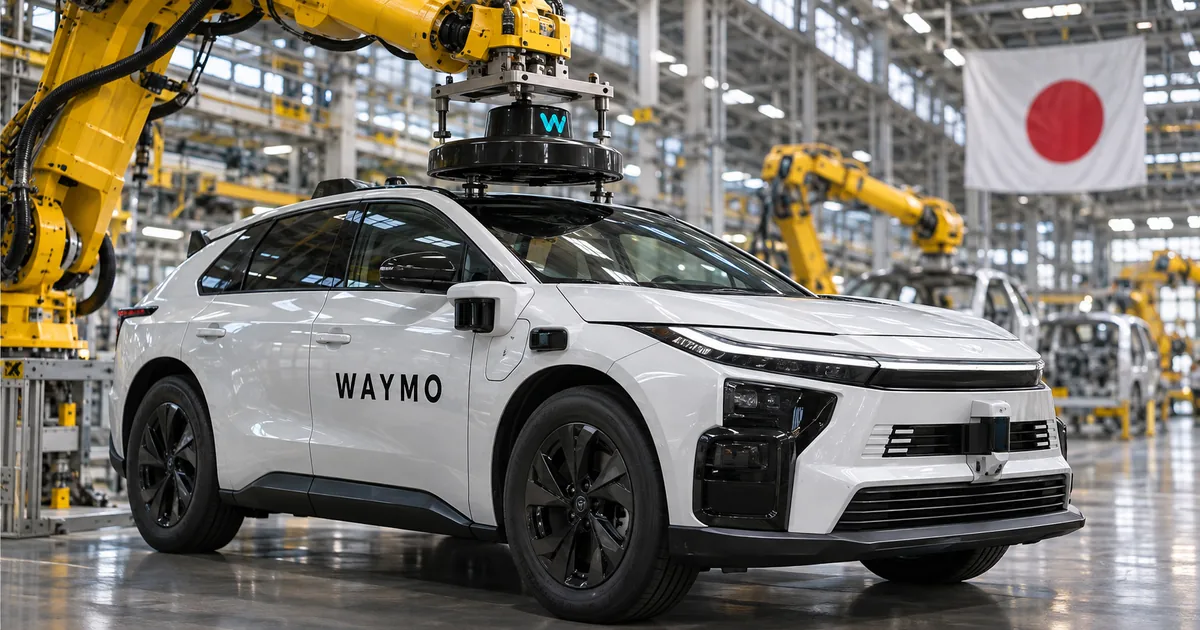
What Toyota and Waymo announced on October 30
Toyota will supply a factory-built bZ4X for Waymo's robotaxi service, and the first step is a test fleet in Japan in 2027. Toyota Motor Corporation and Waymo announced the next phase of their partnership on October 30, 2026. The move turns a preliminary agreement from April 2025 into a specific vehicle and a start date.
Both companies say they want to scale Level 4 vehicles worldwide. Level 4 means the car drives itself entirely within set conditions, such as a mapped service area, with no human driver needed.
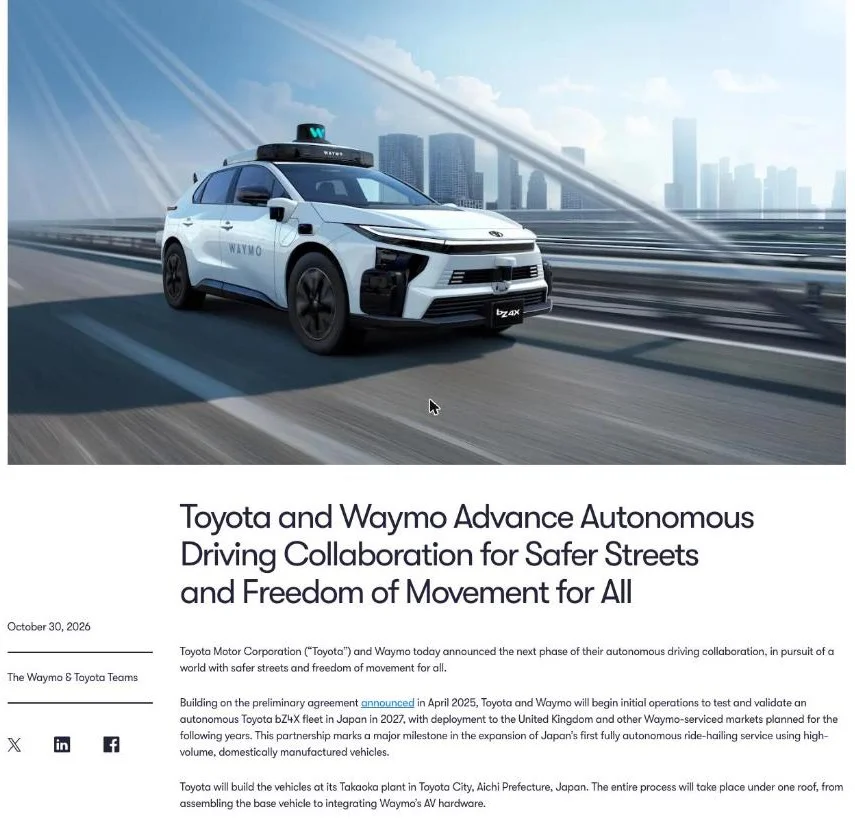
2027 is a test-and-validate phase, not a public launch
Neither company has named a city, a fleet size, a fare or a date when the public can ride. Waymo's blog post describes the 2027 work as "initial operations to test and validate" a bZ4X fleet in Japan. That wording describes a trial stage, and the post says nothing about rides for paying customers.
| Question | What the October 30 announcement says |
|---|---|
| Which car? | Toyota bZ4X, built for Waymo |
| When does work start in Japan? | 2027, with testing and validation |
| Which city, how many cars? | Not announced |
| Fares and public rides | Not announced |
Toyota's Japanese release uses the same framing. It describes the 2027 step as initial operations that include testing and validation, and it adds no service details.
"Toyota and Waymo will begin initial operations to test and validate an autonomous Toyota bZ4X fleet in Japan in 2027, with deployment to the United Kingdom and other Waymo-serviced markets planned for the following years."View official source →
The UK and other Waymo markets come later
After Japan, the bZ4X is planned for the United Kingdom and other markets where Waymo operates, with no dates given for those launches. The companies frame the deal as a way to put more Level 4 vehicles on the road, not as a Japan-only project. Waymo calls the Japan phase a major milestone toward the country's first fully autonomous ride-hailing service built on mass-produced, domestically made cars.
"By pairing Toyota’s global manufacturing and vehicle development expertise with Waymo’s fully autonomous technology, the companies will accelerate scaling safety-validated Level 4 autonomous vehicles globally"View official source →
Toyota will build the bZ4X robotaxi at its Takaoka plant
Waymo's self-driving hardware goes into the car on the same site where Toyota assembles it, in Toyota City, Aichi Prefecture. According to the announcement, the whole process happens under one roof, from building the base bZ4X to integrating Waymo's AV hardware. Toyota brings its manufacturing and vehicle development experience, and Waymo brings its fully autonomous driving technology.
Waymo also designs some of that hardware itself, including a chip that processes raw sensor data (see Waymo custom chip: 5nm ASIC for lidar and cameras). The October announcement does not say which sensors or chips the bZ4X will carry.
How the Waymo bZ4X is built
"Toyota will build the vehicles at its Takaoka plant in Toyota City, Aichi Prefecture, Japan. The entire process will take place under one roof, from assembling the base vehicle to integrating Waymo’s AV hardware."View official source →
Rear legroom, automatic doors and a power liftgate
Toyota and Waymo say the custom-outfitted bZ4X is designed for comfort and accessibility as well as safety. The rider-facing changes are generous rear legroom, automatic doors, a power liftgate and ambient lighting. The companies say these features are meant to make it easier for riders to get in and out.
| Feature | Detail |
|---|---|
| Rear seats | Generous legroom |
| Doors | Open and close automatically |
| Liftgate | Powered |
| Cabin | Ambient lighting |
"Beyond safety, the custom-outfitted bZ4X is designed for comfort and greater accessibility. Generous rear legroom and features such as automatic doors, a power liftgate, and ambient lighting will provide seamless entry and exit for riders."View official source →
Why did Waymo choose Toyota?
Waymo co-CEO Dmitri Dolgov pointed to the safety, reliability and quality of Toyota's vehicles, and also claimed Waymo is up to 20 times safer than human drivers for serious crash injuries. He said Waymo picked Toyota out of respect for those qualities. The 20x figure is Waymo's own claim and applies to the areas where it already operates.
Hiroki Nakajima, a Toyota board member and executive vice president, said safety technology makes the biggest difference when it reaches as many people as possible. He added that no single company can reach zero traffic accidents alone.
The two companies will keep exploring self-driving technology for personally owned Toyota cars. With Woven by Toyota, they also plan to study how lessons from Waymo's operations could improve safety for other road users.
"We chose Toyota because of our respect for the legendary safety, reliability, and quality of their vehicles"/"Safety technology makes the biggest difference when it reaches as many people as possible."/"No single company can achieve the goal of zero traffic accidents alone"View official source →
How the deal relates to Waymo's Tokyo plan
The Tokyo plan, announced in September with Nihon Kotsu and GO, is a separate project, and so far it has no named vehicle. GO runs a ride-hailing app (a phone app for calling a car or taxi), and Nihon Kotsu is a Tokyo taxi operator. On September 14, 2026, the two companies and Waymo said they had officially agreed to prepare an unmanned commercial service in Tokyo for 2027.
Waymo and GO first announced the Tokyo effort in December 2024. Pairing with a ride-hailing app is not new for Waymo: in the US, some cities let riders book its cars through Uber (see Waymo Uber exclusivity to end in Austin, Atlanta). At the time of the Tokyo post, Waymo operated in 15 major US cities and was providing over half a million rides a week.
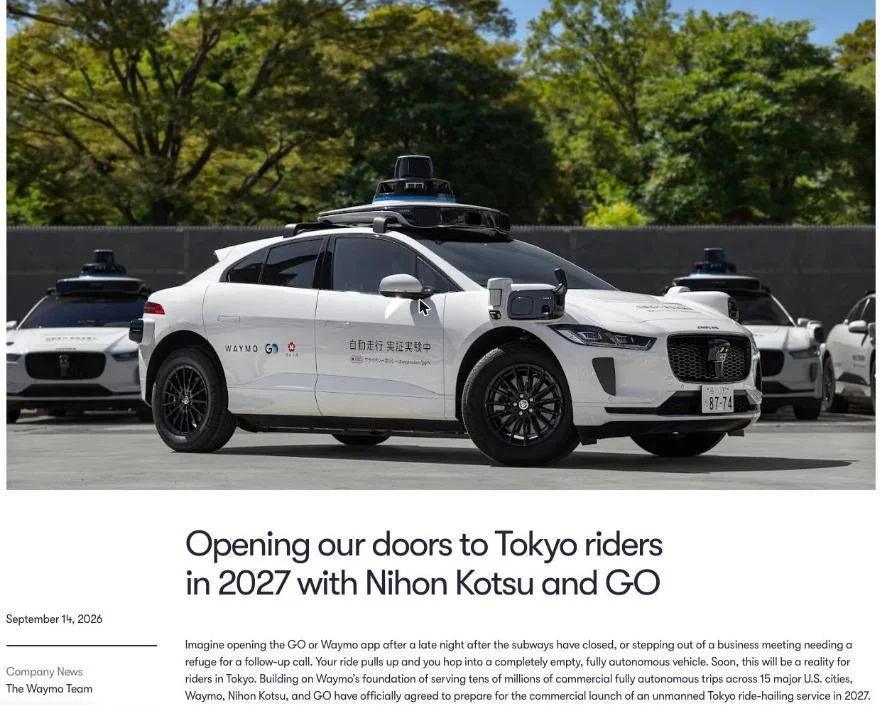
Two separate Waymo announcements about Japan
"Waymo, Nihon Kotsu, and GO have officially agreed to prepare for the commercial launch of an unmanned Tokyo ride-hailing service in 2027."/"Today, Waymo delivers over half a million trips each week"View official source →
Tokyo targets about 100 vehicles, pending approval
Riders would book through the GO or Waymo apps, but the 2027 start depends on national and local approval and on finishing validation. The service would start with a small fleet and grow to around 100 vehicles across key Tokyo neighborhoods. Since arriving in Tokyo in 2025, Waymo cars have driven autonomously for about a year with trained Nihon Kotsu crew members supervising.
| Item | September 14 announcement |
|---|---|
| How to book | GO app or Waymo app |
| Fleet | Small at first, growing to around 100 vehicles |
| Target | First fully autonomous public rides in Tokyo in 2027 |
| Conditions | National and local approval, plus completed validation |
"This timeline is contingent on securing regulatory approval from national and local authorities, as well as completing the ongoing validation of Waymo’s technology and our joint operations. The service will be accessible through both the GO and Waymo apps, launching with an initial fleet before gradually expanding to around 100 vehicles across key Tokyo neighborhoods."View official source →
Neither announcement names the car for Tokyo
Whether the Tokyo fleet will use the bZ4X is an open question, because the September post names no vehicle and the October post does not mention Tokyo. Both plans point to 2027 in Japan, but they were announced by different groups of companies on different dates.
Until Waymo says which car will run in Tokyo, it is not safe to assume the 100 Tokyo vehicles will be Toyota bZ4Xs. The October announcement covers the car and the plant only.
What is still unknown about Waymo in Japan
Waymo now has a Japanese-built car and Tokyo partners, announced separately, but riders still have no city, fare or start date to plan around. Each announcement covers what the other leaves out. The October post explains how the car will be built but not where it will run.
The September post explains where the service will run, which apps riders will use and roughly how many cars there will be, but not which car. Neither post gives a fare.
| Announcement | What it covers | What it leaves out |
|---|---|---|
| Toyota and Waymo (October 30) | Vehicle, factory, rider features | Service area, fleet size, fares |
| Waymo, Nihon Kotsu and GO (September 14) | Tokyo, booking apps, fleet target | Vehicle, fares |
Some coverage has treated the bZ4X as the car for Waymo's Tokyo launch, but neither announcement links the two plans. Until Waymo names a vehicle for Tokyo or a service area for the bZ4X, riders cannot tell when or where they will be able to take one.
FAQ
- When can the public ride Waymo's Toyota bZ4X robotaxis in Japan?
- No date has been announced. Toyota and Waymo said on October 30, 2026 that initial operations to test and validate a bZ4X fleet will begin in Japan in 2027. Neither company has named a city, a fleet size, fares or a date for public rides.
- Where will Toyota build the Waymo robotaxis?
- At Toyota's Takaoka plant in Toyota City, Aichi Prefecture, Japan. The base bZ4X is assembled and Waymo's self-driving hardware is integrated at the same plant.
- Is this the same as Waymo's Tokyo plan with Nihon Kotsu and GO?
- No. The Tokyo plan was announced separately on September 14, 2026 by Waymo, Nihon Kotsu and GO, and targets about 100 vehicles in Tokyo in 2027, pending approval. That announcement does not name a vehicle, so it is not known whether Tokyo will use the bZ4X.
Related articles
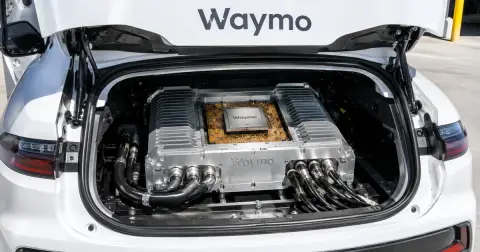 Waymo Custom Chip: 5nm ASIC for Lidar and CamerasThe Waymo custom chip is a 5nm ASIC that fuses lidar, radar and camera data ahead of the driving stack. What its 1,000 TOPS covers, and what it does not.
 Waymo Uber Exclusivity to End in Austin, AtlantaWaymo Uber exclusivity in Austin and Atlanta ends in early 2028, with a Waymo app planned. It stays on Uber at least through May; split talk is an FT report.
 Claude Fable 5.2: 20% price cut, up to 30% fasterAnthropic released Claude Fable 5.2 on November 9, 2026. API prices fall 20% to $8/$40 per million tokens, and output is up to 30% faster than Fable 5.1.
 PayPay security and passkeys in 10 Japan pay appsPayPay security compared with 9 other Japanese payment apps: passkeys, extra checks to send or pay, and fraud compensation deadlines.