Inkling Small is an open weights model from Thinking Machines Lab
Inkling Small is an open-weights multimodal model from Thinking Machines Lab, released on July 30, 2026. It takes text, images and audio as input and gives its answers as text. The company calls it an efficient model with "comparable performance to Inkling at a quarter of its size," and its own pages spell the name with a hyphen, Inkling-Small.
Size against Inkling: 276B total and 12B active parameters
Inkling Small has 276B total parameters and 12B active parameters, against 975B and 41B for Inkling, the larger model the company released earlier in July 2026. Active parameters are the part of the model that does the work for each token, the small chunk of text a model reads or writes in one step. The company's own compute estimate is built on that active count, multiplied by the number of tokens the model generates.
Inkling Small and Inkling by parameter count
The company's phrase for the gap is "a quarter of its size," and the arithmetic comes out a little higher. By total parameters Inkling Small is about 28% of Inkling, and by active parameters it is about 29%. It was trained on NVIDIA GB300 NVL72 systems and reads up to 1M tokens of context, the amount of input it can hold at once.
"Today, we are releasing Inkling-Small, an efficient open-weights model that achieves comparable performance to Inkling at a quarter of its size."/"Inkling-Small is a Mixture-of-Experts transformer with 276B total parameters, 12B active, trained on NVIDIA GB300 NVL72 systems. Like Inkling, it features native reasoning over audio and images, variable thinking effort, a context window of up to 1M tokens, and well-rounded performance across a range of benchmarks."/"975B total 41B active"/"Output TFLOPs per sample are estimated as 2 × active parameters × mean generated tokens per sample" — from the opening, the parameter comparison and the compute chart note of the release postView official source →
A mixture of experts model with image and audio input
Inkling Small is a mixture of experts model: parts of each layer are split into many small expert networks, and each token is sent to only a few of them. The model card lists 42 layers and 256 experts.
A router picks 6 of those experts for each token, and 2 shared experts run on every token on top of that. Attention, the step where the model relates each token to the others, mixes local and global layers.
Images and audio go through the same encoder-free design as Inkling, so no separate encoder model sits in front of the main model. Audio becomes dMel spectrograms, a compact map of sound frequencies over time, and images are cut into 40×40-pixel patches that a four-layer hMLP turns into model input. A light embedding layer then passes both in alongside the text tokens, and the model reads them together.
"A 42-layer decoder-only transformer with a sparse Mixture-of-Experts (MoE) feed-forward backbone: each token is routed to 6 of 256 experts, plus 2 shared experts active on every token. Attention is a hybrid of local and global layers." — from the "Architecture type" entry of the model cardView official source →
"Inkling-Small uses the same natively multimodal encoder-free architecture as Inkling. Audio is represented as dMel spectrograms, while images are divided into 40×40-pixel patches and transformed using a four-layer hMLP. Both are transformed via a light-weight embedding layer and processed jointly with text tokens." — from the "Multimodality" section of the release postView official source →
Apache 2.0 license and the acceptable use policy link
The model card gives the license as Apache 2.0 and links a separate Model Acceptable Use Policy in its intended-uses entry. The license and the policy are two different documents, so a team planning a product on the model should read both. The card says the weights are open so that developers further down the chain can research the model, fine-tune it and build it into third-party products.
The same entry describes who the model is for. It names coding assistants, chatbots, agents that use tools, and systems that look up documents before they answer, known as retrieval-augmented generation. The card adds that the model is meant for English and other languages and for work across many programming languages.
"Apache 2.0"/"Model Acceptable Use Policy"/"The model is designed to be used by developers building AI-powered applications, including agentic and tool-use systems, coding assistants, chatbots, and retrieval-augmented generation systems"/"It is intended for use in English and other languages, and across multiple coding languages."/"It is released with open weights to support research, fine-tuning and integration into third-party products by downstream developers." — from the "License" and "Intended uses" entries of the model cardView official source →
Inkling Small beats Inkling on reasoning and agentic coding
By Thinking Machines Lab's own numbers, Inkling Small scores higher than Inkling on reasoning and agentic coding benchmarks, while Inkling keeps the lead on knowledge coverage and factuality. So "beats" holds benchmark by benchmark, not across the board. The company links the gains to a later start and a changed training recipe, and it reports the scores in its tables at one fixed thinking effort.
Humanity's Last Exam at 31.6% and SWE-bench Verified above 80%
Inkling Small scores 31.6% on Humanity's Last Exam against Inkling's 29.7%, and 80.2% on SWE-bench Verified against Inkling's 77.6%. Humanity's Last Exam (HLE) is a set of hard questions written by subject experts, and SWE-bench Verified checks whether a model can fix real issues in open-source code.
That second test is run in an agentic style: in the company's bash-only harness, the model works through each task on its own with shell commands. The company adds that the HLE lead holds at every thinking budget, so Inkling Small stays above Inkling however much reasoning each model is allowed.
The table below lists six rows from the company's full table, with DeepSeek V4 Flash as a third column because the company uses it as a comparison model in its own charts. Terminal Bench 2.1 runs tasks in a command-line terminal, GPQA Diamond asks graduate-level science questions, and SciCode asks for scientific code. GDPval-AA v2 scores work tasks from many occupations and is reported as a rating rather than a percentage.
Selected scores from Thinking Machines Lab's table (effort 0.99)
| Benchmark | Inkling Small | Inkling | DeepSeek V4 Flash |
|---|---|---|---|
| Humanity's Last Exam (text only) | 31.6% | 29.7% | 32.1% |
| SWE-bench Verified | 80.2% | 77.6% | 79.0% |
| Terminal Bench 2.1 | 64.7% | 63.8% | 61.8% |
| GPQA Diamond | 89.5% | 87.2% | 89.4% |
| SciCode | 48.7% | 46.1% | 44.9% |
| GDPval-AA v2 (rating) | 1269 | 1238 | 1189 |
Inkling Small is ahead of Inkling on all six rows. DeepSeek V4 Flash, with 13B active and 284B total parameters, is close to Inkling Small in size and edges it only on HLE among these rows, 32.1% against 31.6%. That model is covered in DeepSeek V4 Flash 0731: Benchmarks and MIT License.
SWE-bench Verified in the company's table
Inkling and Inkling Small were run with a bash-only harness. DeepSeek V4 Flash's number is self-reported.

These scores come from the company's own table, which takes several of its numbers from Artificial Analysis and other outside evaluators. On SWE-bench Verified the company ran both Inkling models with a bash-only harness, a setup where the model works only through shell commands, and it used the other companies' self-reported numbers for their models.
"On Humanity’s Last Exam it scores 31.6%, ahead of Inkling’s 29.7%, and the advantage holds at every thinking budget: Inkling-Small’s test-time compute curves sit above Inkling’s throughout. On SWEBench-Verified it exceeds 80%."/"To improve consistency, we rely on externally reported evaluations for both internal and external models when applicable."/"SWEBench Verified: Inkling and Inkling-Small’s numbers are reported using a bash-only harness. We use self-reported numbers for external models." — from the "Reasoning and Agentic Tasks" and "Benchmarking Inkling-Small" sections of the release postView official source →
Model distillation from Inkling and two more weeks of coding RL
The company says Inkling Small began training after Inkling, which gave the team room to improve the training process. It gives two examples of what changed, the pre-training data mix and the machine learning recipe. An earlier checkpoint, Inkling-Small (preview), was then post-trained partly with on-policy distillation, with Inkling acting as the teacher.
Distillation trains a smaller model to imitate a larger one, and on-policy means the teacher grades answers that the student writes itself. From that checkpoint, the team kept scaling reinforcement learning (RL) on agentic coding for two more weeks, training the model by reward on coding tasks it carries out itself. The release post presents these steps together as the improvements behind the results and does not say how much each one contributed.
"Inkling-Small began training after its larger counterpart, which let us improve its training process. For example, we made changes to Inkling-Small’s pre-training data mix and machine learning recipe."/"in part using on-policy distillation with Inkling as the teacher. Starting from that checkpoint, we continued scaling agentic coding RL for two weeks." — from the "Capabilities" section of the release postView official source →
Inkling still leads on knowledge coverage and factuality
Inkling leads by a wide margin on the fact tests, with 43.9% against 20.6% on SimpleQA Verified and 2.1 against -9.0 on the AA Omniscience index. SimpleQA Verified asks short questions that each have one correct answer. The AA Omniscience index is a scale that can go below zero, and Inkling Small's score is below zero while Inkling's is just above it.
Inkling also leads on four more rows of the company's table, by smaller margins. AIME 2026 is competition math, and Global-MMLU-Lite asks knowledge questions in many languages. Tau 3 Banking tests an agent working through banking tasks, and AA Index v4.1 is a combined score from Artificial Analysis, where Inkling leads 41.0% to 40.0%.
Rows where Inkling scores higher than Inkling Small (effort 0.99)
| Benchmark | Inkling Small | Inkling | DeepSeek V4 Flash |
|---|---|---|---|
| SimpleQA Verified | 20.6% | 43.9% | 34.1% |
| AA Omniscience index | -9.0 | 2.1 | -22.9 |
| AIME 2026 | 95.5% | 97.1% | 95.8% |
| Tau 3 Banking | 15.5% | 23.7% | 22.9% |
| Global-MMLU-Lite | 86.7% | 88.7% | 88.4% |
| AA Index v4.1 | 40.0% | 41.0% | 40.0% |
SimpleQA Verified in the company's table
All three scores come from the same table at effort 0.99. DeepSeek V4 Flash also scores above Inkling Small here.
The table above marks where the company's "surpassed Inkling" claim stops: factual recall, and a few rows on math and agent tasks such as AIME 2026 and Tau 3 Banking. DeepSeek V4 Flash also scores above Inkling Small on four of these six rows, ties it on AA Index v4.1 and trails it on the AA Omniscience index.
"With these improvements, Inkling-Small surpassed Inkling on reasoning and agentic coding benchmarks. Inkling maintains an advantage on knowledge coverage and factuality." — from the "Capabilities" section of the release postView official source →
Variable thinking effort and output prices of $1.20 against $4.05
Inkling Small lets users set how much it thinks before it answers, and the output prices in the company's cost chart are $1.20 per million tokens for Inkling Small and $4.05 for Inkling. That puts Inkling Small at about 30% of Inkling's output price. The charts sweep the effort setting from minimal to xhigh, while every score in the company's tables was run at effort 0.99.
The cost chart estimates the price of one answer by multiplying the average number of generated tokens, reasoning included, by that output price. On four benchmarks (GDPval-AA v2, Tau 3 Banking, AA-Briefcase and CritPt), the company says Inkling Small at maximum effort is among the most token-efficient open-weights models.
It also says the model runs well in many coding and agent harnesses, the software that steps a model through a task and hands it tools. The company calls it a cost-efficient choice for coding and tool-use work.
"Sweeping reasoning effort from minimal to xhigh traces the performance-cost curve (dollar output price per sample) for Inkling-Small and Inkling on Terminal-Bench 2.1, HLE (no tool), and IFBench."/"Estimated output cost per sample is computed as mean generated tokens per sample × output price per token"/"Inkling output pricing is $4.05 / 1M tokens and Inkling-Small output pricing is $1.20 / 1M tokens"/"Inkling-Small is among the most efficient open weights models, marked by the dashed line."/"Inkling-Small also runs smoothly across a variety of coding and agent harnesses, making it a cost-efficient choice for coding and tool-use workflows."/"All evals run at effort 0.99 and temperature 1.0." — from the cost chart, the token-efficiency chart and the benchmarking notes of the release postView official source →
Self hosting Inkling Small takes 180 GB of VRAM with NVFP4
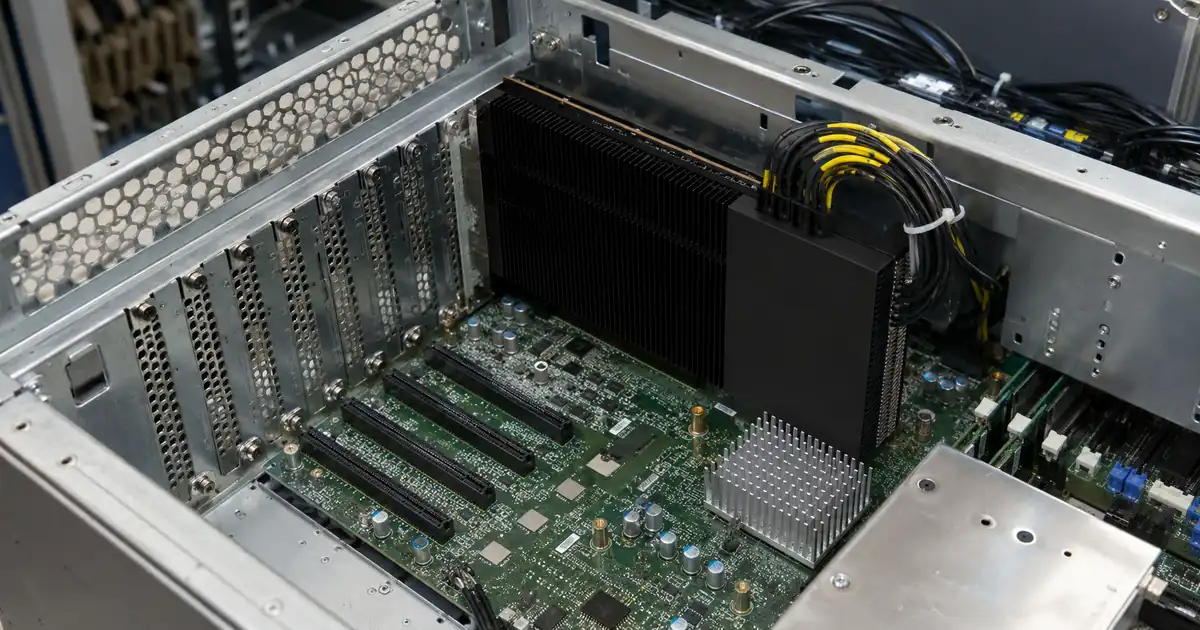
Self-hosting Inkling Small, which means running it on hardware the user controls, depends on the checkpoint, and the smallest one needs at least 180 GB of VRAM. VRAM is the memory on a graphics processor (GPU), and the model's weights have to fit in it. That is far more than a laptop or a single desktop graphics card holds, so self-hosting points to data-center GPUs, and a hosted service is the other way in.
BF16 needs 600 GB of VRAM and NVFP4 needs 180 GB
The BF16 checkpoint needs at least 600 GB of combined VRAM, and the NVFP4 checkpoint needs at least 180 GB, 30% of the BF16 figure. BF16 stores each weight as a 16-bit number, and NVFP4 is NVIDIA's 4-bit format.
Storing weights in fewer bits is called quantization, and it is how the NVFP4 build shrinks the memory it needs. The model card lists the GPU setups that meet each requirement, shown in the table.
Inkling Small checkpoints and the GPUs the model card lists
| Checkpoint | Combined VRAM | GPU setups |
|---|---|---|
| BF16 | At least 600 GB | 4x NVIDIA B300, or 8x NVIDIA H200 |
| NVFP4 | At least 180 GB | W4A4 on 1x NVIDIA B300 (needs SM100+), or W4A16 on 2x NVIDIA H200 |
W4A4 means 4-bit weights and 4-bit activations, the values the model computes as it runs, and the card says this mode also needs SM100 or newer GPU architecture. W4A16 keeps the weights at 4 bits and the activations at 16 bits, and it is the mode the card pairs with two H200s.
Software is the other half of the setup. The card lists five inference frameworks: SGLang, vLLM, TokenSpeed, Unsloth and Hugging Face.
Each one is installed with its own dependency libraries. Requests to a running inference server are usually written in JSON, and the JSON formatter below is there for working with them.
"The BF16 checkpoint requires a GPU cluster with at least 600 GB of aggregated VRAM."/"4x NVIDIA B300 GPUs"/"8x NVIDIA H200 GPUs"/"The NVFP4 checkpoint offers a quantized alternative that reduces the aggregated VRAM requirement to at least 180 GB."/"W4A4 on 1x NVIDIA B300 GPU (note: W4A4 mode additionally requires SM100+ architecture)"/"W4A16 on 2x NVIDIA H200 GPUs"/"Running the model directly on GPU hardware requires an inference deployment framework–either SGLang, vLLM, TokenSpeed, Unsloth, or Hugging Face, along with all of their respective dependency libraries." — from the "Running the open weights model on your own system" section of the model cardView official source →
Multimodal input limits: 4096px images and audio under 2 minutes
The model card recommends images between 40px and 4096px on each side and audio as 16kHz WAV files, ideally under 2 minutes long. Text goes in as UTF-8, the standard text encoding, and the output is UTF-8 text only. Any pixel-based image input is accepted, and small images are scaled up: when the long edge is under 2048 px, it is resized to 2048 px or to twice its length, whichever is smaller.
The card presents the image and audio figures as the ranges that give the best results. It gives the context window as up to 1M tokens, and for languages it lists English plus general multilingual support.
"Text: UTF-8 encoded text"/"Image: Any pixel-based image input. For optimal performance, each image dimension should be between 40px to 4096px."/"Audio: WAV format, sampled at 16kHz. For optimal performance, audio length should ideally be under 2 mins."/"Inkling-Small supports a context window of up to 1M tokens."/"For all input images whose long edge is smaller than 2048 px, we resize the long edge to the smaller of 2048 px or 2× its original length."/"English, general multilingual support" — from the "Model properties" and "General information" sections of the model cardView official source →
Download the weights from Hugging Face or use the Tinker API
The weights can be downloaded from Hugging Face, with the NVFP4 build in its own repository, and the model is also available through the company's Tinker platform. Tinker is Thinking Machines Lab's fine-tuning service, and it offers API access, so developers can call the model from their own code without running their own GPUs. For getting started, the model card points to the Tinker Cookbook and the tml-renderers package.
Inkling and Inkling Small are both on Tinker at a limited-time discount. Tinker Playground adds chat with text, image and audio input, which needs neither GPUs nor code. Third-party inference providers also offer the model through their APIs, and each provider documents its own access.
"The weights are available for download through Hugging Face here and here for NVFP4"/"Developers can also access the model using the Tinker fine-tuning platform, which provides API access."/"The model is also available via API access through third party inference providers."/"For accessing our model via Tinker, you can get started by referring to the Tinker Cookbook here"/"installing the tml-renderers package here"/"For accessing our model via third party inference providers, you can refer to the documentation from our inference provider partners." — from the "Methods of distribution" section of the model cardView official source →
"Inkling and Inkling-Small are available on Tinker with a limited-time discount and can be chatted with on the Tinker Playground using text, image, and audio." — from the "Try Inkling-Small on Tinker" section of the release postView official source →
Where Inkling Small fits, from audio scores to safety limits
Thinking Machines Lab's own tables put Inkling Small close to Inkling on image, audio and two of its three safety measures, and its model card lists limits that apply to any deployment. The figures come from Thinking Machines Lab's release post and the model card. The rows where each model scored higher are the first thing to check when picking one for a task.
Audio and chart scores against specialist multimodal models
Inkling Small nearly matches Inkling on most image and audio tests, and on Audio MC it scores 54.9%, ahead of specialist omni models such as MiMo V2.5 at 30.4% and Gemini 3.5 Flash-Lite at 33.6%. Omni models are built to take in several kinds of media, and the company compared Inkling Small with both open and closed ones. It notes that it ran the other models on Audio MC itself, because they are not on the official leaderboard.
The table below shows the two Inkling models side by side on six image and audio rows. On every row they sit within two points of each other, and Inkling Small is slightly ahead on MMMU Pro, a test of answering questions about images.
Image and audio scores in the company's tables (effort 0.99)
| Benchmark | Inkling Small | Inkling |
|---|---|---|
| MMMU Pro (Standard 10) | 74.0% | 73.5% |
| Charxiv RQ | 77.4% | 78.1% |
| Charxiv RQ with Python | 81.3% | 82.0% |
| Audio MC | 54.9% | 56.6% |
| MMAU | 77.0% | 77.2% |
| VoiceBench | 90.1% | 91.4% |
Audio MC against specialist omni models
The company ran the other models on Audio MC itself. All scores were reported at effort 0.99.
 Gemini 3.5 Flash-Lite
 MiMo V2.5
The company also improved how the model uses Python on visual tasks. While it reasons, it can crop, zoom and inspect an image through code, which helps with documents and charts where the detail that matters is small. On Charxiv, a chart-reading test, Inkling Small's score rises from 77.4% to 81.3% when Python is allowed.
"Inkling-Small nearly matches Inkling across most multimodal evaluations at a lower cost."/"The model can combine visual reasoning with operations such as cropping, zooming, and programmatic image inspection, improving usability on documents and charts where relevant information may be small or difficult to inspect directly."/"Audio and vision benchmarks against specialist omni models (open- and closed-weight), reported at effort=0.99."/"Audio MC: Other models were evaluated internally since they are not on the official leaderboard." — from the "Multimodality" section and the table notes of the release postView official source →
Safety results and the limits the model card lists
Inkling Small went through the same safety training and pre-release testing as Inkling, and it scores close to Inkling on StrongREJECT but lower on the adversarial part of FORTRESS. StrongREJECT checks whether a model refuses clearly harmful requests, and Inkling Small scores 98.4% against Inkling's 98.6%.
FORTRESS has an adversarial part and a benign part. Inkling Small refuses 71.6% of the harmful requests against Inkling's 78.0%, and it still answers 96.9% of the safe ones against 95.9%. The testing combined internal evaluations with red-teaming, where trusted outside partners try to make the model misbehave.
The model card names one remaining risk, which is that the model sometimes goes along with role-play or indirectly worded prompts about harmful topics. The card calls this consistent with any open-weight model and says moderation tools such as Llama Guard are compatible and can be layered around it. It encourages classifying both inputs and outputs as part of the deployment, especially for consumer-facing or high-traffic apps.
The card also lists general limits. The model can hallucinate and give plausible answers that are wrong, and it sometimes fails to follow instructions precisely.
It does worse in long multi-turn conversations, and its knowledge stops at its training cutoff. The card advises against medical, legal or safety-critical decisions without extra fine-tuning, domain-specific validation and human oversight.
"Inkling-Small inherited the same safety post-training recipe as Inkling"/"Inkling-Small also underwent the same pre-deployment testing process, comprising both internal evaluations and red-teaming by trusted external partners."/"FORTRESS adversarial is the rate of refusing harmful requests, benign the rate of still answering safe ones." — from the "Safety" section of the release postView official source →
"Inkling-Small’s occasional tendency to comply with role-play and indirectly framed prompts concerning harmful topics"/"Common downstream moderation tools, such as Llama Guard, are compatible with Inkling-Small and can be layered around the model to catch jailbreak attempts, filter unsafe outputs, and enforce use-case-specific policies."/"Inkling-Small may exhibit general limitations common to foundation models, including hallucination (generating plausible but factually incorrect or unsupported content), occasional failures to follow instructions precisely, and degraded performance in long multi-turn conversations."/"Inkling-Small’s knowledge is limited to information available as of its training cutoff"/"Avoid deploying Inkling-Small in domains such as medical, legal, or safety-critical decision-making without additional fine-tuning, domain-specific validation, and human oversight" — from the "Safety" and "Bias, risks and limitations" sections of the model cardView official source →
Choosing between Inkling Small and Inkling by task
The company's own split puts reasoning, agentic coding and lower cost on Inkling Small's side, and knowledge coverage and factuality on Inkling's. Work such as code changes carried out by an agent, or step-by-step problem solving, lines up with the rows where Inkling Small scored higher. Work that depends on the model recalling facts without a lookup suits Inkling, which scored higher on rows such as SimpleQA Verified.
Hardware also shapes the choice. Inkling Small's NVFP4 build is the one that runs from 180 GB of VRAM, against at least 600 GB for the BF16 checkpoint.
FAQ
- What is Inkling Small?
- Inkling Small is an open-weights multimodal model that Thinking Machines Lab released on July 30, 2026. It reads text, images and audio and replies in text. It has 276B total and 12B active parameters, and the company says it performs comparably to Inkling at a quarter of the size, although the parameter counts put it at about 28%.
- Is Inkling Small better than Inkling?
- It depends on the benchmark. In Thinking Machines Lab's table, Inkling Small scores higher on reasoning and agentic coding, for example 80.2% against 77.6% on SWE-bench Verified. Inkling stays ahead on knowledge coverage and factuality, including 43.9% against 20.6% on SimpleQA Verified.
- What hardware does Inkling Small need?
- The BF16 checkpoint needs at least 600 GB of combined GPU memory (VRAM), such as four NVIDIA B300 or eight H200 GPUs. The quantized NVFP4 checkpoint needs at least 180 GB and runs on one B300 in W4A4 mode or on two H200s in W4A16 mode. Either one also needs an inference framework such as SGLang or vLLM.
- What license does Inkling Small use?
- The model card lists Apache 2.0 and links a separate Model Acceptable Use Policy. According to the card, the weights are open so that developers can research the model, fine-tune it and build it into products of their own.
- What inputs can Inkling Small take?
- It takes text, images and audio, and it answers in text only. The model card recommends images between 40px and 4096px per side and 16kHz WAV audio, ideally under 2 minutes. The card lists a context window of up to 1M tokens.
Related articles
 LFM2.5-24B-A2B: Liquid AI's MoE for local agentsLFM2.5-24B-A2B is Liquid AI's 24B MoE with 2B active. It leads or matches Qwen3.6-35B-A3B on 5 of 8 agent tests and runs at 184 tok/s in 15 GB on an M5 Max.
 What is mixture of experts (MoE)? How it worksMixture of experts (MoE) splits an AI model into many experts and runs only a few per token. See how routing works, what active parameters mean and the catch.
 GLM 5.2 local: run 744B on a 24 GB PC, no GPUGLM 5.2 local runs on 24 GB of RAM, not the 223 GB the buying guides quote. Why Ollama only offers a cloud tag, what the requirements say, and real speed.
 Claude Fable 5.2: 20% price cut, up to 30% fasterAnthropic released Claude Fable 5.2 on November 9, 2026. API prices fall 20% to $8/$40 per million tokens, and output is up to 30% faster than Fable 5.1.