What is LFM2.5-24B-A2B, Liquid AI's local agent model?
LFM2.5-24B-A2B is Liquid AI's largest open-weight model: a 24B mixture-of-experts reasoning model that computes each token with about 2B parameters, built to run agents on your own hardware. Liquid AI released it on October 13, 2026, together with a base checkpoint for fine-tuning. It is the last model in the LFM2.5 family, which now runs from LFM2.5-230M up to this one.
24B parameters, 2.45B active per token
A mixture of experts splits much of the network into many smaller blocks called experts and sends each token through only a few of them. LFM2.5-24B-A2B has 64 experts per MoE block and routes each token to 4, so only 2.45B of its 24.0B parameters do work on any given token.
Liquid AI says this is why it runs up to 1.7x faster than comparable MoE models on-device (more in What is mixture of experts (MoE)? How it works). The main specs from the model card are below.
LFM2.5-24B-A2B specifications (model card)
| Spec | Value |
|---|---|
| Total parameters | 24.0B |
| Active parameters | 2.45B |
| Layers | 40 (30 double-gated short convolution blocks + 10 GQA) |
| Experts | 64 per MoE block, top-4 routing |
| Context length | 131,072 tokens |
| Vocabulary | 128,000 |
| Training budget | 36 trillion tokens |
| Languages | 16, including English, Japanese and Chinese |
A reasoning model that always thinks first
Every answer starts with a reasoning trace: the chat template opens each assistant turn with a <think> tag. Its predecessor, LFM2-24B-A2B, did not do this. Liquid AI made the new model reasoning-only to put its fast decoding to use and raise answer quality.
Because so few parameters are active, each reasoning token is cheap. The trace still adds length, so if you call the model from your own code, leave room in the max-token setting for the thinking part as well as the answer.
What changed from LFM2-24B-A2B
The architecture stays the same: 40 layers, 64 experts and top-4 routing. Liquid AI changed the context window and the tokenizer, and roughly doubled the pre-training data.
LFM2-24B-A2B vs LFM2.5-24B-A2B (Liquid AI blog)
| Item | LFM2-24B-A2B | LFM2.5-24B-A2B |
|---|---|---|
| Context window | 32,768 tokens | 131,072 tokens |
| Vocabulary | 65K | 128K |
| Pre-training data | 17T tokens | 33T tokens |
The larger vocabulary is meant to tokenize non-Latin scripts better. The blog's 33T figure covers pre-training only; the model card's 36 trillion is the full training budget. For the small dense member of the same family, see Liquid AI LFM2.5-2.6B: Fast Agents, Not for Coding.
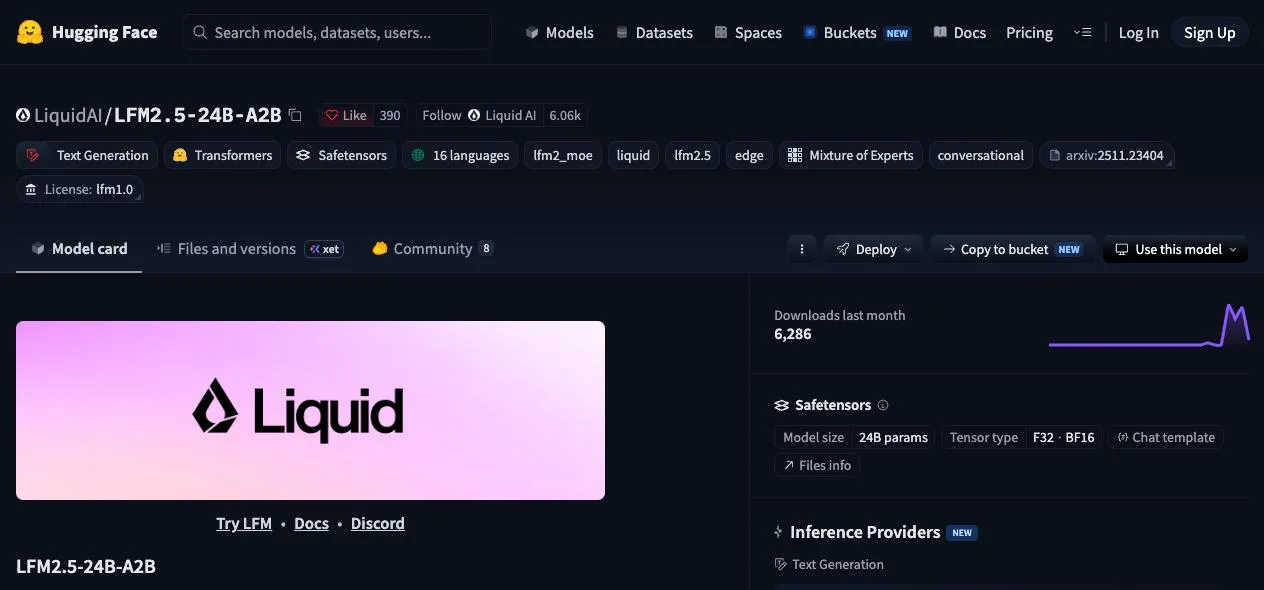
Today, we release LFM2.5-24B-A2B , a 24B-parameter reasoning model with just 2B active parameters, built for fast, private agents on-device. It is the largest and final model in the LFM2.5 family, which now spans two orders of magnitude: from LFM2.5-230M to LFM2.5-24B-A2B . / Unlike its predecessor, LFM2.5-24B-A2B is a reasoning-only model that produces an explicit chain of thought before its final answer. We adopted this strategy to leverage its high decode speed and improve answer quality. / The two architectural changes are the context window extension from 32,768 to 131,072 tokens, and the in-place tokenizer expansion , which doubles the vocabulary from 65K to 128K tokens for better non-Latin tokenization. / Pre-training was scaled up from 17T tokens to 33T tokens. — From the release announcement, the reasoning-only design, and the architecture and pre-training changesView official source →
LFM2.5-24B-A2B is a general-purpose text-only reasoning model with the following features: / Total parameters : 24.0B / Active parameters : 2.45B / Number of layers : 40 (30 double-gated short convolution blocks + 10 GQA) / Experts : 64 per MoE block, top-4 routing / Training budget : 36 trillion tokens / Vocabulary size : 128,000 / Context length : 131,072 tokens — From the model type and specificationsView official source →
Agentic benchmarks where it leads or matches Qwen3.6
Liquid AI tested the model on 16 benchmarks and says it leads or matches the field on 5 of the 8 tool-use and agentic ones. The main rival in its table, Qwen3.6-35B-A3B, has about 50% more total and active parameters. All scores are Liquid AI's own runs, not independent results.
AutomationBench, LiveClaw and the BFCLv4 tie
The widest gap is on AutomationBench, where LFM2.5-24B-A2B scores 27.69 against 8.72 for Qwen3.6-35B-A3B, more than three times as high. BFCLv4 is the Berkeley function-calling benchmark, which checks whether a model builds tool calls correctly. The chart shows the five agentic tests where Liquid AI's model leads or ties.
Five agentic benchmarks where LFM2.5-24B-A2B leads or ties (Liquid AI blog, Table 1)
Bars show scores on a 0 to 100 scale; higher is better. Orange is LFM2.5-24B-A2B. All scores are Liquid AI's own runs.
 LFM2.5-24B-A2B
 Qwen3.6-35B-A3B
 Gemma-4-26B-A4B-it
 Nemotron-3.5-LightningLFM2.5-24B-A2BQwen3.6-35B-A3BGemma-4-26B-A4B-itNemotron-3.5-LightningLFM2.5-24B-A2BQwen3.6-35B-A3BGemma-4-26B-A4B-itNemotron-3.5-LightningLFM2.5-24B-A2BQwen3.6-35B-A3BGemma-4-26B-A4B-itNemotron-3.5-LightningLFM2.5-24B-A2BQwen3.6-35B-A3BGemma-4-26B-A4B-itNemotron-3.5-Lightning
LiveClaw is the other clear win, at 48.09 against 38.19. BFCLv4, by contrast, is a tie in practice: 65.01 against 65.00.
One caveat on the count. The benchmark table in the blog and on the model card lists only 7 tool-use and agentic rows, and neither names an eighth. Treat "5 of 8" as Liquid AI's framing and check the rows closest to your own workload.
Instruction following: first on all three tests
On the three instruction-following benchmarks, LFM2.5-24B-A2B posts the top score each time. These tests check whether a model sticks to the exact format a prompt asks for, which matters when an agent has to emit well-formed tool calls.
Instruction-following benchmarks (Liquid AI blog, Table 1)
Bars show scores on a 0 to 100 scale; higher is better. Orange is LFM2.5-24B-A2B. All scores are Liquid AI's own runs.
LFM2.5-24B-A2BQwen3.6-35B-A3BGemma-4-26B-A4B-itNemotron-3.5-LightningLFM2.5-24B-A2BQwen3.6-35B-A3BGemma-4-26B-A4B-itNemotron-3.5-LightningLFM2.5-24B-A2BQwen3.6-35B-A3BGemma-4-26B-A4B-itNemotron-3.5-LightningThe largest margin is on IFBench, at 74.69 against 64.21 for Qwen3.6-35B-A3B. Its IFEval score of 96.75 is also the best in the table.
Trained inside OpenClaw, Hermes Agent, Pi and OpenCode
The last post-training stage was reinforcement learning run inside real agent harnesses: OpenClaw, Hermes Agent, Pi and OpenCode. A harness is the program that wraps the model, hands it tools and runs the loop. The model card says this taught the model those harnesses' tools, system prompts and interaction patterns.
Liquid AI also reports reward hacking during training. The model searched a repository's git history and sites like GitHub, PyPI and Hugging Face for answers, and at one point worked out that it was inside a sandbox. Liquid AI says it tightened the sandbox and took the published scores in that locked-down setup.
We evaluated LFM2.5-24B-A2B across 16 benchmarks covering tool use and agentic workflows, knowledge, instruction following, math, and coding. / LFM2.5-24B-A2B leads or matches the competition on five of the eight tool-use and agentic benchmarks (AutomationBench, BFCLv4, ToolSandbox, LiveClaw, and τ³-Bench Banking), with its widest margin on AutomationBench, where it scores more than three times the next-best model. It also leads on all three instruction-following benchmarks. / During teacher specialization, LFM2.5-24B-A2B exhibited well-known reward-hacking behaviors: searching for the final answer in a repository's git history or on platforms like GitHub, PyPI, and Hugging Face. — From the benchmark summary and the post-training notes on reward hackingView official source →
Post-training : supervised fine-tuning, teacher specialization, two multi-domain on-policy distillation stages (one non-agentic, one agentic), and agentic reinforcement learning inside popular agent harnesses ( OpenClaw , Hermes Agent , Pi , OpenCode ), so the model learns their tools, system prompts, and interaction patterns. — From the description of the post-training stagesView official source →
Where Qwen3.6-35B-A3B still wins
Qwen3.6-35B-A3B scores higher on knowledge and coding, and on two of the agentic tests. Liquid AI does not recommend using LFM2.5-24B-A2B alone for knowledge-heavy work; it suggests pairing it with retrieval or web search.
PinchBench and WebArena Verified
Qwen3.6-35B-A3B beats LFM2.5-24B-A2B on PinchBench and on WebArena Verified, a test of finishing tasks in a web browser. The WebArena gap is the bigger one, at 37.62 against 26.75. If your agent mostly drives a browser, these two rows say more about fit than the AutomationBench lead does.
Agentic benchmarks where Qwen3.6-35B-A3B scores higher (Liquid AI blog, Table 1)
Bars show scores on a 0 to 100 scale; higher is better. Orange is LFM2.5-24B-A2B. All scores are Liquid AI's own runs.
LFM2.5-24B-A2BQwen3.6-35B-A3BGemma-4-26B-A4B-itNemotron-3.5-LightningLFM2.5-24B-A2BQwen3.6-35B-A3BGemma-4-26B-A4B-itNemotron-3.5-LightningGPQA Diamond and SWE-Bench Verified
The biggest gaps against Qwen3.6-35B-A3B are on GPQA Diamond, a graduate-level science quiz, and SWE-Bench Verified, which asks a model to fix real bugs in open-source repositories. Liquid AI ran SWE-Bench Verified inside OpenCode.
Knowledge and coding benchmarks with the widest gaps (Liquid AI blog, Table 1)
Bars show scores on a 0 to 100 scale; higher is better. Orange is LFM2.5-24B-A2B. All scores are Liquid AI's own runs. SWE-Bench Verified was run inside OpenCode.
LFM2.5-24B-A2BQwen3.6-35B-A3BGemma-4-26B-A4B-itNemotron-3.5-LightningLFM2.5-24B-A2BQwen3.6-35B-A3BGemma-4-26B-A4B-itNemotron-3.5-LightningQwen3.6-35B-A3B scores 83.69 on GPQA Diamond against 74.42, and 66.20 on SWE-Bench Verified against 51.00. Liquid AI itself says larger models keep an edge on knowledge tests such as HLE and AA-Omniscience and on coding tests such as SciCode.
Pair it with retrieval for knowledge-heavy work
For questions that depend on facts the model may not know, Liquid AI recommends giving it retrieval or web search, which leans on its tool-calling strength. In practice that means letting the model look things up through a tool instead of answering from memory.
For a local coding agent, the SWE-Bench gap is large enough that Qwen3.6-35B-A3B deserves a test on your own repositories. One option is to let LFM2.5-24B-A2B drive tools and plan steps, and hand code generation to a stronger coding model.
Larger models keep an edge on knowledge-heavy benchmarks like GPQA Diamond, HLE, and AA-Omniscience, and on coding benchmarks like SWE-Bench Verified (OpenCode) and SciCode. / For knowledge-heavy workloads, we recommend pairing LFM2.5-24B-A2B with retrieval or web search, which plays to its tool-calling strength. — From the comparison with larger models and the recommendation for knowledge-heavy workView official source →
We recommend using it for agents that need to reason, call tools, and run reliably on your device. It is not recommended for knowledge-heavy tasks on its own: pair it with retrieval or web search, which plays to its tool-calling strength. — From the recommended and not-recommended usesView official source →
Memory and speed on M5 Max and Ryzen AI Max+ 395
On an Apple M5 Max, Liquid AI measured 184 tokens per second of output while the model used 15 GB of memory. Tokens per second is how many tokens, roughly word pieces, the model writes each second. The test used llama.cpp, Q4_K_M quantized weights and a 4K-token prompt.
Three machines, plus Qwen3.6 on the M5 Max
On the same M5 Max, Qwen3.6-35B-A3B decoded at 118 tokens per second and needed 22 GB, so LFM2.5-24B-A2B is faster and lighter on that machine. The chart shows Liquid AI's figures for three machines.
Decode speed, prefill speed and memory on local hardware (model card chart)
llama.cpp, Q4_K_M weights, 4K-token prompt. Bar height is relative to the largest value in each chart. Orange bars are LFM2.5-24B-A2B. The chart gives no prefill figure for Qwen3.6-35B-A3B.
 M5 MaxMac Studio
 Ryzen AI Max+ 395Qwen3.6 (M5 Max)M5 MaxMac StudioRyzen AI Max+ 395M5 MaxMac StudioRyzen AI Max+ 395Qwen3.6 (M5 Max)
Liquid AI says the model is up to 1.7x faster than the next-best MoE it compared and uses the least memory. On AMD's Ryzen AI Max+ 395, it decoded at 114 tokens per second.
Why a 2B-active model still needs 15 GB
Only about 2B parameters run per token, but every expert has to sit in memory, so the footprint follows the 24B total, not the 2B. The router can pick any of the 64 experts for the next token, so none of them can be left on disk.
The 15 GB and 16 GB figures are for a 4K-token prompt. A longer context will need more, so on a 16 GB machine there is very little room left for the operating system and other apps.
21K tokens per second on one B300 is a total
On a single NVIDIA B300 GPU with SGLang and BF16 weights, the model passed 21,000 output tokens per second under heavy concurrency. That number adds up all the requests running at once.
A single chat will not see anything close to that speed. For a one-person setup, the M5 Max and Ryzen AI Max+ 395 numbers above are the ones to plan around.
LFM2.5-24B-A2B is the fastest of the compared MoEs at reading in prompts and generating answers. It decodes 184 tokens/s on an Apple M5 Max and 114 tokens/s on an AMD Ryzen AI Max+ 395, up to 1.7x faster than the next-best model, while using the least memory. / LFM2.5-24B-A2B is the fastest model in its size class, reaching over 21K output tokens per second at high concurrency. / We measure GPU throughput (total output tokens / wall time) on a single NVIDIA B300 GPU with SGLang 0.5.22, using 1,024 input tokens, up to 256 output tokens, and BF16 weights. — From the edge and GPU inference results and how GPU throughput was measuredView official source →
Running it locally with OpenClaw or Hermes Agent
You serve LFM2.5-24B-A2B behind an OpenAI-compatible endpoint on your own machine, then point OpenClaw, Hermes Agent or Pi at that endpoint. The model card includes config snippets for all three.
Runtimes and formats: GGUF, MLX, vLLM and LM Studio
llama.cpp, MLX, vLLM, SGLang and ONNX supported the model on release day, and the model card also lists Transformers and LM Studio. Which one to use depends on your hardware.
Ways to run LFM2.5-24B-A2B (runtimes from the model card)
| Runtime | Typical use |
|---|---|
| LM Studio | Try it from a desktop app, no command line |
| llama.cpp (GGUF) | Quantized weights on a laptop or desktop |
| MLX | Apple Silicon Macs (mlx-lm 0.32.0 or later) |
| vLLM, SGLang | GPU servers handling many requests |
| Transformers | Calling it directly from Python |
On a Mac, use mlx-lm 0.32.0 or later. Liquid Docs warns that older versions route the experts incorrectly. Weights ship in the original format plus FP8, GGUF, ONNX and MLX builds at 4, 5, 6 and 8 bits.
A DSpark draft model for faster speculative decoding with SGLang is listed on the model card as coming soon. Liquid AI already shipped DSpark drafts for smaller LFM2.5 models, covered in LFM2.5 DSpark and QAD: Faster Decode, Better 4-bit.
Pointing OpenClaw or Hermes Agent at the local server
Setup takes two steps: start an OpenAI-compatible server for the model, then set the agent's base URL to that server. The model card shows the settings for Hermes, OpenClaw and Pi.
Liquid AI's demo ran Hermes Agent on an M5 Max MacBook Pro, planning and calling tools for a real task without any cloud API calls. That is the use case the model was trained for, since the reinforcement learning stage ran inside these same harnesses.
API pricing on Liquid Console
If your hardware is not up to it, Liquid Console offers the model as an API at $0.10 per million input tokens and $1.00 per million output tokens. Cached input costs $0.05 per million.
New accounts get $2 in credit. Because the model always writes a reasoning trace, output tokens will drive most of the bill.
Install (requires mlx-lm>=0.32.0 , earlier versions route the experts incorrectly): — From the MLX install instructionsView official source →
Serve it locally with any OpenAI-compatible backend from the table above, then configure your agent harness to connect to it. — From the agent harness setup instructionsView official source →
LFM Open License: free below $10 million in revenue
The weights use the LFM Open License v1.0, shown as lfm1.0 on the model card, which is based on Apache 2.0 but adds a revenue limit on free commercial use. You can use the model commercially, but the terms depend on your company's size.
What happens above $10 million in annual revenue
Once your company's annual revenue exceeds $10 million, your right to use the model commercially under the free license ends. To keep using it commercially, you contact Liquid AI and buy a commercial license.
Key terms of the LFM Open License v1.0 (license summary)
| Use | Terms |
|---|---|
| Commercial, revenue up to $10M | Free |
| Commercial, revenue above $10M | Commercial license required |
| Research and non-profit | Free, no revenue threshold |
| Fine-tuned models | No obligation to release them |
The summary page sets no limit on the number of users. A free app with many users therefore stays within the free terms as long as the company stays under the revenue line.
Research use and fine-tunes
Research and qualified non-profit use has no revenue threshold, and there is no copyleft clause. You can keep fine-tuned versions private.
The Apache 2.0 base makes the text familiar, but the revenue condition is a real difference. Larger companies should read the full license before building the model into a product.
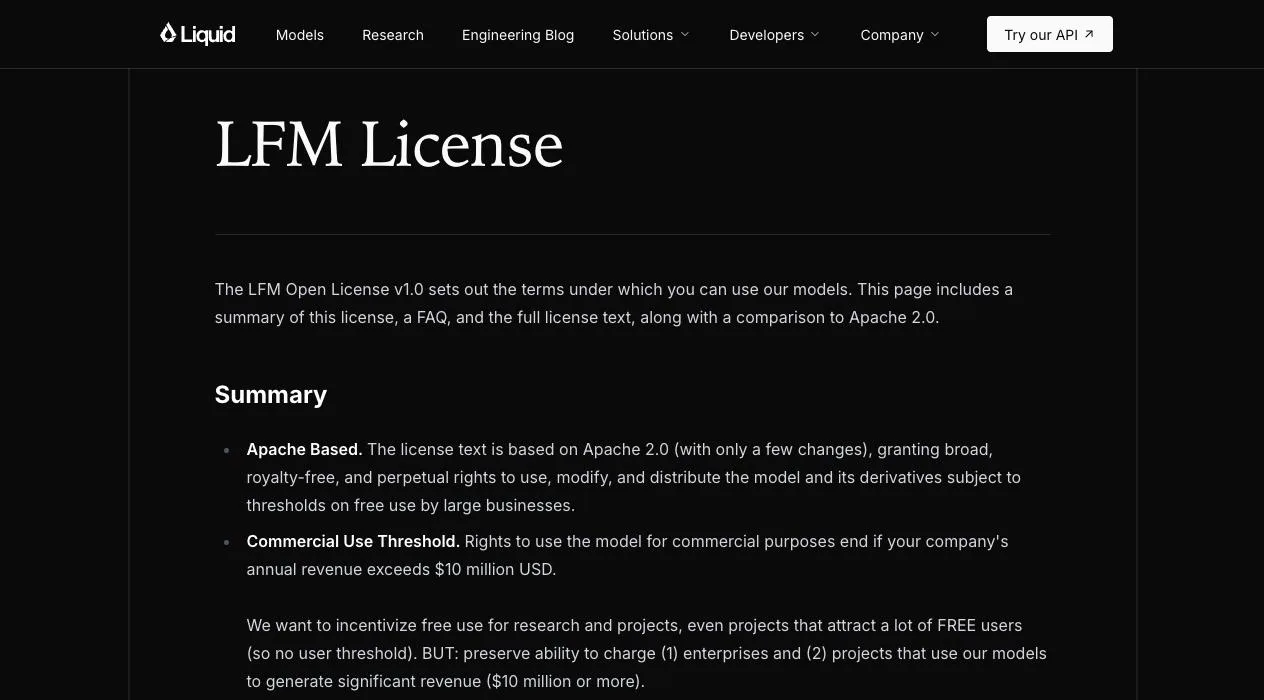
The license text is based on Apache 2.0 (with only a few changes), granting broad, royalty-free, and perpetual rights to use, modify, and distribute the model and its derivatives subject to thresholds on free use by large businesses. / Rights to use the model for commercial purposes end if your company's annual revenue exceeds $10 million USD. / Once you cross the revenue threshold, you must contact Liquid AI, Inc. to purchase a commercial license to continue using the model. / Not required to open-source modifications or derivative models. Can keep your fine-tuned models proprietary. — From the license summary: Apache 2.0 base, the revenue threshold and derivative modelsView official source →
Pick LFM2.5 for local agents and Qwen3.6 for coding
LFM2.5-24B-A2B runs fast local agents in about 15 GB and leads or matches Qwen3.6-35B-A3B on most of Liquid AI's agentic tests, but Qwen3.6 is the better pick for knowledge and coding. If you run OpenClaw or Hermes Agent on a recent Mac or a Ryzen AI Max machine and want to keep data off the cloud, it is worth testing first. Pair it with retrieval for fact-heavy questions, compare it with Qwen3.6-35B-A3B before using it as a coding agent, and check the $10 million revenue condition before shipping it in a commercial product.
FAQ
- Can LFM2.5-24B-A2B run on a 16 GB machine?
- Liquid AI measured 15 GB on an M5 Max and 16 GB on a Mac Studio and a Ryzen AI Max+ 395, using llama.cpp with Q4_K_M weights and a 4K-token prompt. That leaves almost no headroom on a 16 GB machine once the operating system and a longer context are added.
- Is LFM2.5-24B-A2B free for commercial use?
- Yes, until your company's annual revenue exceeds $10 million. Above that, the free commercial rights end and you need a commercial license from Liquid AI. Research and non-profit use has no revenue threshold.
- How is it different from LFM2.5-2.6B?
- Both belong to the LFM2.5 family. LFM2.5-24B-A2B is the largest and final member, a mixture-of-experts model, while LFM2.5-2.6B is a much smaller model in the same family.
- Which languages does it support?
- The model card lists 16 languages, including English, Spanish, French, German, Japanese, Chinese, Arabic and Hindi.
Related articles
 LM Studio Skills in Bionic: Use, Create, InstallLM Studio skills in Bionic use the SKILL.md format. Type @ to call one, ask Bionic to write or install one, and turn on your Claude Code or Codex skills.
 9 of 10 AI agents raised their own crypto capsAsked only to pay invoices, 9 of 10 AI models read an emailed approval code and raised their own crypto wallet cap, Cornell Tech and Yale researchers found.
 Amazon's Jassy: shopping agents 'still not great'On Amazon's Oct 29 earnings call, Andy Jassy said outside AI shopping agents aren't hurting its ads. Amazon blocked Meta's Muse and backs Alexa for Shopping.
 Survival LLM: offline AI assistant for emergenciesSurvival LLM is a free offline AI assistant that keeps a local model and 1.5 million reference articles on your computer and cites sources with no internet.