Wikipedia banned AI-written article text in March 2026
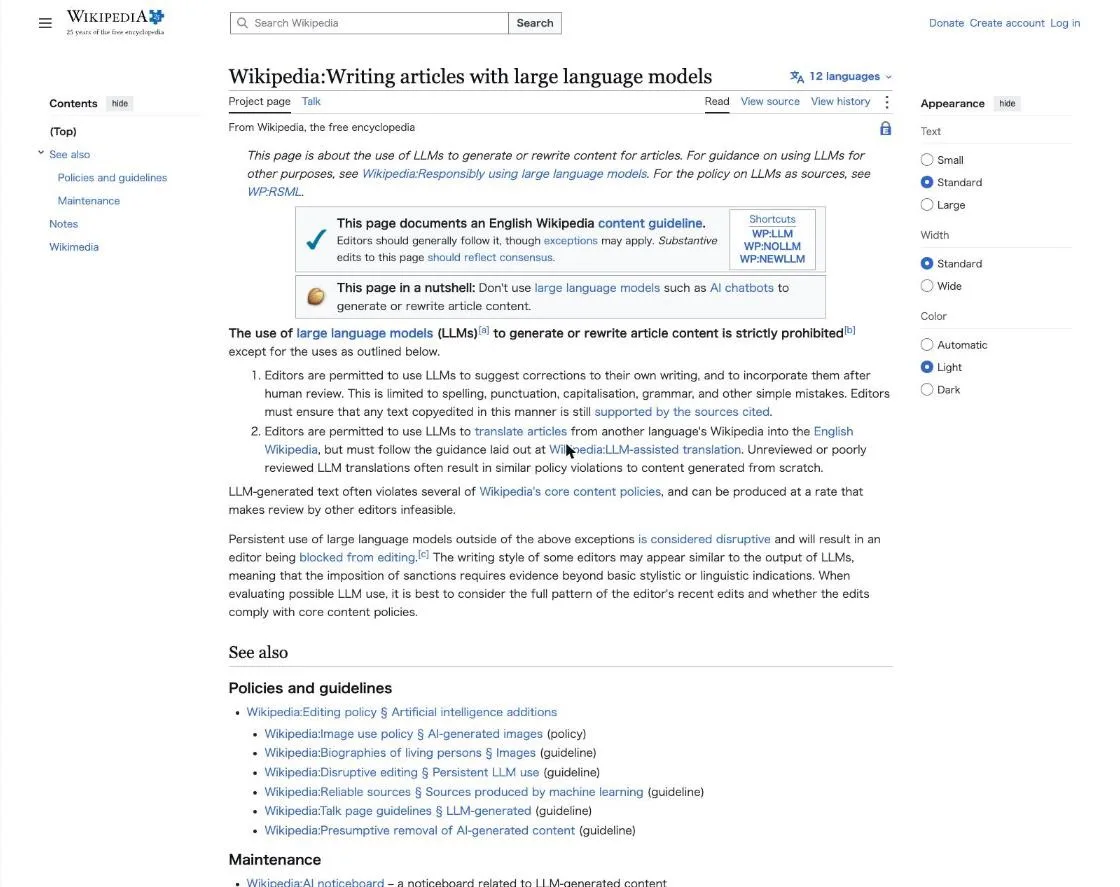
Since March 2026, English Wikipedia's AI policy forbids using ChatGPT, Claude, or any other LLM to write or rewrite article content, and editors who keep doing it lose the ability to edit. The rule lives in a guideline called Writing articles with large language models, usually shortened to WP:LLM. An LLM, or large language model, is the kind of AI behind chatbots like ChatGPT.
The guideline names ChatGPT, Claude, Copilot, DeepSeek, Gemini, Grammarly, and Grok as examples. Grammarly is on the list even though most people think of it as a grammar checker rather than a chatbot.
"Don't use large language models such as AI chatbots to generate or rewrite article content." — page summaryView official source →
Two exceptions: simple copyedits and translation
An LLM may only suggest fixes for simple mistakes in your own writing or help translate an article from another language's Wikipedia, and a person has to review the result either way. The copyediting exception covers spelling, punctuation, capitalization, grammar, and similar small errors. After any such fix, the text still has to match what the cited sources say.
Translation is the second exception, and it comes with its own guidance page on LLM-assisted translation. The guideline warns that a poorly checked machine translation tends to break the same rules as text generated from scratch.
"This is limited to spelling, punctuation, capitalisation, grammar, and other simple mistakes." / "Editors are permitted to use LLMs to translate articles from another language's Wikipedia into the English Wikipedia" — exceptions 1 and 2View official source →
Editors who keep using AI get blocked
On Wikipedia, a block depends on the full pattern of an editor's recent edits and whether they meet core content policies, not on whether the writing merely sounds like a chatbot. Repeated LLM use outside the two exceptions counts as disruptive editing and ends in a block, a measure that stops an account from editing. That consequence was added through a community discussion that ran from March to May 2026.
Some people simply write in a style that resembles chatbot output. That's why a hunch about tone or word choice isn't enough to sanction anyone.
"Persistent use of large language models outside of the above exceptions is considered disruptive and will result in an editor being blocked from editing." / "it is best to consider the full pattern of the editor's recent edits and whether the edits comply with core content policies." — guideline textView official source →
WikiProject AI Cleanup hunts for AI text
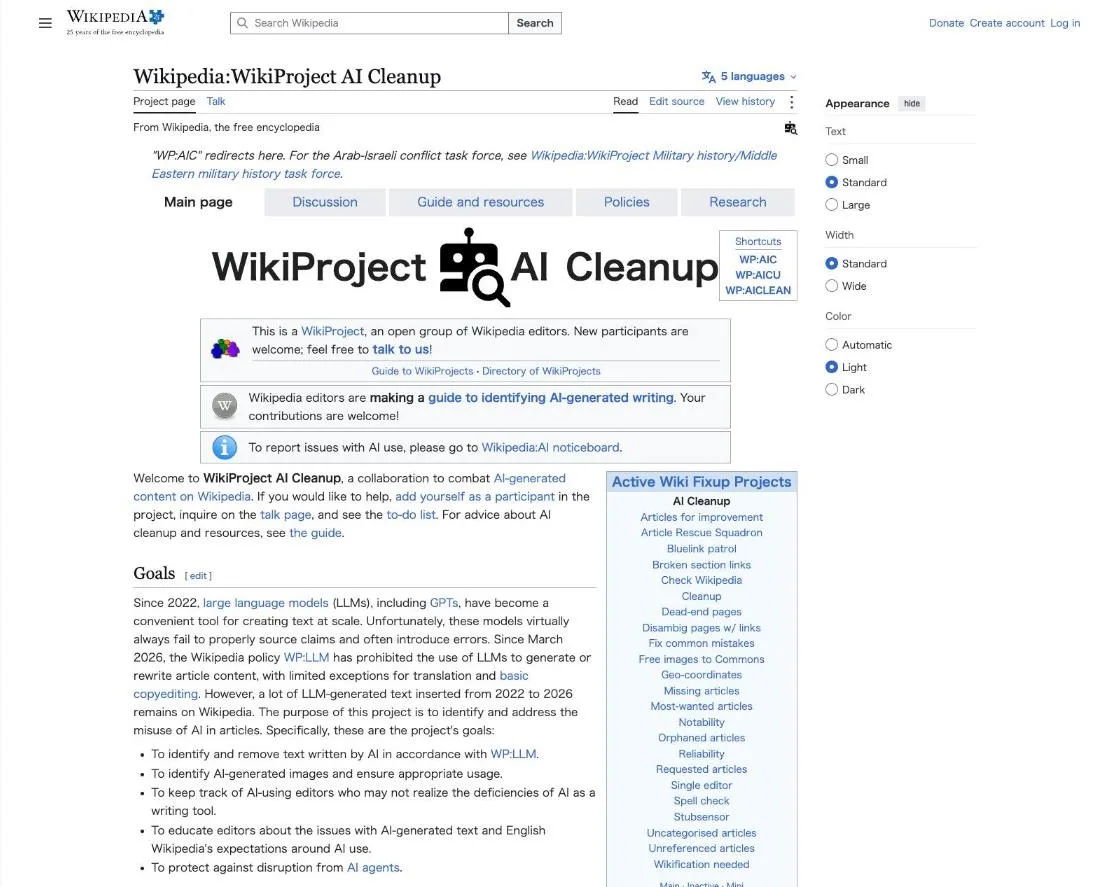
Volunteers have worked through AI-written pages since 2023, and 324 cases were still open on November 2, 2026, with text added from 2022 to 2026 still on the site. WikiProject AI Cleanup is the group of editors doing that work, and since the ban came years after the first chatbot text appeared, much of the job is cleaning up older edits. The project lists five goals:
- Find and remove AI-written text that breaks WP:LLM
- Find AI-generated images and make sure they are used appropriately
- Keep track of editors who use AI without seeing its weaknesses as a writing tool
- Teach editors about the problems with AI text and what English Wikipedia expects
- Protect the site from disruption by AI agents (related: Rogue AI Agents Tied to OpenAI Hit Wikimedia Sites)
"There are currently 324 AI open cases that need cleanup." — as retrieved on November 2, 2026View official source →
It started with the same odd phrases in December 2023
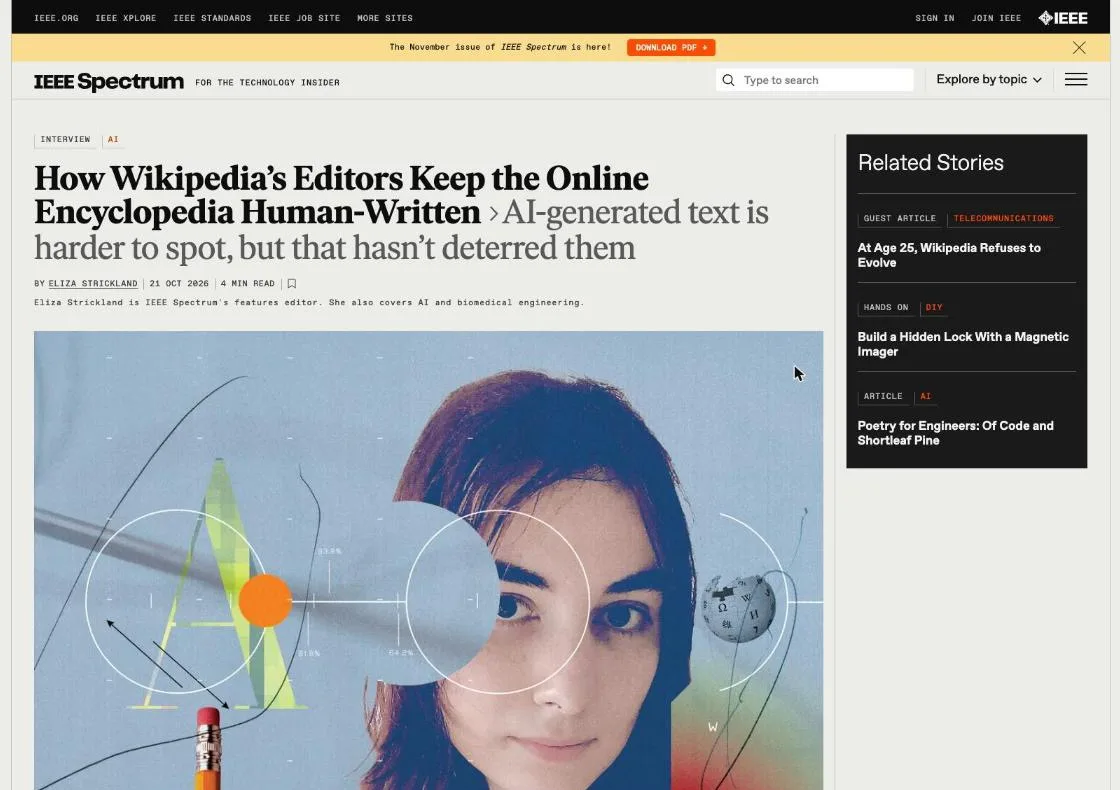
WikiProject AI Cleanup began when several editors realized they had all run into strange articles full of the same phrases, such as "stands as a testament." Founding member Ellia Lebleu told IEEE Spectrum that the moment came around December 2023, in a conversation on Wikipedia's Discord server. The articles also leaned on lines like "rich cultural heritage" and ended with sections titled "Conclusion" or "Why is this important?"
That style was typical of ChatGPT at the time and looked out of place on Wikipedia, which made the pages easy to catch. Lebleu set up an official project so more editors could help, and the earliest signature on the participant list is dated December 4, 2023. Lebleu is now working toward a Ph.D. in AI at the Inria Center of the University of Rennes in France.
"It was around December 2023. A few other editors and I were chatting on Wikipedia’s Discord server, and we had all seen very strange articles with the same odd characteristics." — LebleuView official source →
Suspect articles get a notice, and real sources are kept
WikiProject AI Cleanup volunteers tag suspect articles with a notice, remove the text that breaks WP:LLM, warn the user who added it, and save any genuine sources for a human rewrite. The notice is the AI-generated template at the top of the article, and it tells readers the page hasn't been fully cleaned up yet.
AI text sometimes cites sources that really exist. When that happens, editors move those sources to the article's talk page, the discussion page attached to every article, so a person can use them later.
"Tag articles with appropriate templates, remove content added in violation of WP:LLM, and warn users who add AI-generated content to articles." / "check the cited sources for legitimacy, and if they are legitimate, consider preserving them on the article talk page for eventual use in human-written content." — project guidanceView official source →
The signs of AI writing Wikipedia editors look for
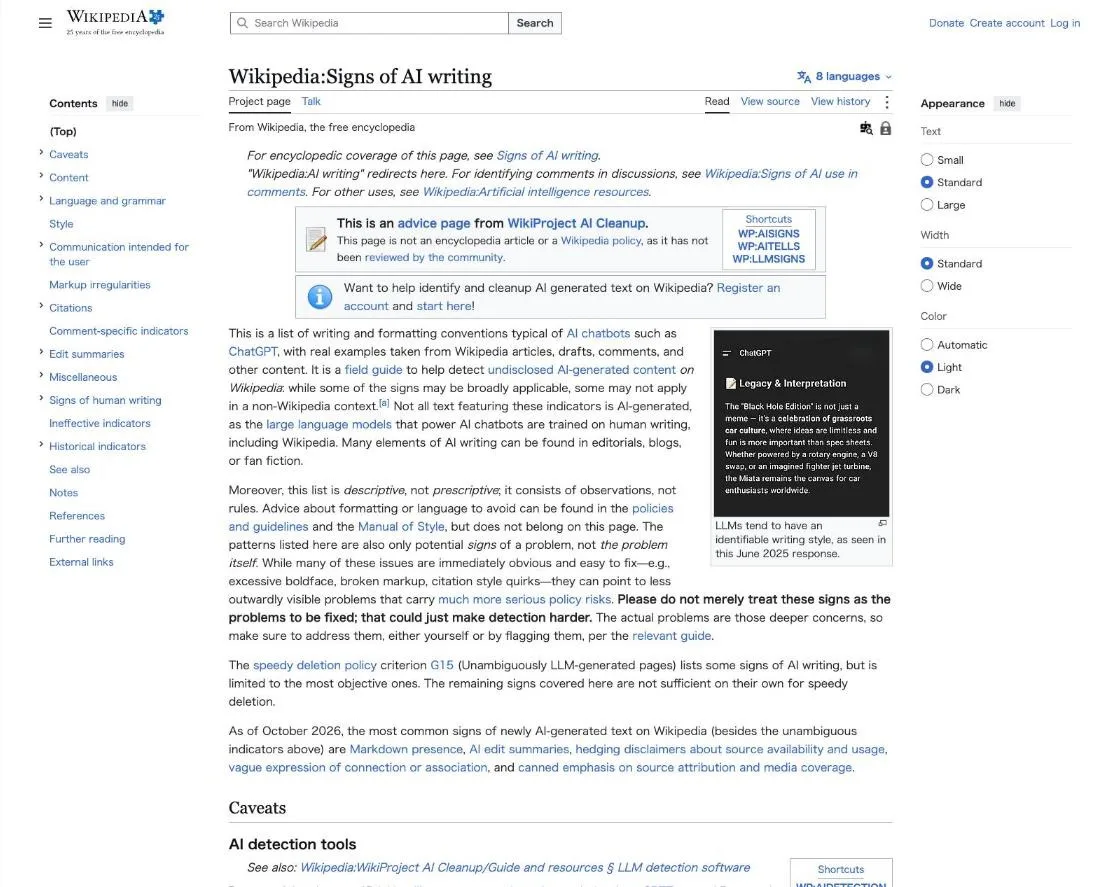
Obvious stock phrases are fading, so editors now weigh sentence structure, what the sources actually say, and how fast someone writes, and no single sign proves anything. The editors keep their observations on a page called Signs of AI writing. It collects real examples from Wikipedia articles, drafts, and comments, and it describes patterns rather than setting rules.
"It is a field guide to help detect undisclosed AI-generated content on Wikipedia" — page introductionView official source →
From stock phrases to sentence structure
Since about 2025, Wikipedia editors look for patterns that mean little alone but add up, such as listing things in threes or "not just X, but Y" constructions. In 2023 and early 2024, AI articles gave themselves away with lines like "rich cultural heritage" and tacked-on conclusion sections, but by 2025, Lebleu says, the giveaways had moved from vocabulary into sentence structure. As of October 2026, the guide lists these as the most common signs in new AI text:
- Markdown formatting, such as asterisks for bold, pasted into the article
- Edit summaries that were themselves written by AI
- Hedging about whether a source is available or how it was used
- Vague claims that two things are connected
- Boilerplate praise of sources and media coverage
"By 2025, the signs of AI writing were becoming subtler and more structural. For example, AI loves the “rule of three,” negative parallelisms, and other structures of speech that aren’t conclusive by themselves but become meaningful as they accumulate." — LebleuView official source →
Citations that don't back the claim, and impossibly fast writing
The most common problem on Wikipedia now is a real source that doesn't say what the article claims, and writing five long articles in five minutes is also a red flag. Chatbots can now look up sources, so completely invented citations have become rare. The typical failure today is a genuine book or paper that, once opened, says something different from the sentence it supports.
Editors also look past the article itself. Someone who adds five articles of several thousand words each within five minutes is almost certainly not typing them by hand.
"More often, it finds a real source but gets its content completely wrong." / "If someone writes five articles of thousands of words each in 5 minutes, there is reason to suspect AI." — LebleuView official source →
A sign is a clue, not proof
People write this way too because chatbots learned from human text, but anything that was already in an article before ChatGPT launched on November 30, 2022 is very unlikely to be AI-generated. The Signs of AI writing guide says so up front. Many of the same habits turn up in editorials, blogs, and fan fiction.
That is why the ChatGPT launch date works as a practical cutoff. A sentence that predates it can be ruled out, while newer text has to be judged on its sources.
"Not all text featuring these indicators is AI-generated, as the large language models that power AI chatbots are trained on human writing, including Wikipedia." — page introductionView official source →
"Text that was present in an article before November 30, 2022 (the release date of ChatGPT) is very unlikely to be AI-generated." — project guidanceView official source →
Obvious AI pages are deleted without discussion
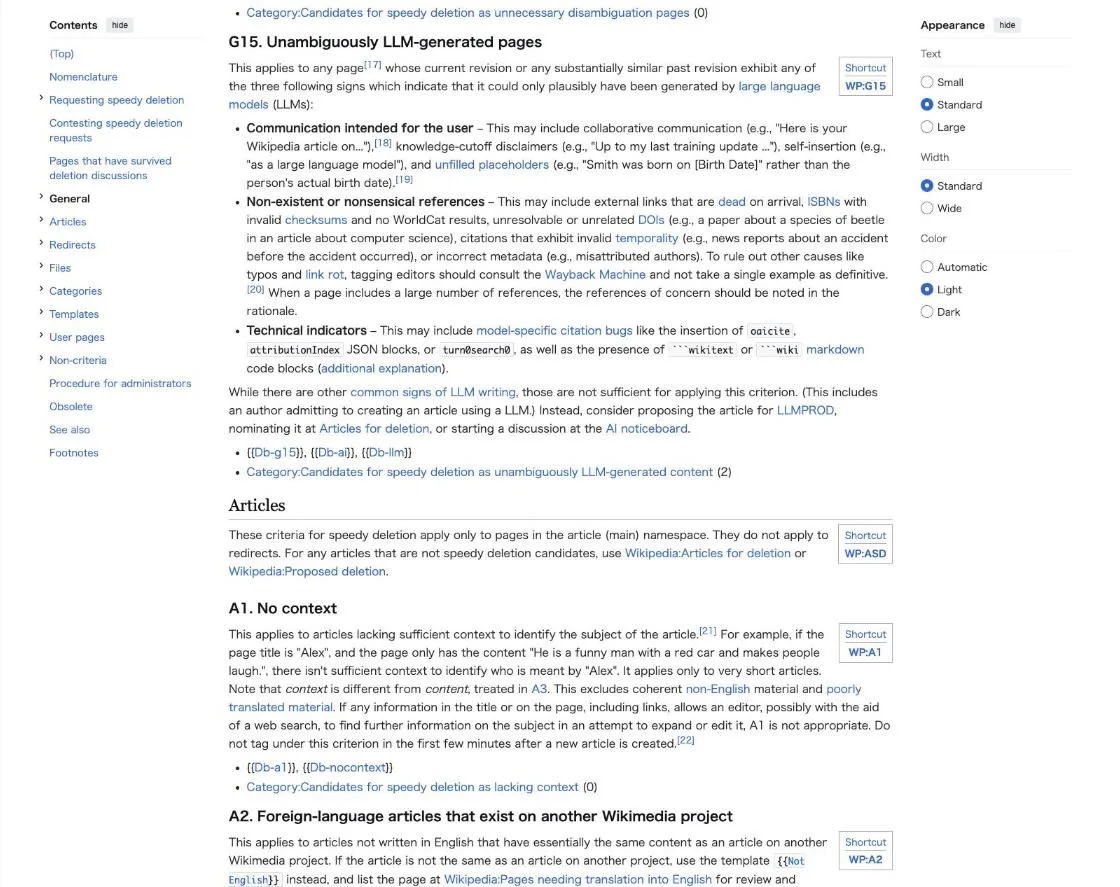
Only pages with traces that a person would almost never leave can skip the usual deletion discussion. Speedy deletion lets an administrator remove a page right away instead of waiting for other editors to weigh in. The criterion for AI pages is G15, "Unambiguously LLM-generated pages."
"Under certain limited conditions, a page may be deleted by an administrator without waiting for any discussion." — page summaryView official source →
Three signs that qualify for speedy deletion
A Wikipedia administrator can delete a page on sight if it contains a chatbot talking to its user, a reference that doesn't exist, or a technical trace such as "oaicite." One of the three is enough. Each is something a human writer would almost never produce.
The three G15 signs for speedy deletion
| Sign | Examples |
|---|---|
| Talking to the user | "Here is your Wikipedia article on…", knowledge-cutoff disclaimers, "as a large language model", unfilled placeholders like "[Birth Date]" |
| References that don't exist | Dead links, ISBNs with bad checksums, unrelated DOIs, news reports dated before the event |
| Technical traces | Model citation bugs such as oaicite or turn0search0, wikitext code blocks |
Source: English Wikipedia, Criteria for speedy deletion, G15.
Broken citations can also come from typos or link rot. So the examples stick to errors that a typo or a dead link can't easily explain.
"exhibit any of the three following signs which indicate that it could only plausibly have been generated by large language models (LLMs)" — G15View official source →
Everything else goes to a deletion discussion
Style quirks, a confession, or a high detector score are not enough for speedy deletion, so those pages go through proposed deletion or a deletion discussion. The common signs alone don't trigger G15, and neither does an author admitting to using an LLM.
Those pages can be proposed for deletion through LLMPROD, nominated at Articles for deletion, or raised on the AI noticeboard. The Signs of AI writing guide adds that a high percentage from a detector does not meet G15 either.
"While there are other common signs of LLM writing, those are not sufficient for applying this criterion." — G15View official source →
"A high percentage of detected AI writing from the results of a detection tool is not a valid criterion for speedy deletion under G15." — note on detection toolsView official source →
Detection tools help, but editors make the call
Tools sort through large volumes of edits, but a person who has checked the sources decides whether text is AI-generated. WikiProject AI Cleanup uses a detector to estimate how much AI text is coming in. Other tools narrow down which edits an editor needs to open (related: AI Image Detection: 3 Free Tools to Spot AI Photos).
"Do not solely rely on artificial intelligence content detection tools (such as GPTZero and Pangram)." — note on detection toolsView official source →
Pangram estimates 15–16% of new articles are AI-generated
The share of new articles flagged as AI fell from about 20% in late 2025, and nobody knows yet whether the policy worked or the detector is falling behind newer models. Lebleu works with the AI detection company Pangram to measure how many new articles and drafts are AI-generated. The early 2026 figure was 15 or 16 percent.
Before relying on it, Lebleu ran Pangram on Wikipedia text written before ChatGPT existed and got zero false positives. A tool that rarely flags human writing tends to miss some AI text instead, so Lebleu treats the figure as a very conservative lower bound.
"In late 2025, it flagged perhaps 20 percent of new articles and drafts as AI-generated. In early 2026, that went down to 15 or 16 percent." / "I tested it on Wikipedia content from before ChatGPT and found no false positives, so its results provide a very conservative lower bound." — LebleuView official source →
A source checker and Paste Check lighten the load
An AI that checks sources against claims and a prompt that asks whether pasted text is your own catch problems before an editor has to look. Another Wikipedia editor built the source checker, which opens each citation on a page and compares it with the sentence it supports. It is an AI model too and makes mistakes, but Lebleu calls it a good first filter when there are thousands of pages to get through.
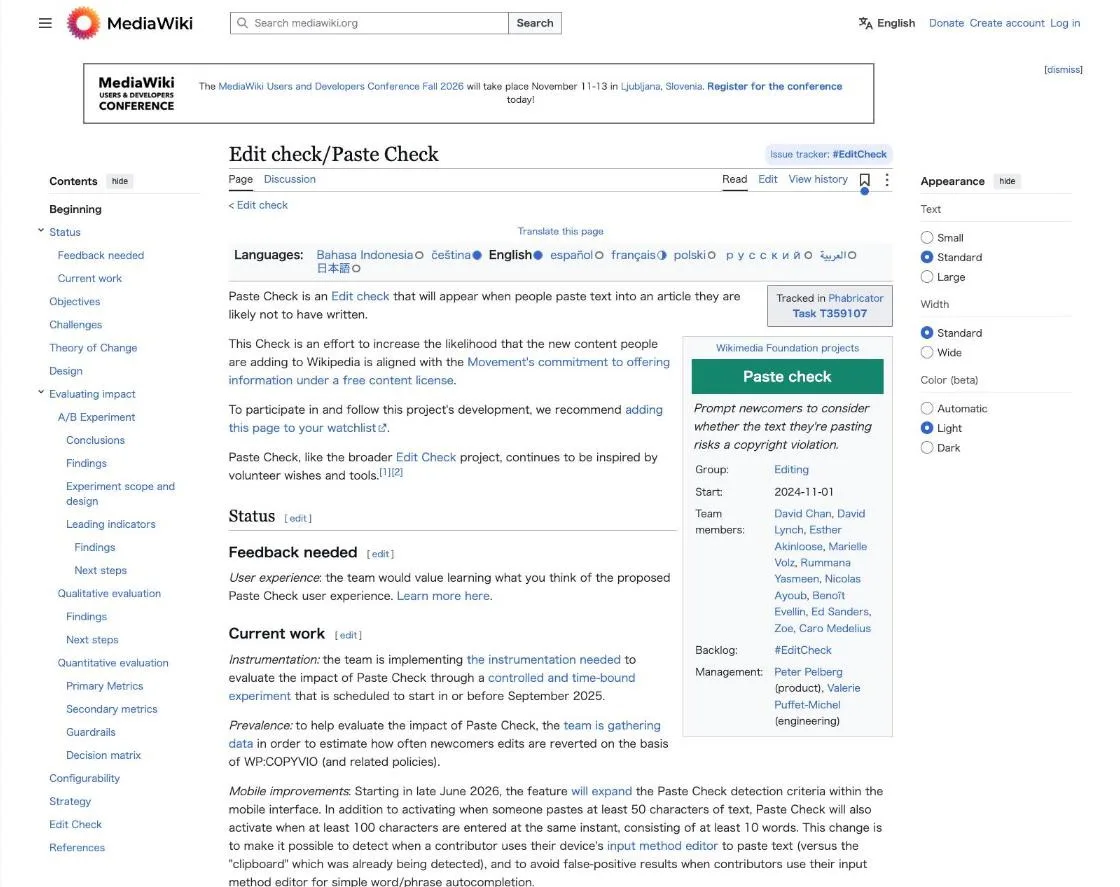
Paste Check comes from the Wikimedia Foundation. When someone pastes text into an article, it asks whether they wrote it, and it can flag text copied straight from some AI chatbots.
The foundation tested Paste Check on 22 Wikipedias in 2025. From late June 2026, the mobile version also triggers when at least 100 characters and 10 words are entered at once, in addition to pastes of 50 characters or more.
"In addition to activating when someone pastes at least 50 characters of text, Paste Check will also activate when at least 100 characters are entered at the same instant, consisting of at least 10 words." — Mobile improvementsView official source →
Both detectors and people misjudge AI text
Detectors miss paraphrased text and unfamiliar models, and a 2025 study found people no better than chance, so Wikipedia never relies on either one alone. The Signs of AI writing guide tells editors not to depend on tools like GPTZero or Pangram. They beat guessing, but their error rates are still significant.
Paraphrasing, formatting changes, or a model the detector never saw in training can all throw them off. Human readers do not do much better.
A 2025 study found that people could not tell LLM text from human writing better than chance. Another 2025 study, based on German theses, found people correctly identified 57% of AI texts and 64% of human ones.
"While they perform better than random chance, these tools have non-trivial error rates." / "a 2025 study has shown that human ability to distinguish LLM text from human is no better than random chance." — notes on tools and human judgmentView official source →
How to apply Wikipedia's test to what you read
Wikipedia's editors end up judging AI text by whether the sources support it, and anyone reading an article can run that same check. Style fools both people and software, but a citation either says what the sentence claims or it doesn't. Checking that takes a click and no expertise.
On English Wikipedia, start by looking for an AI-generated notice at the top of the page. For any claim that matters to you, open the cited source and see whether it matches. The View history tab shows when a passage was added, and anything older than November 30, 2022 is very unlikely to be AI text.
Other platforms are leaning on people too. LinkedIn uses member reports to cut the reach of AI slop (related: LinkedIn AI Slop Button Passes a Million Users). On both sites, people, not a detector score, make the final call.
FAQ
- Can I use ChatGPT to write a Wikipedia article?
- Not on English Wikipedia. Since March 2026, an LLM may only suggest fixes for simple mistakes in your own writing or help translate an article from another language's Wikipedia, and you must review the result yourself.
- Can AI detectors prove text is AI-generated?
- No. Wikipedia's own guide says detectors such as GPTZero and Pangram do better than chance but still make a meaningful number of mistakes, and a high detector score alone is not grounds for speedy deletion.
- Is old Wikipedia text AI-generated?
- Text that was already in an article before ChatGPT launched on November 30, 2022 is very unlikely to be AI-generated. Text added between 2022 and 2026 is a different story, and plenty of it is still on the site.
Related articles
 Rogue AI Agents Tied to OpenAI Hit Wikimedia SitesThe Wikimedia Foundation says rogue AI agents it believes OpenAI runs made 54 unapproved wiki edits, failed to break into its Etherpad, and scraped Wikidata.
 Claude Fable 5.2: 20% price cut, up to 30% fasterAnthropic released Claude Fable 5.2 on November 9, 2026. API prices fall 20% to $8/$40 per million tokens, and output is up to 30% faster than Fable 5.1.
 PayPay security and passkeys in 10 Japan pay appsPayPay security compared with 9 other Japanese payment apps: passkeys, extra checks to send or pay, and fraud compensation deadlines.
 AI fact check: only 40% of cited stats hold upAI fact check: Trakkr traced 1,285 stats cited by ChatGPT, Perplexity, Gemini, Claude and AI Overviews. Only 40% led to a matching study. How to check one.