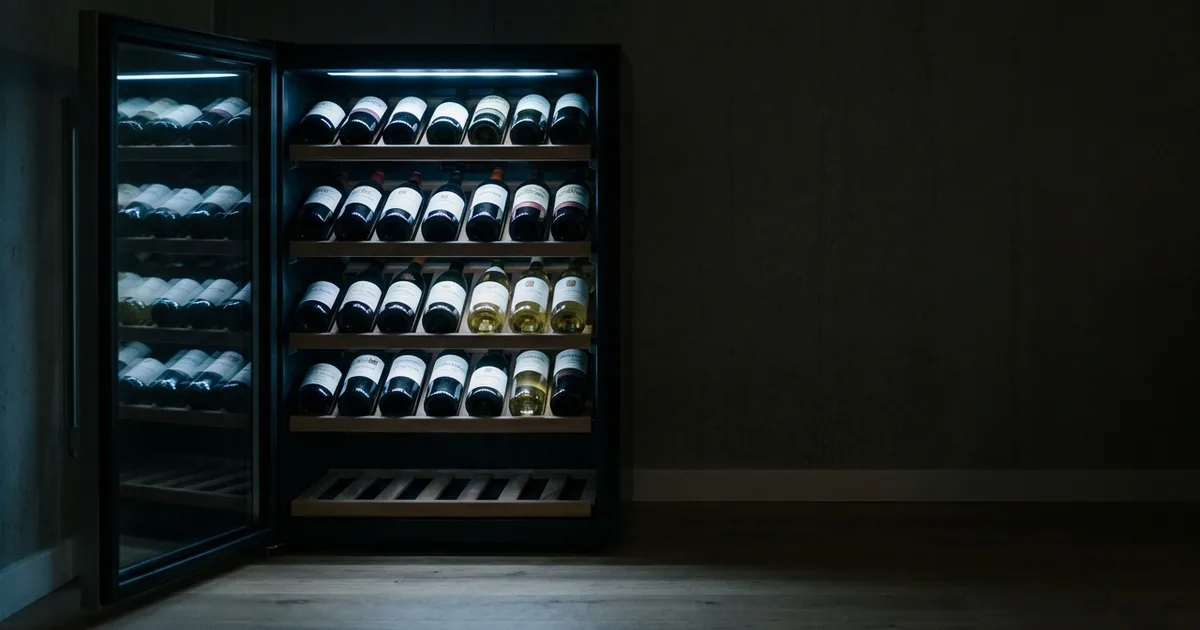
Wine cellar capacity: how many bottles really fit
A wine fridge's capacity is the bottle count its maker rates, and EuroCave attaches a condition to that count. Its buying guide states the condition and also says how full to run a cabinet.
Three checks on a rated capacity
EuroCave rates capacity in Bordeaux-size bottles
EuroCave states that the capacities it gives are calculated based on Bordeaux bottle sizes. The rated count is therefore a count of Bordeaux-size bottles.
Collections with Burgundy, Alsace or Champagne bottles need a second look at the cabinet's fittings. EuroCave says its detachable "Main du Sommelier" bottle supports and repositionable shelves let all sizes be stored with no restrictions. Read the rated figure as a Bordeaux count, then check how the maker holds the other shapes.
Whatever selection of bottles you have - Bordeaux, Burgundy, Alsace or Champagne – our individual, detachable "Main du Sommelier" bottle supports and our repositionable shelves allow you to store all sizes with no restrictions. / *the capacities given are calculated based on Bordeaux bottle sizes. — From question 2 on how many bottles you want to store in your wine fridgeView official source →
Fill a wine fridge to at least 75% of capacity
EuroCave recommends filling a wine fridge to at least 75% of its capacity for optimal performance. The same guide warns that a cabinet oversized for the bottles you will store uses unnecessary energy over time.
Both points lead to one comparison. Set the rated count next to the number of bottles you own now and plan to keep, and look for a cabinet whose rated count sits close to that number and leaves it at least three quarters full.
We recommend you fill your fridge to at least 75% of its capacity for optimal performance. Choosing a wine cabinet with a storage capacity that is oversized in relation to the actual number of bottles you will store in it will result in unnecessary energy consumption in the long term. — From the key information under question 2View official source →
Wine fridge organization: zones, shelf height and light
Where a bottle goes depends on the temperature zones the cabinet offers, and light matters wherever it sits. EuroCave describes three kinds of zoned cabinet. The Australian Wine Research Institute (AWRI) covers light and temperature swings.
Temperature zones and light
Multi-temperature cabinets set temperature by shelf height
A multi-temperature cabinet is one where the temperature changes with shelf height. EuroCave says the temperature is staggered over the whole height of the cabinet and can be set from 5 to 20°C. Its example serves a Bordeaux stored at the top at 17°C, a Burgundy just below at 16°C and a Pinot Gris at the bottom at 11°C.
In such a cabinet, the shelf a bottle sits on sets its temperature. A three-temperature cabinet divides the space into zones instead. EuroCave gives 15-22°C for the upper zone (wine cellaring) and 9-15°C for the central zone (storing wine), and the lower zone is for chilling.
The temperature, staggered over the entire height of the wine cabinet and settable from 5 - 20°C, allows you to serve a Bordeaux stored at the top of the fridge at 17°C, a Burgundy stored just below at 16°C and a Pinot Gris at the bottom of the cabinet at 11°C. / Upper zone settable from 15°C - 22°C: for wine cellaring, / Central zone settable from 9°C - 15°C: for storing wine, — From the sections on multi-temperature and 3-temperature cabinetsView official source →
A two-temperature cabinet splits reds and whites
EuroCave's two-temperature serving cabinets have two separate compartments, each dedicated to a wine color. Before serving, reds can be stored at 15-20°C, and whites, rosés and Champagnes at 5-13°C.
Reds go in one compartment, and whites, rosés and Champagnes in the other. These ranges are for wine waiting to be served. For the temperature of long storage, see "Wine Cellar Temperature: One Number, Held Steady".
White wine is not served at the same temperature as red wine. This wine cooler has two separate temperature compartments, each dedicated to its wine colour. Before serving, red wines can be stored at 15 - 20°C. Whites, rosés and champagnes at 5 - 13°C. — From the section on 2-temperature wine-serving cabinetsView official source →
Keep bottles out of light to avoid a lightstruck taste
The AWRI says light exposure can change how a wine tastes. Volatile sulfur compounds form, and the result is known as lightstruck flavor, a taste change caused by light.
The AWRI also cites a recommendation to store bottled wine in a cool (15-20°C), dry location with the cork in contact with the wine. It says large temperature swings between day and night should be avoided. On the cabinet side, EuroCave lists solid or glass doors with highly effective UV screening.
Light exposure can affect the taste of a wine through the production of volatile sulfur compounds, known as ‘lightstruck’ flavour. / recommend that bottled wine be stored with the cork in contact with the wine in a cool (15–20°C), dry location. / Thermal cycling where the temperature varies significantly between day and night should be avoided (Hirlam 2019a,b). — From the sections on temperature, humidity and light during storageView official source →
solid or glass doors with highly effective UV screening — From the description of wine storage cabinetsView official source →
How to organize a wine cellar inventory with numbered slots
After each bottle has a place, write the place down. Number every slot, and the record can name the slot instead of describing it.
Three ways to record where a bottle sits
Wine cellar labels: number every shelf and slot
Here is one numbering scheme, offered as an example and not as a rule from any source. Count shelves from the top and slots from the left. The bottle on the second shelf, fifth slot from the left, is then "2-5".
Write the scheme down where a second person can read it, so both people read a number the same way. A label at each shelf and slot can show the numbers on the cabinet itself.
Add a location column to a wine cellar spreadsheet
A wine list in a spreadsheet needs one more column. Add a location column next to the producer and vintage, and type the slot number in it, such as "2-5".
Keep the column current in two cases. When a bottle is drunk, delete that wine's line; when one is moved, type its new number. For column layouts, see "Wine Inventory Excel: Columns and Where It Breaks".
Shelvin records the row and tier of each bottle
Row and tier mean the shelf and the position on it, the same idea as the "2-5" scheme. Shelvin's App Store listing says the app registers several cellars and visually records which shelf each wine is on, by row and tier. It also manages "In Storage" and "Available" statuses and shows shelf availability right after a wine is finished.
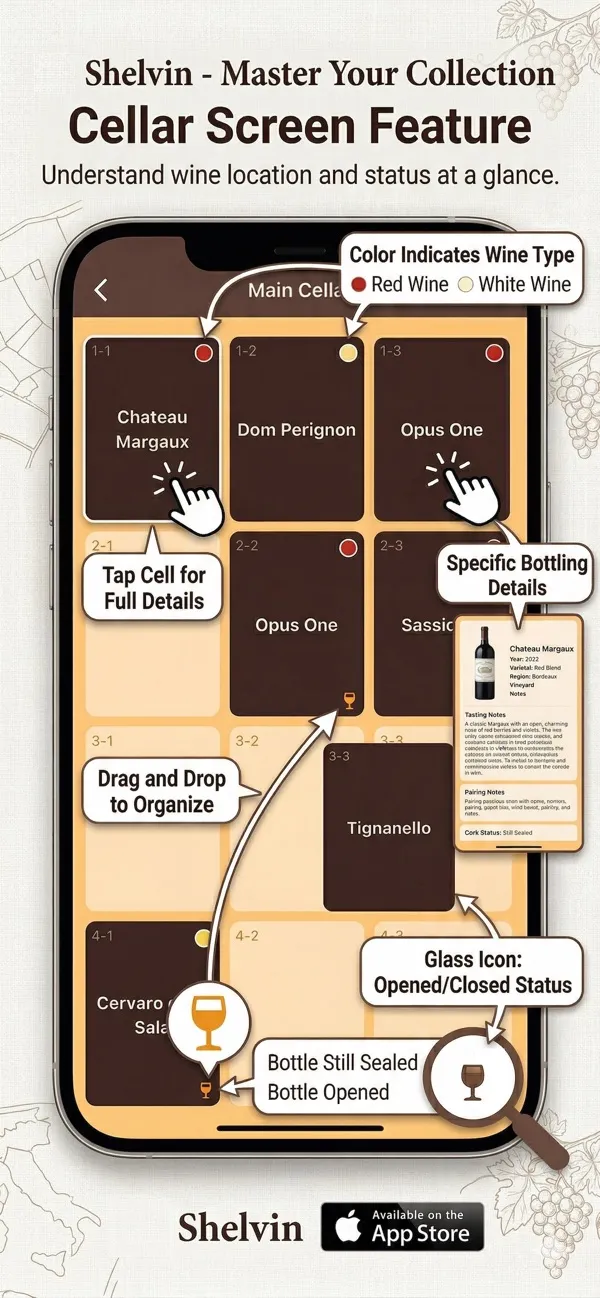
The listing gives the price as $6.99. For a comparison of other apps, see "Wine Inventory Apps: 5 Cellar Trackers Compared".
Cellar Registration and Allocation Recording: Register multiple cellars and visually record which wines are located on which shelf (row/tier)./Inventory Status: Manage "In Storage" and "Available" statuses in real time. You can also instantly check shelf availability after finishing a wine./Price: $6.99 (USD) — From the graphical cellar management feature and the subscription sectionView official source →
Summary: organize a wine cellar in three steps
Wine cellar organization takes three steps. First, read the rated capacity as a Bordeaux-bottle count, and aim to fill at least 75% of the cabinet. Second, place wines by temperature zone and keep them out of light: choose the shelf by height in a multi-temperature cabinet, and put reds and whites in separate compartments in a two-temperature one.
Third, number every shelf and slot and log the number in a spreadsheet column or an app. For an app that records the row and tier of each bottle and lets you check shelf availability after a wine is finished, try Shelvin (App Store).
FAQ
- Does a wine fridge hold as many bottles as its capacity says?
- Not necessarily. EuroCave says the capacities it gives are calculated based on Bordeaux bottle sizes, so the figure assumes Bordeaux bottles. For Burgundy, Alsace or Champagne bottles, it points to its detachable bottle supports and repositionable shelves.
- How full should a wine fridge be?
- EuroCave recommends filling a wine fridge to at least 75% of its capacity for optimal performance. It adds that a cabinet oversized for the bottles you will store uses unnecessary energy over time.
- Where do reds and whites go in a two-temperature wine fridge?
- Each goes in its own compartment. EuroCave's two-temperature serving cabinets keep reds at 15-20°C and whites, rosés and Champagnes at 5-13°C before serving.
- Does light harm wine stored in a cellar?
- It can. The Australian Wine Research Institute says light exposure can change a wine's taste through the production of volatile sulfur compounds, an effect known as lightstruck flavor.
- How do I record where each bottle is in my cellar?
- Give every shelf and slot a number, then record that number against each wine in a spreadsheet column or an app. Shelvin's App Store listing says the app records which shelf a wine is on, by row and tier.
Related articles
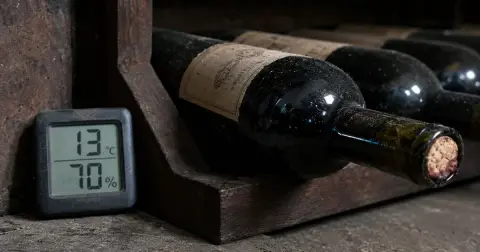 How to Store Wine at Home, Unopened and OpenedHow to store wine: keep it at a steady 10–14°C (50–57°F) with humidity near 70%, lay corked bottles flat, and finish opened wine in 2 days to a week.
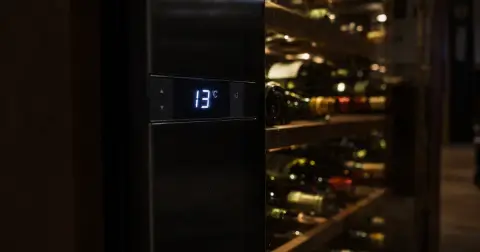 Wine Cellar Temperature: One Number, Held SteadySet your wine cellar temperature to 12°C (54°F) for every wine and hold it. Full-bodied reds at 18°C and dry whites at 8°C are for serving, not storage.
 CellarTracker: Languages, Pricing, Free TierCellarTracker app explained: four ways to add bottles, English as its only listed language, what the free tier covers, and subscription costs on site vs iOS.
 Wine Inventory Excel: Columns and Where It BreaksBuild a wine inventory Excel sheet from five columns: producer, wine, vintage, quantity and location. Add dropdowns, a table and a ready-to-drink color rule.