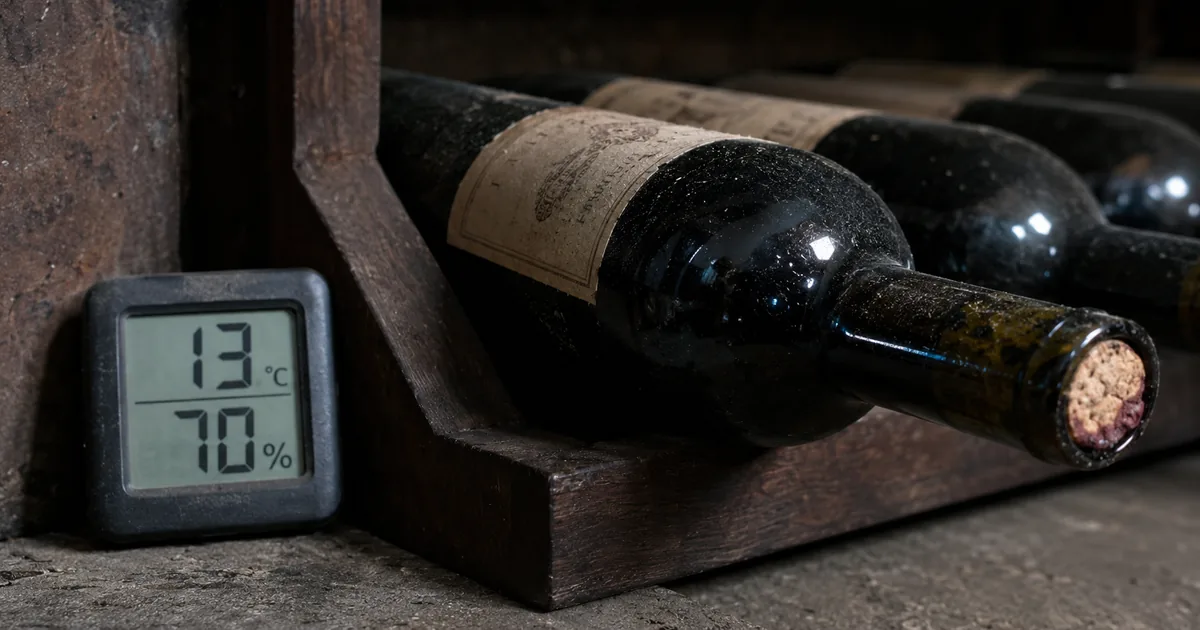
Home wine storage conditions come down to five things
Temperature, humidity, light, vibration and air decide how well a bottle holds up at home. Each has a number or a clear rule from EuroCave, a maker of wine cabinets, or from the Australian Wine Research Institute (AWRI).
The five storage conditions
The ideal wine storage temperature is a steady 10–14°C (50–57°F)
Keep wine between 10 and 14°C (50 and 57°F), and keep it there whatever the weather outside does. That is EuroCave's range, and the company names sudden swings as the thing to avoid above all.
Warmth speeds up how a wine develops, and EuroCave says sudden jumps in temperature can shorten how long a bottle will keep in the cellar. The AWRI sets the ceiling: long periods above 25°C (77°F), or short ones above 40°C (104°F), can affect quality, and past 40°C a wine's look and taste can change within days.
The AWRI also advises against storage where the temperature climbs by day and drops at night. Pick a spot that stays at the same temperature day and night.
Wine must have a stable temperature of 10°C - 14°C, whatever the external temperature differences are.
The higher the temperature, the quicker the wine develops. Above all, sudden fluctuations in temperature are harmful and could reduce the cellaring potential of your wine. Wine must have a stable temperature of 10°C - 14°C, whatever the external temperature differences are. — From the section on temperatureView official source →
Temperatures in excess of 40°C will induce visual and sensory changes to a wine in only a matter of days (Ough 1986). In general, any storage place where the temperature exceeds 25°C for long periods and 40°C for short periods can affect wine quality (Ough 1992)./Thermal cycling where the temperature varies significantly between day and night should be avoided (Hirlam 2019a,b). — From the section on the effects of temperature, humidity and light on bottled wineView official source →
Wine cellar humidity near 70% keeps corks from drying out
Aim for humidity around 70%, the level EuroCave recommends for a wine cellar. The cork is what keeps air out of the bottle, and a cork that dries out shrinks and lets air reach the wine, which then oxidizes.
EuroCave describes what goes wrong at each end. In dry air the corks pull back and some of the wine evaporates and oxidizes, while in damp air the labels suffer and mold can grow.
The AWRI makes the same point about dry air: wine under a natural cork can dry out and leak. It adds that most storage facilities do not adjust humidity at all.
The recommended humidity level for a wine cellar is around 70%.
On the contrary, a cellar which is too damp could damage your beautiful labels and cause mould to develop. The recommended humidity level for a wine cellar is around 70%. — From the section on humidity in the wine cellarView official source →
Humidity is important too, as wines under natural closures can dry out and leakage can occur if the air is too dry; however, in most storage facilities humidity is not adjusted. — From the section on the effects of temperature, humidity and light on bottled wineView official source →
Proper spots keep bottles dark, away from vibration and odors
Store wine somewhere dark, still and ventilated. EuroCave says long exposure to daylight or lamplight harms a wine's taste by breaking down its tannins, and the AWRI ties light to volatile sulfur compounds behind a fault called "lightstruck" flavor.
Where a light has to stay on, EuroCave suggests low-energy bulbs, which are dimmer and give off less heat. It also suggests keeping more fragile bottles in wooden cases.
Vibration is the next thing to rule out, because it unsettles the slow way wine matures and can ruin fine wines. EuroCave names household sources such as washing machines and other appliances, and outside ones such as road traffic and subway trains.
Stale, closed air is the last risk. Bad odors can work their way through the cork, and mold and bacteria can take hold, so EuroCave asks for at least one air vent when the wine is kept in a living space.
Vibration disrupts the slow development process of wine and is often fatal to fine wines.
In the case of prolonged exposure, natural or artificial light has undesirable effects on the taste of wine. It causes the tannins to break down./Vibration disrupts the slow development process of wine and is often fatal to fine wines./Bad odours can penetrate the cork, mould and bacteria can develop./In a living space, ensure that your wine cellar has at least one air vent. — From the sections on lighting, vibration and ventilationView official source →
Light exposure can affect the taste of a wine through the production of volatile sulfur compounds, known as ‘lightstruck’ flavour. — From the section on the effects of temperature, humidity and light on bottled wineView official source →
Lay corked bottles on their side to keep wine long term
If a corked bottle is going to sit for months or years, lay it on its side. Lying flat keeps the cork in contact with the wine, so it does not dry out the way it can in dry air.
Which way to store a bottle
Storing wine upright is fine if you will open it soon
Standing a bottle up does no harm when you plan to drink it soon. EuroCave describes upright shelving as meant for wines that will be drunk quickly, and it prefers flat storage for anything kept longer.
In practice that splits a rack in two. Bottles for this week can stand, and bottles you are saving can lie down with the cork kept wet.
Note that vertical bottle storage is more for wines which will be drunk quickly. For longer term storage, it is preferable to keep your wine bottles flat.
Note that vertical bottle storage is more for wines which will be drunk quickly. For longer term storage, it is preferable to keep your wine bottles flat. — From the passage on choosing shelvesView official source →
Side or upright mattered little in studies, bar agglomerated cork
In the two studies the AWRI summarizes, bottle position made little measurable difference, except under agglomerated cork. Agglomerated cork is a stopper made from cork granules bonded together rather than cut from a single piece.
In 2002, Mas and colleagues tested six closures on a white and a red wine. After 24 months, the upright bottles had slightly more yellow-brown color than the flat ones, but the gap was not significant. With agglomerated cork stoppers, though, the upright bottles oxidized more, and the white wine showed higher acetaldehyde from three months on.
In 2005, Skouroumounis and colleagues followed a wooded Chardonnay and a Riesling for 60 months and found orientation had little effect on their chemistry or taste. Across both studies, agglomerated cork is the one stopper where orientation showed a clear difference.
The study showed that oxidation was higher for upright samples sealed with agglomerated cork stoppers, with elevated acetaldehyde levels seen in white wine samples from the 3-month timepoint onwards.
The study showed that oxidation was higher for upright samples sealed with agglomerated cork stoppers, with elevated acetaldehyde levels seen in white wine samples from the 3-month timepoint onwards./Based on the testing undertaken, including yellow/brown colour (OD420nm), ascorbic acid and sensory analysis, the bottle orientation (horizontal or upright) was shown to have little effect on the chemical composition and sensory properties of the two wines across a 60-month period. — From the Mas et al. (2002) and Skouroumounis et al. (2005) studies, in the section on bottle orientation during transport and storageView official source →
Opened wine lasts 2 days to a week, tannic reds at the long end
Once the cork is out, most wine stays good for 2 days to about a week, and the style decides where it falls in that range. Opening a bottle lets oxygen in, and the wine absorbs it. The day counts come from winemakers quoted in a EuroCave blog piece by Anne Krebiehl MW.
How long opened wine keeps
Red and white wine last 3–4 days after opening, tannic reds up to 6
Expect a good white or a red to hold up for three to four days after opening. John Belsham, founder and winemaker of Foxes Island in New Zealand, gives that span for a quality Chardonnay, Riesling, Sémillon or Sauvignon Blanc left half full, and says the better the wine, the longer it keeps.
In his view, simpler, mass-produced whites and rosés are best finished within two days. At the other end, he has seen a high-grade single-vineyard white with most of the bottle still in it last at least a week in the fridge.
Reds follow the same pattern, and tannin is what protects a red against oxygen. He allows three to four days for an elegant Beaujolais and five to six for a robust southern Rhône or Primitivo.
it will comfortably be in good shape for three to four days
I would expect a quality bottle of Chardonnay, Riesling, Sémillon or Sauvignon Blanc to last comfortably three to four days in a half-full bottle./Mass-produced, simpler whites and rosés are probably best [enjoyed] over two days./With red wine, similarly, it will comfortably be in good shape for three to four days/The more robust the red wine, the more tannin it has to protect itself against oxygen. — From John Belsham's comments on white wine and red wineView official source →
Opened sparkling wine stays fresh 3–4 days under a clamp stopper
A sparkling wine with only one glass poured keeps three to four days if a clamp stopper holds its pressure. That is the guideline from Marcello Lunelli, co-owner of Cantine Ferrari in Trento, Italy. It holds only while the stopper keeps the bottle fully sealed.
Each time the bottle is opened, some pressure escapes, so a half-full bottle is best finished within two days. After that the bubbles fade, though Lunelli says the wine itself is still good.
If there is just a glass missing, a re-stoppered bottle will keep three to four days, as long as the stopper completely maintains the pressure.
If there is just a glass missing, a re-stoppered bottle will keep three to four days, as long as the stopper completely maintains the pressure./If the bottle is half-full, just two days is probably best./That said, the wine inside will still be good, just with less pressure. — From Marcello Lunelli's comments on sparkling winesView official source →
A growing collection needs a wine cabinet and an inventory app
Once the bottles add up, you need a place that holds the five conditions and a record of where each bottle sits. A wine cabinet handles the first, and an inventory app or a spreadsheet handles the second.
What a growing collection needs
A wine fridge or cooler holds its temperature in rooms of 0–35°C
A EuroCave wine fridge is built to manage its inside temperature while the room around it ranges from 0 to 35°C (32 to 95°F). EuroCave says keeping wine well for several years is hard in today's homes, even for people who own a natural cellar, and a cabinet is its answer to that.
Its display shows the actual temperature inside the cabinet rather than the setting, so you see what the bottles are really getting. For the number to set, see "Wine Cellar Temperature: One Number, Held Steady," and to decide which bottles deserve years in a cabinet, read "When to Drink Wine: Drinking Window and Aging."
Storing your fine wines and best discoveries over several years in a suitable environment is difficult to achieve in contemporary homes, even for people who own a natural wine cellar.
Storing your fine wines and best discoveries over several years in a suitable environment is difficult to achieve in contemporary homes, even for people who own a natural wine cellar./EuroCave manages the temperature inside its wine fridges taking into consideration the temperature of the external environment (0° - 35°C)./For peace of mind, EuroCave displays the actual temperature inside the wine fridge and not the temperature setting. — From the introduction and the section on wine fridges and cabinetsView official source →
Shelvin, a wine inventory app, logs each bottle's shelf and row
Shelvin, a wine cellar app, records the exact shelf and row where each bottle sits. You can set up home cellars and wine fridges as separate storage units, and each bottle is tracked as Stored, Opened or Empty.
A record does not have to live in an app. "Wine Inventory Excel: Columns and Where It Breaks" lists the columns for a spreadsheet, and "Wine Inventory Apps: 5 Cellar Trackers Compared" sets several apps side by side.
New bottles go in by photographing the label, and Shelvin's AI fills in the name, producer, vintage and region. The free plan allows 2 scans a week and Premium allows 50 a month, with Premium priced at $6.99 a month. The app also keeps a tasting log with star ratings, notes and dish pairings for the wines you open.
Visual shelf grid: View the exact shelf and row position of every bottle.
Multiple cellar management: Set up multiple storage units such as home cellars, wine fridges, and restaurant storage./Visual shelf grid: View the exact shelf and row position of every bottle./Status tracking: Track real-time bottle status including Stored, Opened, and Empty./(Note: Free plan includes up to 2 scans per week; Premium plan includes up to 50 scans per month.)/Title: Premium Plan/Duration: 1 month (auto-renewal)/Price: $6.99 (USD) — From the key features and the subscription section, in that orderView official source →
Summary: steady cool storage, and opened wine lasts 2 days to a week
How to store wine comes down to a steady 10–14°C (50–57°F), humidity near 70%, and a dark, still spot with fresh air. Long spells above 25°C (77°F) are the heat to avoid.
Lay corked bottles on their side if you plan to keep them, and stand up the ones you will open soon. Once opened, quality whites and most reds keep three to four days, simple whites and rosés about two, and robust reds up to six.
As the collection grows, a wine cabinet holds the conditions and an inventory record tells you where each bottle is. Shelvin (App Store) records each bottle's shelf and row, along with a tasting log for the wines you finish.
FAQ
- What temperature should wine be stored at?
- Keep it at a steady 10–14°C (50–57°F), the range EuroCave gives. EuroCave adds that the temperature should hold there however much the weather outside changes.
- Does wine need to be stored on its side?
- Lay a corked bottle on its side if you plan to keep it for a long time, so the cork stays in contact with the wine. EuroCave treats upright storage as fine for bottles you will drink soon.
- What humidity does wine storage need?
- Around 70%, which is the level EuroCave recommends for a cellar. Drier air lets corks shrink and the wine oxidize, and damper air harms labels and lets mold grow.
- How long does opened wine last?
- From about 2 days to a week, depending on the wine. Winemaker John Belsham gives quality whites and most reds three to four days, simple whites and rosés two, and robust reds five to six.
- How hot is too hot for stored wine?
- Long stretches above 25°C (77°F), or short ones above 40°C (104°F), can affect wine quality, according to the AWRI. It also advises against places where the temperature swings widely between day and night.
Related articles
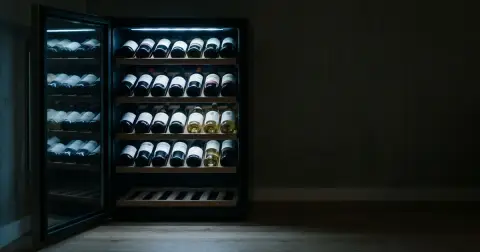 Wine Cellar Organization: Zones and CoordinatesWine cellar organization starts with how many bottles fit. Then sort wines by temperature zone, keep them out of light and number each slot to log a bottle.
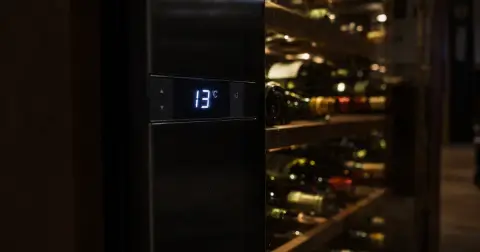 Wine Cellar Temperature: One Number, Held SteadySet your wine cellar temperature to 12°C (54°F) for every wine and hold it. Full-bodied reds at 18°C and dry whites at 8°C are for serving, not storage.
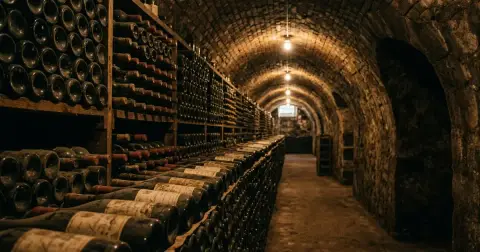 CellarTracker: Languages, Pricing, Free TierCellarTracker app explained: four ways to add bottles, English as its only listed language, what the free tier covers, and subscription costs on site vs iOS.
 Wine Inventory Excel: Columns and Where It BreaksBuild a wine inventory Excel sheet from five columns: producer, wine, vintage, quantity and location. Add dropdowns, a table and a ready-to-drink color rule.