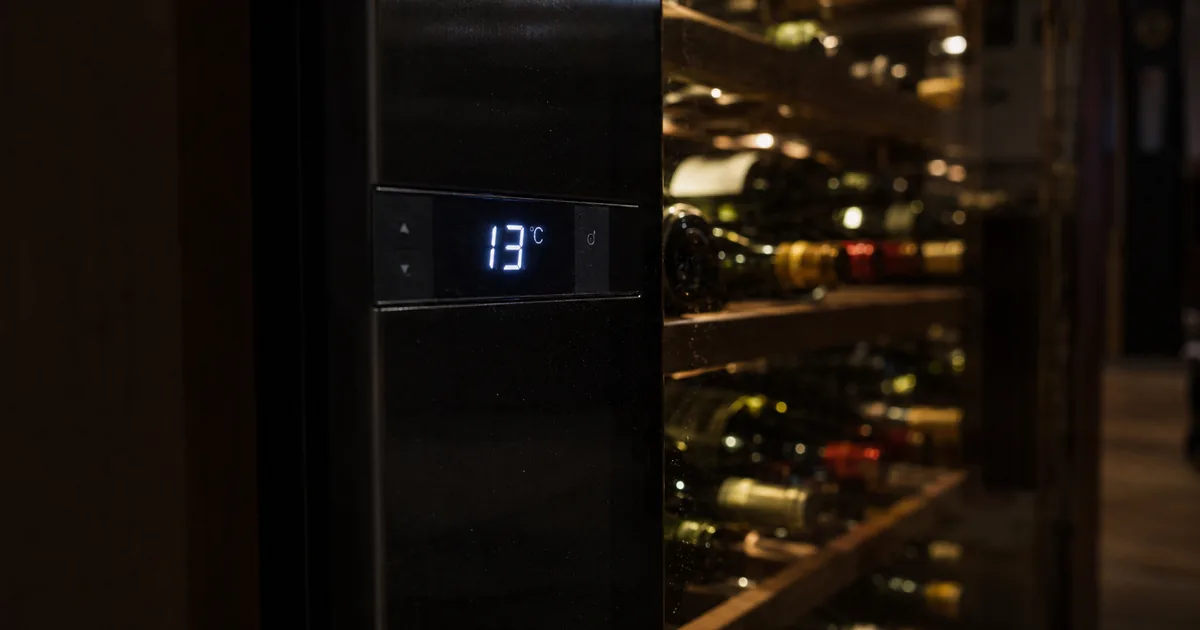
Set the wine cellar temperature to 12°C for every wine
A wine cellar needs one number, 12°C, not a range. The figure comes from cabinet maker EuroCave, and the limits around it come from Australian wine research.
Storage figures at a glance
EuroCave puts the ideal maturing temperature at 12°C
The maturing temperature is the one a bottle sits at while it is kept for the long term. EuroCave gives it as 12°C and says it applies to wine of any color. The same page asks for that temperature to be even from the top of the cabinet to the bottom.
In Fahrenheit, 12°C is 54°F. You do not need one setting for reds and another for whites while they are in storage. The difference between styles only matters on the way to the glass.
The ideal maturing temperature is 12°C.
The ideal maturing temperature is 12°C. It must be homogeneous throughout the wine fridge or wine cellar in order to age your wine gradually until its peak, without rushing. Furthermore this is the true whatever the color of your wine. — From the section on the wine maturing temperatureView official source →
Long spells above 25°C can affect wine quality
The setting has a partner number: how warm is too warm. The Australian Wine Research Institute (AWRI) says long periods above 25°C (77°F), or short periods above 40°C (104°F), can affect quality. Past 40°C, it adds, a wine's look and taste can change within days.
The same AWRI page cites a recommendation to keep bottles in a cool, dry place at 15 to 20°C (59 to 68°F), with the cork touching the wine. Treat 25°C and 40°C as ceilings to stay under, not as settings to aim for.
In general, any storage place where the temperature exceeds 25°C for long periods and 40°C for short periods can affect wine quality (Ough 1992).
In general, any storage place where the temperature exceeds 25°C for long periods and 40°C for short periods can affect wine quality (Ough 1992)./Temperatures in excess of 40°C will induce visual and sensory changes to a wine in only a matter of days (Ough 1986)./Amon and Simpson (1986) recommend that bottled wine be stored with the cork in contact with the wine in a cool (15–20°C), dry location. — From the section on the effects of temperature on bottled wine (all three)View official source →
Hold 12°C steady and avoid big swings between day and night
Thermal cycling is the rise and fall of temperature between day and night, and the AWRI advises avoiding it when the swing is large. EuroCave makes the same point about cabinets: it calls a stable temperature essential and warns that sudden changes inside can damage wine.
That makes the cabinet's surroundings part of the setting. A cabinet that has to fight a room heating up every afternoon will not hold its number as well as one in a room that stays even.
Thermal cycling where the temperature varies significantly between day and night should be avoided (Hirlam 2019a,b).
Thermal cycling where the temperature varies significantly between day and night should be avoided (Hirlam 2019a,b). — From the section on the effects of temperature on bottled wineView official source →
It is essential that this temperature is stable. You must avoid any suddent change in temperature inside the wine cellar, which could damage your wines. — From the section on the wine maturing temperature (the source spells it "suddent")View official source →
Natural corks can dry out and leak if the air is too dry
Humidity is the second number to watch when bottles stay under natural cork for years. The AWRI warns that bottles sealed with natural cork can dry out and leak in very dry air, and that most storage facilities never control humidity.
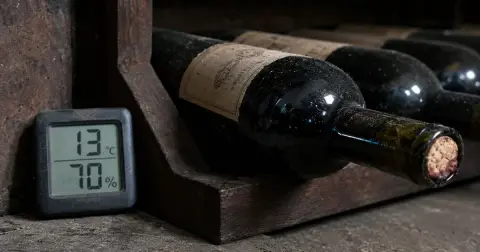
EuroCave specifies 70% humidity for its single-temperature cabinets built for long-term cellaring. A cool closet or basement can hold the temperature and still be dry, so a hygrometer is worth adding there. Light, vibration and the rest of the storage conditions are covered in "How to Store Wine at Home, Unopened and Opened."
Humidity is important too, as wines under natural closures can dry out and leakage can occur if the air is too dry; however, in most storage facilities humidity is not adjusted.
Humidity is important too, as wines under natural closures can dry out and leakage can occur if the air is too dry; however, in most storage facilities humidity is not adjusted. — From the section on the effects of temperature and humidity on bottled wineView official source →
Single-temperature wine cabinets with a controlled temperature throughout the cabinet and 70% humidity. — From the section on cabinets for long-term cellaringView official source →
Wine serving temperature is a separate number from storage
A common mix-up starts with a serving chart. Someone sees 18°C next to red wine and types it into a cabinet that holds every bottle they own.
Storage and serving temperatures
| Purpose | Temperature | Applies to |
|---|---|---|
| Storage | 12°C / 54°F | Every bottle in the cabinet |
| Serving dry white and champagne | 8°C / 46°F | The bottle you open tonight |
| Serving light red | about 14°C / 57°F | The bottle you open tonight |
| Serving full-bodied red | 18°C / 64°F, very heavy wines no more than 19–20°C | The bottle you open tonight |
Serve full-bodied reds at 18°C and dry whites at 8°C
Liebherr's drinking temperatures put full-bodied reds at 18°C (64°F) and very heavy wines at no more than 19 to 20°C. Light reds come in around 14°C (57°F). Lighter dry whites and champagne go to 8°C (46°F), and white wine overall runs from 6 to 10°C depending on style and sweetness.
Liebherr also calls the old rule of serving red at room temperature outdated, because rooms today are too warm for it. Every one of those figures is for the glass, not the cabinet.
Full-bodied red wines : 18 °C, very heavy wines max. 19–20 °C
White wine: 6–10 °C depending on style and sweetness/Light red wines : approx. 14 °C, Spätburgunder 16 °C/Full-bodied red wines : 18 °C, very heavy wines max. 19–20 °C/‘Red wine at room temperature’ is outdated (today’s room temperatures are too warm)/Dry white wines that are not too heavy and champagne should be served at 8 °C — From the key points at the top of the article and the section on white wineView official source →
Take bottles out hours early; wine gains 2°C in the glass
Getting from 12°C to the glass takes a little planning rather than a second setting. EuroCave suggests taking bottles out a few hours before serving: reds come up toward room temperature, while champagne, whites and rosé get chilled.
Wine warms by around 2°C once it is poured, according to the same page. Pour a red slightly below its target and it reaches the right temperature in the glass. EuroCave describes both ways of getting it wrong: a wine served too cold keeps its flavors shut in, and one served too warm lets the alcohol smother the aromas.
Before serving your wine, you can take your bottles out a few hours beforehand and bring them to an ideal serving temperature, by bringing your reds to room temperature and cooling your champagne, white and rosé wine.
Before serving your wine, you can take your bottles out a few hours beforehand and bring them to an ideal serving temperature, by bringing your reds to room temperature and cooling your champagne, white and rosé wine./Wine quickly warms up in the glass, in the order of around 2 °C, take this into account when bringing wine to the table./Too cold and the wine will close up and not reveal its flavours. Too warm and it will be too alcoholic and stifle the aromas. — From the passage after the maturing temperature and the section on wine serving temperatureView official source →
A dual-zone wine fridge makes sense when you serve from it
A dual-zone fridge splits the cabinet into two compartments that each hold their own temperature. It helps if you pour from the cabinet and matters much less if you mostly keep bottles in it.
Which cabinet fits which use
A 2-temperature cooler has a white section and a red section
EuroCave sorts its serving cabinets into three types. Multi-temperature coolers bring every style to serving temperature, and 2-temperature coolers split into one side for white and one for red. Its 3-temperature coolers add storage and cooling for whites and champagne next to a serving section for reds.
EuroCave presents these as cabinets for people who drink their wine regularly and keep it only for a short time. A second zone saves you from planning ahead, because whites and reds are already near serving temperature.
2-temperature wine coolers have a compartment for white wine and a compartment for red wine.
If you drink your wines regularly and are only storing them for a relatively short period, the wine serving fridge is made for you. It allows you to store your wine as close as possible to its ideal serving temperature in a suitable environment. EuroCave offers three types of wine serving cabinet. Multi-temperature wine coolers allow you to bring to serving temperature all types of wines and champagnes. 2-temperature wine coolers have a compartment for white wine and a compartment for red wine. 3-temperature coolers have a service temperature section for reds, storage and cooling for whites and champagne. — From the section on wine serving cabinetsView official source →
If the cabinet is for storage, one zone at 12°C is enough
A single zone fits when most bottles in the cabinet are being kept rather than opened this week. Every rack then holds wine at the storage setting, and the bottles you plan to drink come out a few hours ahead.
A second zone earns its space when you open bottles without deciding in advance. Sorting what you keep from what you drink soon is a drinking-window question, covered in "When to Drink Wine: Drinking Window and Aging."
Heat, fill and the door move the wine fridge temperature
Setting 12°C takes a minute; holding it takes more care. Placement, how full the cabinet is and how long the door stays open all move the reading.
What moves the temperature after you set it
Keep the cabinet away from heat sources and direct sunlight
EuroCave's purchase guide tells buyers not to install a wine fridge near a source of heat or where direct sunlight reaches it. Both push the cabinet to work harder against a changing room.
That rules out many obvious spots in a kitchen, such as next to an oven or under a sunny window. An interior wall in a room that stays even through the day gives the cabinet the easiest job.
It is important not to place your wine fridge in an area close to a source of heat or subject to direct sunlight, for optimal performance.
It is important not to place your wine fridge in an area close to a source of heat or subject to direct sunlight, for optimal performance. — From question 3 on where to install the wine fridgeView official source →
Fill at least 75% of capacity, counted in Bordeaux bottles
EuroCave recommends filling a wine fridge to at least 75% of its capacity for good performance. The same guide says the published capacities are calculated on Bordeaux bottle sizes. Count the real slots once the shelves are loaded, and aim to keep at least three quarters of them filled.
We recommend you fill your fridge to at least 75% of its capacity for optimal performance.
We recommend you fill your fridge to at least 75% of its capacity for optimal performance./*the capacities given are calculated based on Bordeaux bottle sizes. — From question 2 on how many bottles to store (both)View official source →
Shelvin shows the row and tier before you open the door
Every search with the door open is a temperature change you cause yourself. Shelvin, a wine cellar inventory app, lets you set up several cellars, wine fridges included, and see the exact shelf and row of every bottle, so you do the searching on your phone instead.
It also tracks each bottle as Stored, Opened or Empty. Version 1.9.0 added Tasting Logs, where you record ratings, tasting notes and food pairings. How to lay out the shelves is covered in "Wine Cellar Organization: Zones and Coordinates," and other apps in the category are compared in "Wine Inventory Apps: 5 Cellar Trackers Compared."
Visual shelf grid: View the exact shelf and row position of every bottle. No more moving bottles around to find what is stored in the back.
Multiple cellar management: Set up multiple storage units such as home cellars, wine fridges, and restaurant storage./Visual shelf grid: View the exact shelf and row position of every bottle. No more moving bottles around to find what is stored in the back./Status tracking: Track real-time bottle status including Stored, Opened, and Empty./Tasting Logs: Log and preserve your tasting experiences—whether opened from your cellar or enjoyed at a restaurant. Record ratings, detailed notes, serving styles, and food pairings. — From Visual Cellar Mapping in the app description and the version 1.9.0 release notesView official source →
Summary: store at a steady 12°C and serve by wine style
Set a wine cellar to 12°C (54°F) for reds, whites and rosés alike, and leave it there. Long spells above 25°C (77°F) or brief ones above 40°C (104°F) can affect quality, so avoid warm rooms and big day-to-night swings, and watch humidity so natural corks do not dry out.
Serving temperatures are a different set of numbers: about 18°C (64°F) for full-bodied reds and 8°C (46°F) for dry whites and champagne. Take bottles out a few hours ahead and allow for the roughly 2°C the wine gains in the glass. A dual-zone fridge suits a household that pours straight from the cabinet, and a single zone suits one that mostly keeps bottles for later.
Once the setting is right, keep the cabinet away from heat and sunlight, fill it to at least 75% and spend less time with the door open. Shelvin (App Store) shows the exact shelf and row of every bottle, so you can find it before opening the door. Label scanning is capped at 2 a week on the free plan and 50 a month on Premium, which costs $6.99 a month.
(Note: Free users can scan up to 2 times/week; Premium users can scan up to 50 times/month).
(Note: Free users can scan up to 2 times/week; Premium users can scan up to 50 times/month)./Title: Premium Plan/Duration: 1 month (auto-renewal)/Price: $6.99 (USD) — From the label scanning feature and the subscription section, in that orderView official source →
FAQ
- What temperature should a wine cellar be set to?
- Set it to 12°C (54°F). EuroCave gives 12°C as the ideal maturing temperature and asks for it to be the same throughout the cabinet. Pick the setting once and leave it alone, because EuroCave also calls a stable temperature essential.
- Should red and white wine be stored at different temperatures?
- No. EuroCave's 12°C applies to wine of every color, so reds, whites and rosés can share one cabinet setting. Their difference only shows up at serving time, and serving has its own set of temperatures.
- How warm is too warm for stored wine?
- The Australian Wine Research Institute says long periods above 25°C (77°F), or short periods above 40°C (104°F), can affect wine quality. Above 40°C, wine can change in appearance and taste within days. A room that climbs into those temperatures in summer is not a safe place for bottles you plan to keep.
- What temperature should red wine be served at?
- Liebherr puts full-bodied reds at 18°C (64°F) and caps very heavy wines at 19 to 20°C. Light reds sit around 14°C (57°F). Liebherr also calls the old advice to serve red at room temperature outdated, since rooms today run too warm.
- Is a dual-zone wine fridge worth it?
- It is worth it if you pour straight from the cabinet. EuroCave lists its 2-temperature coolers, with one compartment for white and one for red, among its serving cabinets. If the cabinet mostly holds bottles you are keeping for later, a single zone at 12°C does the job.
Related articles
 How to Store Wine at Home, Unopened and OpenedHow to store wine: keep it at a steady 10–14°C (50–57°F) with humidity near 70%, lay corked bottles flat, and finish opened wine in 2 days to a week.
 Wine Cellar Organization: Zones and CoordinatesWine cellar organization starts with how many bottles fit. Then sort wines by temperature zone, keep them out of light and number each slot to log a bottle.
 Bar Inventory for Wine: Records, Vintages, SharingBar inventory for wine: TTB wants a log of what you receive or every invoice. See what the IRS asks, why each vintage needs a line and how staff share a list.
 Wine Inventory App Sharing: Four Apps ComparedCompare wine inventory app sharing in Shelvin, InVintory, CellarTracker and Vinotag: how you add a partner or staff, what they can change and what it costs.