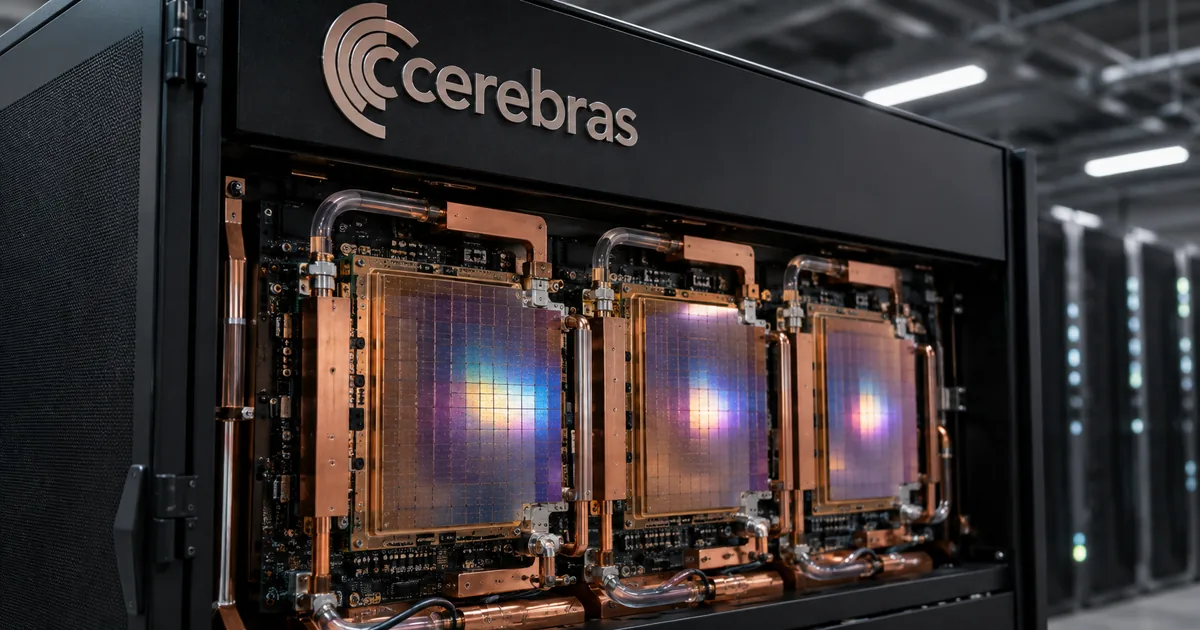
CS-4 is an AI accelerator of three wafer scale engines
The Cerebras CS-4 is the fourth generation of the Cerebras System, a rack-scale AI accelerator built from three newly released Wafer Scale Engine 3 Turbo processors. Cerebras calls it the fastest AI accelerator in the industry. It is also the first system on the Nexus platform architecture, the rack design that the same announcement describes.
A wafer scale engine is Cerebras's processor built on a whole silicon wafer rather than a cut-down chip. The release describes the WSE-3 Turbo, shortened to WSE-3T, as the largest AI processor ever built. All of these figures are Cerebras's own claims, from its press release and blog post of August 18, 2026.
"The CS-4 is a rack-scale solution built from three new Wafer Scale Engines and revolutionary rack and system designs. The CS-4 is the first member of the next-generation Cerebras Nexus rack-scale platform architecture." — from the Cerebras press releaseView official source →
"Today, we are introducing the fourth generation of our Cerebras System: CS-4." — from the Cerebras blog postView official source →
The WSE-3 Turbo chip doubles bandwidth for inference
The release says the WSE-3 Turbo doubles the WSE-3's AI compute to 250 PFLOPS per wafer and doubles its memory bandwidth to 43.2 petabytes per second. Each wafer holds four trillion transistors and 900,000 cores, with 44GB of SRAM on the wafer itself. Cerebras calls memory bandwidth the determining factor in speed and throughput, so the release presents the bandwidth doubling as a gain in both.
Two more per-wafer figures double as well: on-chip fabric bandwidth to 53.5 petabytes per second and off-chip I/O to 2.4 terabits per second. I/O latency falls from five microseconds to as low as two.
The release also gives a system-level comparison. Read it with one fact in mind: the CS-3 column is one wafer and the CS-4 column is three. The compute and bandwidth rows are totals, so each reflects both the move from one wafer to three and the doubling above, while the per-wafer figures show the change in the chip itself.
| Metric | CS-3 (one wafer) | CS-4 (three wafers) |
|---|---|---|
| AI compute | 125 PFLOPS | 750 PFLOPS |
| Memory bandwidth | 21.6 PByte/s | 129.6 PByte/s |
| Fabric bandwidth on the chip | 26.7 PByte/s | 160.5 PByte/s |
| I/O bandwidth of the system | 1.2 Tbit/s | 7.2 Tbit/s |
| I/O latency | 5 microseconds | 2 microseconds |
"Like the WSE-3, the WSE-3T is the largest AI processor ever built, containing four trillion transistors and 900,000 AI-optimized cores across 46,225 square millimeters of silicon, with 44GB of SRAM integrated directly on the wafer." / "The WSE-3T doubles AI compute to 250 PFLOPS per wafer and doubles memory bandwidth to 43.2 petabytes per second. And since memory bandwidth is the determining factor in driving speed and throughput, this translates to a step-change improvement in both." / "The on-chip fabric bandwidth and off-chip I/O both double to 53.5 petabytes per second and 2.4 terabits per second respectively. I/O latency shrinks from five microseconds to as low as two microseconds." — from the Cerebras press releaseView official source →
What 30x AI inference speed means in tokens per second
The 30x is measured in tokens per second per user. In the release's head-to-head run on GPT-OSS-120B with identical prompts, the CS-4 reaches more than 4,400 tokens per second for each user, which the release puts at up to 30 times the speed of GPU solutions. Against its own CS-3, Cerebras claims up to 2x, and the release says that 2x brings the CS-4's advantage over GPUs to up to 30x.
A token is a small piece of text that a model reads or writes. Tokens per second per user measures how fast one person's answer streams out. The release makes a separate claim about efficiency: up to 10x more throughput per watt than the CS-3.
Sean Lie, the CTO and co-founder of Cerebras, links speed to what an agent can do. He says the extra speed lets an agentic system fit more than an order of magnitude more reasoning, checking or tool use into the same elapsed time. A footnote in the release adds that real throughput changes with the model, the context length, the numeric precision and how the system is served.
Cerebras vs NVIDIA: the release names only GPU solutions
Both documents compare the CS-4 with unnamed hardware. They say "GPU solutions", "GPU systems", "production GPU systems" and "conventional GPU boards", and neither names a vendor, NVIDIA included, or a GPU model. So neither says which company's product the 30x is measured against.
The 30x is also not a comparison with the CS-3. The CS-3 comparison is the separate 2x in the release.
Which figures are measured and which are projected
The blog prints a source line under each chart, and the lines differ. The "Source lines printed under the CS-4 figures" table lists each figure with the line Cerebras attaches to it.
Source lines printed under the CS-4 figures
| Figure in the blog | Source line printed by Cerebras |
|---|---|
| Up to 30x faster inference, "across the model set shown" | Artificial analysis and internal benchmarking (August 2026) |
| Over 1,000 tokens per second on models above 10 trillion parameters | extrapolation from internal benchmarking (August 2026) |
| Up to 10x more token capacity and up to 2x faster than CS-3 | internal benchmarking and projections (August 2026) |
The blog's text does not list the models in the 30x chart. A footer under the whole post adds that comparisons rest on third-party benchmarking or internal testing, and that observed speed gains over GPU-based systems may vary by workload, configuration, date and models tested.
"In a head-to-head comparison on GPT-OSS-120B, when given identical prompts, the CS-4 delivers" / "more than 4,400 tokens second per user (TPS/user), up to 30 times faster than GPU solutions." / "It is up to twice as fast as the CS-3, bringing the CS-4s advantage in tokens-per-second-per-user over GPUs to up to 30x more." / "Being 30 times faster doesn’t just make a response feel fast. It gives an agentic system room for more than an order of magnitude as much reasoning, verification, or tool use in the same wall-clock time," / "Actual throughput varies by model architecture, context length, precision, and serving configuration." — from the Cerebras press releaseView official source →
"Source: Artificial analysis and internal benchmarking (August 2026)" / "Source: extrapolation from internal benchmarking (August 2026)." / "Source: internal benchmarking and projections (August 2026)." / "Performance comparisons are based on third-party benchmarking or internal testing. Observed inference speed improvements versus GPU-based systems may vary depending on workload, configuration, date and models being tested." — from the Cerebras blog postView official source →
Where the CS-4 speed comes from: power delivery and I/O
Cerebras credits the whole system rather than one part. The blog says faster links between wafers, dense power delivery and the modular Nexus rack platform work together. Cerebras splits the Nexus platform into three elements: compute, power and I/O.
On power, the release says conversion sits about 0.5 millimeters from the processor, 100x closer than the roughly 50 millimeters of conventional GPU boards. Cerebras says this nearly eliminates board-level power loss and delivers twice as much power to the WSE-3T. That, it adds, allows higher operating frequencies and faster token generation.
On I/O, a programmable Wafer I/O Module supports RoCE v2 RDMA over Ethernet, a standard way to connect to existing infrastructure. It also supports Direct Wafer Links, a switch-free way to join wafers within and across racks, with latency as low as two microseconds. Off-wafer bandwidth is 2.4 terabits per second per wafer and 7.2 per CS-4 rack.
"For example, by moving power conversion 100x closer to the processors – from roughly 50 millimeters away from the processor as on conventional GPU boards to approximately 0.5 millimeters – CS-4 nearly eliminates board-level power loss. This delivers twice as much power to the WSE-3T, enabling higher operating frequencies and faster token generation." / "The fully programmable Wafer I/O Module supports standards-based RoCE v2 RDMA over Ethernet for seamless integration into existing infrastructure and with an ecosystem of heterogeneous systems. Aggregate off-wafer bandwidth doubles to 2.4 terabits per second per wafer and 7.2 terabits per CS-4 rack solution." / "The Wafer I/O Module also supports a new communication mode, called Direct Wafer Links, which enables wafers to be linked within and across racks without a switch. Direct Wafer Links enables wafer-to-wafer latency as low as two microseconds." — from the Cerebras press releaseView official source →
The backpack cuts installation from days to hours
The CS-4 uses a Wafer-Scale Backpack, mounted on the rear and attached upright to the power array. It is a self-contained assembly. Inside it, the electronics for power conversion, I/O and control, plus the direct liquid cooling, wrap around the wafer.
Cerebras says that separating compute from the power supplies simplifies manufacturing and cuts deployment from days to hours. Compared with the previous generation, the backpack has 50% fewer components and uses 60% more automated manufacturing.
The modular design also lets compute, power and I/O each scale on their own, which Cerebras says gets innovations to market faster. The blog adds that an improvement in one part of the system can reach customers without waiting for every other part to be redesigned.
"Each Wafer-Scale Backpack is a self-contained assembly that folds power conversion, direct liquid cooling, high-speed I/O, and control electronics into a compact, three-dimensional package built directly around the wafer." / "By decoupling compute from the power supplies, the Wafer-Scale Backpack simplifies manufacturing and reduces deployment time from days to hours. Compared with the prior-generation system, the Wafer-Scale Backpack has 50% fewer components and uses 60% more automated manufacturing." / "Modularity enables each element to scale independently so innovations get to market faster." — from the Cerebras press releaseView official source →
"That platform approach also creates a cleaner path for upgrades, allowing innovation in one part of the system to reach customers without waiting for every other part to be redesigned." — from the Cerebras blog postView official source →
Disaggregated inference with AMD Helios and AWS Trainium
Disaggregated inference gives each of the two phases of inference to a platform built for it. In prefill, the system processes the incoming prompt and prepares the model state. In decode, it generates the response.
The blog describes a purpose-built prefill engine that hands the model state to the CS-4 for ultra-low-latency decoding. It names AMD Helios and AWS Trainium as complementary prefill platforms and says providers can use GPU or ASIC infrastructure for prefill.
The release lists the same two as examples of Cerebras ecosystem partners. See also OpenAI Jalapeno Chip: Inference Benchmarks 2026.
"First, a purpose-built prefill engine processes the incoming prompt and prepares the model state. That state is then transferred to CS-4, where the system performs ultra-low-latency decoding and generates the response." / "Providers can use GPU or ASIC infrastructure for efficient prefill while using CS-4 for ultrafast decode, creating a heterogeneous inference system designed to deliver differentiated, high-speed services." — from the Cerebras blog postView official source →
"The combination of programmability, standards-based interfaces, and very low latency will allow the rapid creation of disaggregated solutions from different Cerebras ecosystem partners, like AMD Helios and AWS Trainium." — from the Cerebras press releaseView official source →
Is there a CS-4 price, and when does it ship?
Neither document gives a CS-4 price or a general availability date. Cerebras says the first CS-4 shipments begin this quarter, and the release points to the CS-4 datasheet for full system specifications. The two documents also leave out any named customer and the name of the quarter.
One more detail is easy to blur. The blog says the CS-4 can reach over 1,000 tokens per second on models above 10 trillion parameters, a figure the blog itself labels an extrapolation. The release says the architecture supports models with over 50 trillion parameters.
The 1,000 tokens per second is a speed figure at one model size, while the 50 trillion is a size the architecture supports, so they should not be read as two versions of one limit. The Cerebras CS-4 headline of 30x is best read with its conditions attached: GPT-OSS-120B, tokens per second per user, and the footnote on throughput.
"First CS-4 shipments begin this quarter. Full system specifications are available in the CS-4 datasheet at https://www.cerebras.ai/cs4-datasheet." — from the Cerebras press releaseView official source →
"With this low-latency communication, CS-4 can deliver more than 1,000 tokens per second on models exceeding 10 trillion parameters." — from the Cerebras blog postView official source →
FAQ
- When can you buy a CS-4?
- Cerebras says the first CS-4 shipments begin this quarter, without naming the quarter. Neither the blog post nor the press release gives a price or a general availability date. Full specifications are in the CS-4 datasheet.
- What is the 30x figure measured against?
- Against GPU systems. The release does not name a vendor or a GPU model. Its measured case is GPT-OSS-120B with identical prompts, where the CS-4 delivers more than 4,400 tokens per second per user. A footnote says real throughput varies with the model, the context length, the precision and the serving setup.
- Does the CS-4 replace GPUs in an inference stack?
- Cerebras describes a pairing. In disaggregated inference, a separate prefill engine reads the prompt and prepares the model state, and the CS-4 then decodes the response. The blog names AMD Helios and AWS Trainium as prefill platforms and says providers can use GPU or ASIC infrastructure for prefill while using CS-4 for decode.
Related articles
 Microsoft to deploy Maia 300 AI chips from 2027Microsoft will put its Maia 300 AI chip into production in 2027. It expects 40% more tokens per megawatt than leading GPU systems but has not named them.
 Claude Fable 5.2: 20% price cut, up to 30% fasterAnthropic released Claude Fable 5.2 on November 9, 2026. API prices fall 20% to $8/$40 per million tokens, and output is up to 30% faster than Fable 5.1.
 PayPay security and passkeys in 10 Japan pay appsPayPay security compared with 9 other Japanese payment apps: passkeys, extra checks to send or pay, and fraud compensation deadlines.
 AI fact check: only 40% of cited stats hold upAI fact check: Trakkr traced 1,285 stats cited by ChatGPT, Perplexity, Gemini, Claude and AI Overviews. Only 40% led to a matching study. How to check one.